
Introduction
Have you ever heard someone say, “I’m taking a day off,” while someone else says, “I’m having an off day”? Although these expressions contain the same two words, they mean completely different things.
A day off is a planned or earned break from work, school, or other responsibilities. An off day, however, describes a day when you don’t feel your best or aren’t performing as well as usual.
Because the phrases look so similar, they’re easy to confuse—especially for English learners. Using the wrong one can make your meaning unclear in conversations, emails, or exams.
In this guide, you’ll learn:
- The exact meaning of day off and off day
- The key differences between them
- When each expression is appropriate
- Common mistakes English learners make
- Real-life examples from work, school, sports, and everyday conversations
- A simple memory trick to help you remember the difference
By the end of this article, you’ll know exactly which phrase to use in every situation.
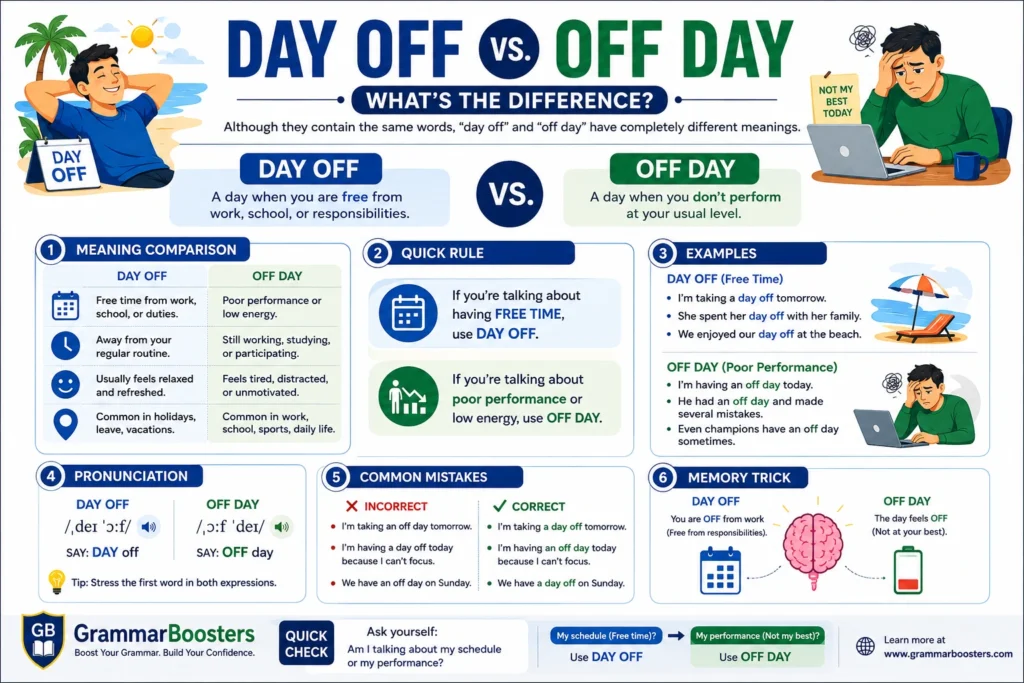
Quick Answer: Day Off vs. Off Day
Here’s the simple difference:
- A day off is a day when you’re free from work, school, or your usual responsibilities.
- An off day is a day when you don’t perform as well as you normally do or simply don’t feel like yourself.
Although the phrases contain the same words, changing their order changes the meaning completely.
| Expression | Meaning | Example |
| Day off | A scheduled break from work, school, or daily responsibilities | I’m taking a day off on Friday. |
| Off day | A day when your performance, focus, mood, or energy is below normal | I’m having an off day today. |
Remember This
✅ Day off = Free from responsibilities
✅ Off day = Not at your best
If you’re talking about your schedule, use day off.
If you’re talking about your performance or mood, use off day.
At a Glance
| If you mean… | Use… |
| Vacation leave | Day off |
| Weekend break | Day off |
| Public holiday | Day off |
| Feeling tired | Off day |
| Playing badly | Off day |
| Unable to focus | Off day |
| Making unusual mistakes | Off day |
What Does “Day Off” Mean?
Short Answer
A day off is a day when you don’t have to work, attend school, or carry out your regular responsibilities. It’s simply time away from your normal routine.
People often spend a day off relaxing, traveling, running errands, or enjoying time with family and friends. Unlike a vacation, which usually lasts several days, a day off typically refers to just one day.
Definition
Day off (noun phrase):
A day when someone is excused from their usual work, school, or daily duties.
The phrase has a positive or neutral meaning because it refers to free time rather than poor performance.
Examples
- I’m taking a day off next Friday.
- She requested a day off for a doctor’s appointment.
- We finally have a day off after a busy week.
- Dad enjoys gardening on his day off.
- They spent their day off exploring the city.
In every example, the person has time away from their usual responsibilities.
Teaching Tip: If you can replace the phrase with time off or leave, then day off is almost always the correct choice.
When Should You Use “Day Off”?
Use day off whenever you’re talking about being free from your normal schedule.
Common situations include:
- Taking leave from work
- School holidays
- Weekends
- Vacation days
- Personal leave
- Public holidays
- Medical appointments
- Family events
- Rest
Example Sentences
- I’ll take a day off after the conference.
- Everyone has the day off on Independence Day.
- She enjoys baking on her day off.
- We planned a picnic during Dad’s day off.
- I’m saving my day off for my sister’s graduation.
Native Speaker Insight
Native English speakers often use take a day off rather than simply take off when referring to work or school.
✔ I’m taking a day off tomorrow.
✔ She took a day off last week.
Although take off can sometimes imply taking leave, day off is much clearer and more natural for English learners.
Common Collocations with “Day Off”
Learning common word combinations (collocations) will help your English sound more natural.
| Collocation | Example |
| take a day off | I’m taking a day off tomorrow. |
| have a day off | Do you have a day off this weekend? |
| enjoy a day off | We enjoyed a day off at the beach. |
| request a day off | She requested a day off next month. |
| scheduled day off | Monday is my scheduled day off. |
| paid day off | Employees receive paid days off each year. |
| well-earned day off | After the project, everyone deserved a well-earned day off. |
Great. We’ll continue with the same editorial standard so the article maintains a consistent, publication-ready quality.
What Does “Off Day” Mean?
Short Answer
An off day is a day when you don’t feel like yourself or aren’t performing as well as you normally do. You may feel tired, distracted, unmotivated, or simply unable to focus.
Unlike a day off, an off day doesn’t mean you’re free from work or school. You’re still carrying out your usual activities, but your performance, energy, or concentration is below your normal standard.
Definition
Off day (noun phrase):
A day when someone performs below their usual level or feels physically, mentally, or emotionally below their best.
An off day is usually temporary and doesn’t reflect a person’s overall ability or skill.
Examples of “Off Day”
Here are some examples from everyday English:
- I’m having an off day, so I can’t seem to concentrate.
- She admitted she was having an off day after making several mistakes.
- Even experienced teachers have an off day once in a while.
- Our team had an off day and lost the match.
- The presentation didn’t go well because I was having an off day.
In each example, the person is still working, studying, or participating—they’re simply not performing at their best.
Quick Tip: If you’re describing how you’re performing, use off day, not day off.
When Should You Use “Off Day”?
Use off day whenever you want to describe temporary poor performance, low energy, or difficulty concentrating.
Common situations include:
- Feeling mentally exhausted
- Making unusual mistakes
- Having trouble focusing
- Performing poorly in sports
- Struggling during an exam
- Feeling emotionally drained
- Having low motivation
- Recovering from poor sleep
Example Sentences
- I’m having an off day, so everything feels more difficult today.
- The chef admitted he was having an off day after preparing the wrong order.
- She usually speaks confidently, but today was an off day.
- Even top athletes have an off day from time to time.
- I think I’m having an off day because I didn’t sleep well last night.
Why Do People Have an Off Day?
Short Answer
Everyone experiences an off day occasionally. It can happen for many reasons, and it’s usually temporary.
Common causes include:
- Poor sleep
- Stress or anxiety
- Mental fatigue
- Minor illness
- Headaches
- Heavy workload
- Emotional pressure
- Lack of motivation
- Burnout
- Personal concerns
Sometimes there’s no obvious reason—you simply don’t feel like yourself.
Remember: Having an off day doesn’t mean you’re incapable. It simply means today isn’t your best day.
Common Situations Where “Off Day” Is Used
At Work
Professionals often use off day to explain a temporary drop in performance.
Examples
- I made several typing mistakes because I was having an off day.
- Our designer admitted today was an off day creatively.
- The cashier apologized after having an off day at work.
- Everyone understood because even experienced employees have off days.
At School
Students may also experience off days, especially during busy or stressful periods.
Examples
- Emma usually scores well, but she had an off day during the math exam.
- I couldn’t concentrate in class because I was having an off day.
- Even excellent students have an off day occasionally.
In Sports
This expression is especially common in sports commentary.
Athletes often describe a disappointing performance as an off day, rather than a sign of declining ability.
Examples
- The striker had an off day and missed several easy chances.
- Even champions have an off day now and then.
- The coach said the team simply had an off day and would bounce back next week.
Native Speaker Insight: Sports commentators frequently use off day because it suggests a temporary setback—not a lack of talent or effort.
In Everyday Conversation
Native speakers also use off day in casual conversations.
Examples
- Sorry I’m so forgetful today. I’m having an off day.
- I wasn’t myself yesterday—it was just an off day.
- If you’re having an off day, don’t be too hard on yourself.
- We all have off days sometimes.
Because the phrase sounds understanding and empathetic, it’s often used to reassure someone after a mistake.
Off Day vs. Bad Day
Although off day and bad day are similar, they are not interchangeable.
An off day focuses on your performance or state of mind, while a bad day describes negative events or experiences.
| Feature | Off Day | Bad Day |
| Main focus | Poor performance or low energy | Unpleasant events or experiences |
| Temporary? | Usually yes | Usually yes |
| Common contexts | Work, school, sports | Any life situation |
| Typical meaning | You’re not at your best | Things went wrong during the day |
Compare These Examples
✅ I had an off day at work and made several typing mistakes.
The focus is on poor performance.
✅ I had a bad day because my car broke down, I missed my train, and it started raining.
The focus is on unfortunate events.
Which One Should You Choose?
Use off day when talking about:
- Your performance
- Your concentration
- Your energy level
- Your mood while working or studying
Use bad day when talking about:
- Problems
- Accidents
- Arguments
- Disappointments
- Unexpected setbacks
Excellent. We’re now moving into one of the highest-value sections of the article. This section is crucial because it targets Google Featured Snippets, AI Overviews, and Passage Ranking while directly answering the user’s main question.
“Day Off” vs. “Off Day”: Key Differences
Short Answer
The main difference is simple:
- A day off means you’re free from work, school, or your usual responsibilities.
- An off day means you’re still working, studying, or participating, but you’re not performing at your usual level.
Although the expressions use the same two words, their meanings are completely different. The correct choice depends on whether you’re talking about your schedule or your performance.
Day Off vs. Off Day: Comparison Table
| Feature | Day Off | Off Day |
| Meaning | A day free from work, school, or regular responsibilities | A day when you don’t perform at your usual level |
| Focus | Free time | Performance or condition |
| Typical Feeling | Relaxed, rested, available | Tired, distracted, unmotivated, or unfocused |
| Activity | Usually away from work or school | Still working or studying |
| Common Contexts | Work, holidays, vacations, personal leave | Work, school, sports, daily life |
| Typical Examples | Taking leave, resting, traveling | Making mistakes, feeling tired, poor performance |
| Similar Expressions | Time off, personal day, rest day | Bad day, rough day, below-par performance |
The Difference in One Sentence
If you’re talking about having free time, use day off.
If you’re talking about not feeling or performing your best, use off day.
That’s the easiest way to remember the difference.
Side-by-Side Examples
Seeing both expressions in similar situations makes the distinction much easier to understand.
| Day Off | Off Day |
| I’m taking a day off tomorrow. | I’m having an off day today. |
| She spent her day off with her family. | She had an off day at work. |
| We enjoyed our day off at the beach. | The team had an off day and lost the match. |
| My day off is every Sunday. | I can’t concentrate because I’m having an off day. |
| He requested a day off next week. | Even experienced employees have an off day sometimes. |
| They planned a picnic on their day off. | The singer admitted she was having an off day during the concert. |
Learning Tip: Read each pair aloud. Hearing the expressions in context makes it easier to remember which one sounds natural.
Why Do People Confuse “Day Off” and “Off Day”?
Short Answer
English learners often confuse these expressions because they contain the same words. However, in English, word order can completely change the meaning of a phrase.
A small change in word order creates two different ideas:
- Day off = Time away from responsibilities
- Off day = A day when something feels wrong or below normal
Understanding this difference will help you avoid one of the most common vocabulary mistakes in everyday English.
Same Words, Different Meanings
At first glance, the phrases look almost identical.
Compare them:
Day off → A break from work, school, or regular responsibilities.
Off day → A day when your performance, mood, or energy isn’t at its usual level.
Notice that only the order of the words changes, but the meaning changes completely.
Example
✅ I’m taking a day off tomorrow.
This means you won’t be working or studying.
✅ I’m having an off day today.
This means you’re still working or studying, but things aren’t going well.
How Context Changes the Meaning
The situation usually tells you which phrase to use.
Imagine these two conversations.
Situation 1: You’re Taking Leave
Manager: Will you be in the office tomorrow?
You: No, I’m taking a day off tomorrow.
Here, you’re talking about your schedule.
Situation 2: You’re Having Difficulty Working
Manager: Is everything okay today?
You: I’m just having an off day.
Now you’re talking about your performance—not your schedule.
Quick Decision Table
| Situation | Correct Expression |
| Taking annual leave | Day off |
| Weekend break | Day off |
| Public holiday | Day off |
| Feeling exhausted at work | Off day |
| Playing badly in a match | Off day |
| Unable to concentrate | Off day |
| Making unusual mistakes | Off day |
Common Mistakes English Learners Make
Even advanced learners sometimes mix up these expressions. Here are the most common mistakes—and how to fix them.
Mistake 1: Using “Off Day” for Time Away from Work
❌ Tomorrow is my off day, so I’m going hiking.
✔ Tomorrow is my day off, so I’m going hiking.
Why?
You’re talking about having free time, not poor performance.
Mistake 2: Using “Day Off” for Poor Performance
❌ I’m having a day off because I can’t focus.
✔ I’m having an off day because I can’t focus.
Why?
You’re describing your condition, not taking leave.
Mistake 3: Thinking Both Expressions Mean the Same Thing
Many learners assume the two phrases are interchangeable because they contain the same words.
They’re not.
Remember:
- Day off describes your schedule.
- Off day describes your performance.
Mistake 4: Translating Directly from Your Native Language
Some languages don’t make this distinction, so direct translation can lead to mistakes.
Instead of translating word for word, connect each phrase to its meaning.
Day off → Free day
Off day → Below your normal performance
This simple association is much easier to remember.
Which Phrase Should You Use?
Ask yourself one question:
Am I talking about my schedule or my performance?
If your answer is my schedule, use day off.
If your answer is my performance, use off day.
Quick Reference
| If you’re talking about… | Use… |
| Time away from work | Day off |
| A school holiday | Day off |
| Paid leave | Day off |
| Feeling tired | Off day |
| Low energy | Off day |
| Poor concentration | Off day |
| Performing below your usual standard | Off day |
How to Use “Day Off” Correctly
Short Answer
Use day off whenever you’re talking about taking time away from work, school, or your usual responsibilities.
It’s the correct expression for planned leave, weekends, public holidays, personal time, or any day when you’re free from your normal routine.
Common Situations
You’ll often hear day off in conversations about:
- Taking leave from work
- School holidays
- Vacation time
- Medical appointments
- Family events
- Rest
Workplace Examples
- I’m taking a day off next Friday for a family event.
- She requested a day off to attend a wedding.
- Our manager approved everyone’s day off after the project ended.
- They enjoyed a well-earned day off following a busy month.
School Examples
- The students have a day off because of the national holiday.
- We finally have a day off after final exams.
- My teacher announced a day off due to severe weather.
Everyday Conversation
- What are you doing on your day off?
- I spent my day off reading a new novel.
- We visited my grandparents during Dad’s day off.
- She loves cooking on her day off.
Usage Tip: You can usually replace day off with time off without changing the meaning.
How to Use “Off Day” Correctly
Short Answer
Use off day when you’re talking about temporary poor performance, low energy, or difficulty concentrating.
You’re still working, studying, or participating—but you’re simply not at your best.
Common Situations
People often use an off day when they:
- Feel mentally tired
- Make unusual mistakes
- Lose focus
- Perform poorly in sports
- Feel emotionally drained
- Struggle to complete everyday tasks
Workplace Examples
- I made several typing errors because I was having an off day.
- Our designer admitted today was an off day creatively.
- The presentation wasn’t my best because I had an off day.
Sports Examples
- The striker had an off day and missed several easy chances.
- Even champions have an off day occasionally.
- The coach said the team simply had an off day.
Everyday Conversation
- Sorry I’m so forgetful today—I’m having an off day.
- We all have off days sometimes.
- Don’t worry. Tomorrow will probably be better.
Native Speaker Tip: Saying “I’m having an off day” sounds much more natural than saying “I’m performing badly today.
A Simple Memory Trick
If you ever forget which phrase to use, remember this:
Day Off = Off from work
You’re off from your normal responsibilities.
Off Day = The day feels off.
Something about your performance, mood, or energy isn’t quite right.
Another Easy Way to Remember
Ask yourself:
Am I talking about my schedule?
👉 Use day off.
Am I talking about my performance?
👉 Use off day.
This simple question will help you choose the correct expression every time.
Quick Recap
Before you go, here’s a quick summary of the key differences.
| If you mean… | Correct Expression |
| A break from work or school | Day off |
| Vacation or personal leave | Day off |
| Weekend or public holiday | Day off |
| Feeling tired or unfocused | Off day |
| Performing below your usual level | Off day |
| Making more mistakes than usual | Off day |
Conclusion
Although day off and off day contain the same words, they describe two completely different situations.
A day off means you’re free from work, school, or your usual responsibilities, giving you time to rest, travel, or enjoy personal activities.
An off day, on the other hand, means you’re still carrying out your normal activities but aren’t performing as well as you usually do. You may feel tired, distracted, or simply not like yourself.
Understanding this distinction will help you communicate more clearly in conversations, emails, exams, and professional settings.
Whenever you’re unsure, think about what you’re describing:
- If it’s free time, choose a day off.
- If it’s poor performance or low energy, choose an off day.
With regular practice and exposure to real-life examples, using these expressions correctly will soon become second nature.
Frequently Asked Questions (FAQs)
Is day off the same as off day?
No. A day off means you’re free from work, school, or regular responsibilities. An off day means you’re still working or studying but aren’t performing at your usual level.
What does day off mean?
A day off is a scheduled or unexpected break from your normal routine. People often use it to relax, travel, attend appointments, or spend time with family.
What does off day mean?
An off day is a day when your energy, focus, mood, or performance is below your normal standard.
Can I say, “I’m taking an off day”?
No. If you’re taking leave from work or school, the correct expression is “I’m taking a day off.” An off day describes your condition or performance, not scheduled leave.
Is off day common in American English?
Yes. Native speakers commonly use off day in conversations about work, school, sports, and everyday life.
Can athletes have an off day?
Absolutely. Athletes often use off day to describe a game or competition in which they don’t perform as well as usual.
Is a day off always planned?
Not always. Some days off are scheduled, such as weekends or vacations, while others happen unexpectedly because of weather, emergencies, or workplace closures.
What are some synonyms for day off?
Depending on the context, you can also say:
- Time off
- Personal day
- Rest day
- Leave
- Holiday (British English)
- Vacation day (American English)
How can I remember the difference?
Think of it this way:
- Day off = Free from responsibilities
- Off day = The day feels off
Which phrase is appropriate in formal writing?
Both are correct when used in the right context.
Use day off when discussing leave or scheduled time away from responsibilities, and use off day when describing temporary poor performance or low energy.

I’m Sarah M, an English content specialist dedicated to helping people improve their grammar, spelling, vocabulary, and writing skills. I love answering common language questions and turning difficult grammar concepts into simple, reader-friendly lessons. My goal is to make English learning enjoyable and accessible for anyone who wants to become a better communicator.