
Birds chirping at night can feel unusual, especially when the world around you grows quiet. You might hear a few soft notes outside your bedroom window, notice a bird calling at midnight, or wake up to birdsong at 3 AM. These moments can spark curiosity and make you wonder whether the experience carries a deeper meaning.
The spiritual meaning of birds chirping at night often relates to intuition, hope, personal transformation, spiritual awareness, and finding peace during uncertain times. In some cultural traditions, birds represent freedom, divine care, renewal, or communication. However, interpretations vary widely, and no single meaning applies to everyone.
There is also a natural explanation worth considering. Some birds sing or call after dark because of artificial lighting, mating behavior, territorial communication, predators, or environmental disturbances. Understanding both the symbolic and biological sides of nighttime birdsong helps you explore its possible meaning without jumping to conclusions.
Quick Answer: What Does It Mean Spiritually When Birds Chirp at Night?
Spiritually, people may interpret birds chirping at night as a symbol of intuition, hope, awakening, change, freedom, or reassurance. Because nighttime often represents mystery and reflection, a bird’s unexpected call may encourage you to pay attention to your emotions, reconsider a situation, or appreciate a quiet moment.
The meaning depends on your personal beliefs, cultural background, and the circumstances in which you hear the sound. For one person, birdsong might represent comfort during a difficult period. For another, it might symbolize a fresh start or a reminder to slow down.
Here are some common symbolic interpretations:
- Intuition: Pay attention to your inner thoughts and feelings.
- Spiritual awareness: Become more mindful of your surroundings and personal experiences.
- Hope: Remember that difficult periods can eventually pass.
- Transformation: Stay open to changes and new opportunities.
- Peace: Make room for quiet, rest, and emotional balance.
- Freedom: Consider whether you need to release an unhelpful habit or limiting belief.
- Connection with nature: Notice the living world around you, even when you cannot see it clearly.
These interpretations offer ways to reflect on an experience. They don’t establish that a bird is delivering a supernatural message or predicting a future event.
Birds Chirping at Night Spiritual Meaning and Symbolism
Nighttime creates a different atmosphere from the busy hours of the day. A sound that seems ordinary in daylight can feel mysterious after dark, which may explain why people connect nighttime birdsong with spiritual symbolism.
A Call to Listen to Your Intuition
One common spiritual interpretation of birds chirping at night is a reminder to listen to your intuition. In symbolic language, a bird’s voice emerging from darkness can represent an insight that becomes easier to notice when distractions fade away.
Think about a decision you’ve been putting off. You may spend the day responding to messages, completing tasks, and listening to other people’s opinions. Later, when everything becomes quiet, you finally have space to consider what you truly want.
If you hear a bird during that moment, you might associate its call with the need to trust your judgment. The bird hasn’t necessarily delivered a message. Instead, the experience may prompt you to notice thoughts you had overlooked.
Spiritual takeaway: Use the moment as an invitation to reflect, not as a command to make an immediate decision.
Spiritual Awakening and Greater Awareness
Some people interpret nighttime birdsong as a symbol of spiritual awakening. This interpretation often reflects a growing interest in life’s deeper questions, personal values, or the connection between human beings and nature.
The darkness can represent uncertainty, while the bird’s voice represents awareness or discovery. Together, these images create a powerful metaphor: even when you cannot see the whole path ahead, you can still notice something meaningful around you.
For example, you might begin spending more time outdoors, reconsider your priorities, or develop a regular meditation practice. A memorable encounter with a bird may become part of that personal journey.
Still, hearing a bird chirp at night doesn’t prove that you’ve entered a spiritual awakening. It can simply be an ordinary experience that inspires meaningful reflection.
Hope During Difficult Times
Birds are often associated with hope because they fly, sing, build nests, and continue their activities through changing seasons. When you hear one calling in the darkness, the sound may remind you that life continues even during challenging periods.
Imagine you’re dealing with a difficult work situation or feeling uncertain about a relationship. You step outside late at night and hear a bird singing from a nearby tree. That brief sound may offer a welcome pause from your worries.
The spiritual meaning comes from the connection you make with the experience. You may take it as a reminder that a difficult chapter doesn’t have to define your entire story.
This interpretation doesn’t promise that everything will improve overnight. Instead, it encourages patience, resilience, and a willingness to keep moving forward.
Change, Growth, and New Beginnings
Birds often symbolize movement and transition. Many species migrate, build new nests, and adjust their behavior as seasons change. These natural patterns make birds useful symbols of personal growth.
When you hear birds chirping at night, you might connect the sound with a transition in your own life. Perhaps you’re starting a new job, moving to another city, ending an unhealthy habit, or preparing for a major responsibility.
Nighttime can represent the period between what you know and what comes next. A bird’s call may serve as a personal reminder that uncertainty doesn’t always mean something is wrong.
Spiritual takeaway: Let change unfold thoughtfully. You don’t need to understand every step before taking the next one.
Freedom and Releasing Emotional Burdens
Birds can symbolize freedom because they move through the sky without the physical boundaries that limit people. In spiritual interpretations, their calls may encourage you to examine what makes you feel restricted.
That restriction might come from an unhealthy routine, unrealistic expectations, lingering resentment, or the pressure to please everyone. You may have become so accustomed to carrying these burdens that you no longer question them.
A nighttime bird call can become a useful reminder to ask yourself a few honest questions:
- Am I holding on to something that no longer helps me?
- Do I need to establish healthier boundaries?
- Have I been ignoring my own needs?
- What small change would help me feel more independent?
The bird doesn’t have to possess a supernatural purpose for the experience to inspire positive action.
A Reminder to Find Peace and Stillness
Another interpretation connects birds chirping at night with inner peace and mindfulness. Nighttime often reduces the usual noise of daily life, allowing you to notice subtle sounds and sensations.
Listening to a bird can help you pause, breathe slowly, and become more aware of the present moment. This resembles mindfulness, which involves noticing an experience without immediately judging it.
You don’t need to assign a religious or supernatural meaning to benefit from that pause. You can simply appreciate the sound, notice how it makes you feel, and return to your evening with a calmer mindset.
Sometimes, the most useful interpretation is also the simplest: stop for a moment and pay attention to the world around you.
Birds Chirping at Night Spiritual Meaning in Different Situations
The circumstances surrounding a bird’s call can influence how you interpret it. The following examples explore common situations without suggesting that a particular time or location guarantees a spiritual message.
Birds Chirping Outside Your Bedroom Window at Night
Hearing a bird outside your bedroom window can feel especially personal. You’re in a familiar, private space, and the unexpected sound may catch your attention immediately.
Symbolically, you might associate the experience with comfort, self-reflection, or the need to pay attention to something in your personal life. If you’re going through a stressful period, the sound may provide a welcome moment of calm.
However, birds may also call near homes because of nearby trees, nesting areas, insects, streetlights, or other sources of disturbance. Reflections in windows and artificial lighting can influence bird behavior.
If the sound repeats every night, observe the surroundings before assuming it has a special meaning.
Birds Chirping at Midnight
Midnight has strong symbolic associations with endings, beginnings, mystery, and transition. It marks the change from one calendar day to another, which can make it feel like a natural moment for reflection.
For this reason, some people interpret birds chirping at midnight as a symbol of new possibilities or a shift in perspective. The sound might encourage you to let go of an old concern or reconsider what matters most.
There is no universal spiritual rule that assigns a special meaning to midnight birdsong. A bird may call at this time for ordinary biological or environmental reasons.
You can still use the moment to reflect on your goals, emotions, or plans for the coming day.
Birds Chirping at 3 AM
Hearing birds at 3 AM can seem particularly strange because many people are asleep at that hour. Some online spiritual interpretations connect this time with heightened awareness, intuition, or spiritual reflection.
These ideas belong to personal belief systems rather than established scientific findings. There is no reliable evidence that birds calling at 3 AM automatically signal a supernatural event.
Natural explanations include artificial lighting, nearby traffic, breeding behavior, alarm calls, and species that naturally vocalize during nighttime hours.
If the sound catches your attention, consider what makes it meaningful to you. Perhaps you’ve been thinking about an important decision or struggling to find peace. The experience may give you a reason to pause without requiring you to treat the time as an omen.
Birds Chirping Before Sunrise
Birds calling before sunrise have a more direct connection with natural daily rhythms. Many species become vocal during the early morning, sometimes producing what people call the dawn chorus.
Symbolically, this behavior fits themes of renewal, hope, fresh starts, and preparation. The approaching daylight makes it easy to connect birdsong with the beginning of a new chapter.
If you hear birds just before sunrise, you might use the moment to set an intention for the day. You could focus on patience, gratitude, courage, or a task you’ve been avoiding.
The experience can be meaningful without requiring a supernatural explanation. Nature itself provides a powerful reminder that daily cycles continue.
Birds Chirping Repeatedly at Night
Repeated chirping may draw your attention because the sound seems persistent. Spiritually, some people associate repetition with awareness, patience, or the need to revisit an unresolved concern.
For example, you may keep hearing a bird while thinking about a difficult conversation. You could take the coincidence as an opportunity to consider whether that conversation needs attention.
However, repeated calls often serve clear biological purposes. Birds may communicate with mates, defend territory, warn others about danger, or respond to nearby sounds.
The most balanced approach is to consider both possibilities: identify the likely cause and reflect on any personal meaning the experience holds for you.
Hearing a Single Bird Chirp in the Darkness
A single chirp can feel striking because it interrupts an otherwise quiet environment. You may interpret it as a symbol of solitude, reassurance, or a moment of awareness.
One short sound can also remind you that life continues beyond what you can see. The bird may be perched nearby, hidden among leaves, or moving through the area.
If the experience makes you feel peaceful, enjoy that feeling. If it leaves you curious, try identifying the sound. There’s no need to turn a brief encounter into a warning or prediction.
Birds Chirping at Night During a Difficult Period
When you’re worried, grieving, or facing uncertainty, ordinary experiences can take on a deeper emotional meaning. A bird’s call may remind you of a loved one, a peaceful memory, or a time when life felt easier.
Some people describe such moments as signs of reassurance. Others view them as reminders of resilience or their connection with the natural world.
Both interpretations can offer personal comfort, provided they don’t replace practical decisions or create unnecessary fear.
For instance, if you hear a bird during a stressful week, you might use that moment to rest, speak with someone you trust, or reconsider how you’re managing your responsibilities.
The sound doesn’t have to predict anything. Its value may lie in the reflection it inspires.
Birds Chirping at Night Spiritual Meaning According to Bird Color
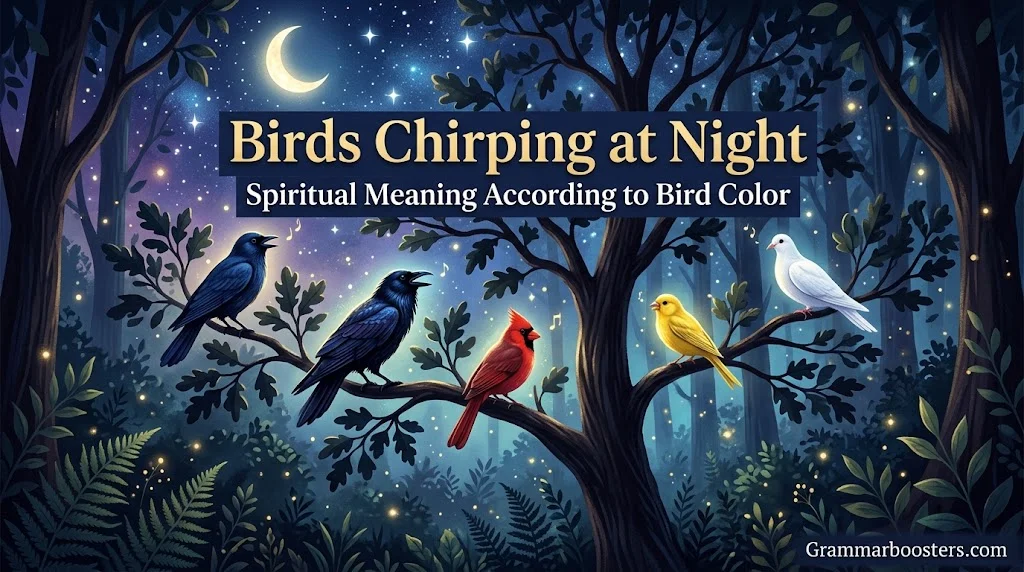
Bird colors carry symbolic meanings in art, folklore, and modern spiritual interpretations. However, color symbolism varies across cultures, and a bird’s color doesn’t establish the spiritual meaning of its call.
At night, identifying a bird by color can be difficult. Unless you see it clearly in adequate light, avoid guessing its appearance or species.
Black Birds Chirping at Night
Black birds may symbolize mystery, transformation, protection, or the unknown in some spiritual interpretations. Their dark feathers can also create a strong visual association with nighttime and uncertainty.
If you hear a blackbird or another dark-feathered bird after sunset, you might reflect on something in your life that feels unclear. Perhaps you’re entering a new stage, reconsidering a belief, or learning to live with uncertainty.
However, black birds don’t automatically represent danger, death, or bad luck. These associations often come from particular stories and cultural traditions rather than universal spiritual rules.
Possible symbolic meaning: Accept uncertainty and approach unfamiliar situations with patience instead of fear.
White Birds Chirping at Night
White birds are sometimes associated with peace, innocence, hope, and spiritual comfort. In certain cultural and artistic traditions, white feathers also represent purity or renewal.
If you see a white bird at night, you might associate the encounter with a desire for peace or a fresh start. For example, someone recovering from a difficult experience may find comfort in the image of a white bird resting quietly nearby.
Still, the bird’s color doesn’t prove that a supernatural presence is communicating with you. A white bird may simply be a species with naturally pale plumage.
Possible symbolic meaning: Seek peace, release unnecessary worry, and make space for emotional renewal.
Brown Birds Chirping at Night
Brown birds can symbolize grounding, stability, simplicity, and connection with the natural world. Their earthy colors often appear in artistic representations of home, nature, and everyday life.
If you associate a brown bird’s call with spiritual meaning, consider whether you need more balance in your daily routine. Perhaps you’ve been rushing between responsibilities or spending too much time worrying about the future.
The experience may remind you to focus on what you can control, including your habits, relationships, and immediate responsibilities.
Possible symbolic meaning: Return to the basics and appreciate the steady things that support your life.
Blue Birds Chirping at Night
Blue birds may symbolize hope, freedom, emotional calm, and communication in modern symbolic interpretations. Blue is also commonly associated with the sky and water, which can suggest openness and tranquility.
If you hear a bird you recognize as blue, you might connect the experience with expressing yourself honestly or approaching a difficult conversation with greater calm.
For instance, someone who has struggled to share their feelings may use the encounter as a reminder to communicate more openly.
These associations are symbolic rather than universal. The sound of a bird doesn’t establish that a particular emotional or spiritual message has been sent.
Possible symbolic meaning: Express yourself clearly and make room for calm, honest communication.
Spiritual Meaning of Different Birds Chirping at Night
The species matters when you’re trying to understand why a bird is calling after dark. Different birds have different activity patterns, and their behavior can help distinguish a natural explanation from a personal symbolic interpretation.
Owls Calling at Night
Owls are among the birds most strongly associated with nighttime. Many owl species hunt after dark and use calls to communicate with mates, defend territories, or maintain contact.
In some cultural traditions, owls symbolize wisdom, observation, mystery, or knowledge. Other traditions associate them with death, warnings, or the supernatural. These interpretations differ considerably, so no single meaning applies to every community.
If you hear an owl calling outside, you might use the encounter as a reminder to observe your surroundings carefully. Owls are also an excellent example of how a sound can feel mysterious while having a practical biological purpose.
Spiritual takeaway: Consider wisdom and awareness as possible personal symbols, but don’t assume an owl predicts good or bad fortune.
Nightingales Singing at Night
Nightingales are famous for their rich songs, which can include varied notes, whistles, and repeated phrases. Males of some nightingale species sing at night, particularly during the breeding season.
In poetry and folklore, nightingales often represent love, longing, beauty, creativity, and emotional expression. Their songs have inspired writers who connect nighttime with romance, solitude, and reflection.
If you hear a nightingale, you might associate its music with expressing emotions you’ve kept to yourself. It may also remind you to appreciate beauty even when circumstances feel difficult.
However, not every nighttime bird song comes from a nightingale. Correct identification requires attention to the sound, location, and species present in your region.
Robins Chirping at Night
Robins are often associated with spring, renewal, and new beginnings in popular symbolism. Their familiar songs can make them feel like reminders of changing seasons and the return of warmer weather.
Some robins sing at night in urban environments, where artificial lighting can disrupt their normal daily rhythms. A brightly illuminated street or building may contribute to nighttime singing.
Symbolically, you might interpret the sound as an invitation to embrace change or approach a new opportunity with optimism.
Remember: Hearing a robin at night doesn’t guarantee that a new relationship, job, or opportunity is coming. Its meaning depends on your interpretation rather than a reliable prediction.
Sparrows Chirping at Night
Sparrows are small, adaptable birds often associated with community, resilience, humility, and everyday life. Their presence around homes and gardens makes them familiar to many people.
In a spiritual context, a sparrow’s call may remind you that small things can matter. You don’t always need a dramatic experience to find comfort or meaning. Sometimes, a quiet moment or a kind conversation can make a difficult day easier.
Sparrows may also make unexpected sounds after dark because of artificial lighting, disturbance, or other environmental conditions.
If you hear one at night, consider whether you’ve overlooked simple sources of support in your life, such as friends, family, or daily routines.
Crows or Ravens Calling at Night
Crows and ravens appear in many stories, myths, and cultural traditions. Their intelligence, dark plumage, and varied calls have contributed to associations with mystery, transformation, memory, and the unknown.
Some traditions treat these birds as messengers or symbols of change. Others connect them with death or misfortune. These interpretations are culturally specific and shouldn’t be treated as universal truths.
Crows and ravens are generally more active during daylight, although disturbances or unusual circumstances can lead to nighttime vocalizations. Their presence after dark doesn’t establish that something bad is about to happen.
Possible symbolic meaning: Examine what may be changing in your life, but let evidence guide important decisions.
Unidentified Birds Chirping in the Darkness
Sometimes you hear a clear, repeated call but cannot see the bird. This uncertainty can make the experience feel more mysterious than it would during daylight.
Spiritually, you might associate the sound with the unknown, intuition, or learning to accept uncertainty. You don’t need to identify a specific species to reflect on those themes.
However, if you want to understand the sound’s natural cause, identification is a better starting point. Record the call if you can do so without disturbing wildlife, note the location and time, and compare it with reliable bird recordings.
Avoid assigning a specific meaning to a species you haven’t identified. A cricket, frog, or another animal can sometimes sound surprisingly similar to a bird.
Birds Chirping at Night: Spiritual Meaning in Different Cultures and Belief Systems
Birds have important roles in religious texts, mythology, folklore, and traditional art. Yet the meaning of a bird call depends on the particular tradition, region, species, and story involved.
It’s important to distinguish established religious teachings from local folklore and modern spiritual interpretations.
Birds Chirping at Night in Christianity
In Christianity, birds appear in biblical imagery connected with God’s care, creation, and the natural world. For example, Matthew 6:26 refers to birds as part of a teaching about trust and God’s provision.
This imagery can encourage Christians to reflect on faith, gratitude, and the value of creation. Hearing birds at night may prompt someone to pray, feel thankful, or appreciate the natural world.
However, the Bible doesn’t establish one universal spiritual interpretation for birds chirping after dark. It doesn’t say that such calls always signal an angel, a warning, or a specific future event.
For Christian readers, the experience may serve as a personal reminder of faith without requiring an unsupported supernatural claim.
Birds Chirping at Night in Hindu Traditions
Birds appear in Hindu stories, religious imagery, and traditional symbolism in many different ways. Garuda, for example, is a significant divine figure associated with Vishnu, while other birds feature in stories about devotion, knowledge, loyalty, and duty.
Because Hindu traditions are diverse, it would be inaccurate to assign one spiritual meaning to all birds chirping at night.
Some individuals may interpret the experience through personal devotion, family traditions, or local beliefs. Others may simply understand it as a natural event.
If you follow a particular Hindu tradition, consider how its teachings and practices approach signs, omens, and the natural world rather than assuming that every bird call has a fixed religious meaning.
Birds Chirping at Night in Islam
Islam teaches that birds and other living creatures belong to Allah’s creation. The Quran refers to birds praising Allah in their own way, including in Surah An-Nur 24:41.
For Muslim readers, observing birds may inspire reflection on creation, gratitude, and the signs of Allah’s power. Hearing a bird at night can be an opportunity to remember the natural world and appreciate its complexity.
However, a bird chirping at night does not automatically establish a divine message or prediction. Specific claims about bad luck, death, or future events require reliable religious support and shouldn’t be attributed to Islam without evidence.
A balanced approach respects faith while distinguishing religious teachings from local superstition.
Birds Chirping at Night in Native American Traditions
Birds hold varied roles in the stories, ceremonies, and cultural practices of Indigenous peoples across North America. Their meanings differ among nations and communities.
Some traditions feature birds as messengers, guides, or important figures in creation stories. However, it would be inaccurate to claim that all Native American communities interpret nighttime birdsong in the same way.
If you explore this subject, look for sources from the specific Indigenous nation or community whose tradition you’re discussing. Avoid generalizing sacred teachings or assigning a universal meaning to an ordinary bird call.
Birds Chirping at Night in Folklore and Traditional Beliefs
Folklore often reflects the fears, hopes, and experiences of the communities that create it. Before widespread electric lighting, a bird calling in the darkness might have seemed unusual or difficult to explain.
As a result, some communities developed stories connecting nighttime bird calls with warnings, protection, good fortune, or approaching change. Other traditions treated particular birds as omens.
These stories can be culturally meaningful without providing evidence that birds predict future events.
When reading a traditional interpretation, ask three things:
- Where did the belief originate? A local story may not represent a wider culture.
- Which bird does it describe? Different species often have different roles in folklore.
- Is it a religious teaching or a popular belief? The two aren’t always the same.
This approach lets you explore spiritual symbolism while respecting cultural differences.
Is Hearing Birds Chirping at Night a Good or Bad Omen?
Many people search for the spiritual meaning of nighttime birds because they want to know whether the sound is a positive sign or a warning. The honest answer is that birds chirping at night isn’t a reliable indicator of future events.
A sound can feel significant without predicting anything. Its emotional impact may come from the circumstances in which you hear it, your cultural background, or a memory it brings to mind.
When Nighttime Birdsong Feels Like a Positive Sign
You may interpret a bird’s call as a positive symbol if it brings comfort, hope, or a sense of connection. For example, someone beginning a new chapter may associate birdsong with renewal.
That interpretation can be useful if it encourages patience, courage, or gratitude. The key is to treat the sound as a source of personal inspiration rather than proof that a particular outcome is guaranteed.
You can appreciate a meaningful moment without expecting it to control what happens next.
Why Some Traditions Associate Nighttime Birds With Warnings
Darkness has historically made it harder for people to see animals and understand unfamiliar sounds. In some communities, this uncertainty contributed to stories about birds as messengers of danger or change.
Such stories may explain why particular calls still make people uneasy. However, cultural associations aren’t evidence that a bird predicts misfortune.
A bird calling repeatedly may be responding to a predator, another bird, artificial lighting, or a disturbance nearby. Looking for these explanations can help you respond calmly.
Does Hearing Birds at Night Mean Something Bad Will Happen?
No reliable evidence shows that nighttime birdsong predicts death, illness, financial loss, relationship problems, or other future events.
If a particular bird frightens you, remember that a feeling of fear isn’t proof of danger. Consider the environment and the bird’s normal behavior before drawing conclusions.
You should also avoid making major decisions based solely on perceived omens. Decisions about health, money, relationships, and safety deserve practical reasoning and trustworthy information.
Scientific Reasons Birds Chirp at Night
Spiritual symbolism is only one way to understand nighttime birdsong. Biological and environmental factors often provide a more direct explanation for why birds vocalize after dark.
Artificial Lights and Light Pollution
Artificial lighting is one important reason some birds sing at unusual hours. Streetlights, illuminated buildings, parking lots, and security lights can change how birds experience the day-night cycle.
Research has found that artificial light at night can affect bird behavior, including the timing of singing and other daily activities. The effects vary by species, location, season, and lighting conditions.
For example, a bird living near a brightly lit building may begin singing before sunrise or continue vocalizing after sunset. This doesn’t mean that every bird near a light will sing at night, but lighting can influence the pattern.
If birds repeatedly call near your window, observe nearby lamps and illuminated trees. Reducing unnecessary outdoor lighting can also help limit disruption to wildlife.
Nocturnal and Crepuscular Bird Species
Not every bird follows the same daily schedule. Some species are active at night, while others become especially active around dawn and dusk.
These patterns are often described using two terms:
| Term | Meaning | Examples |
| Nocturnal | Primarily active at night | Many owl species and some nightjars |
| Diurnal | Primarily active during the day | Many sparrows, crows, and songbirds |
| Crepuscular | Most active around dawn or dusk | Some species show strong activity during twilight |
These categories describe general patterns, not strict rules for every individual bird.
Nightingales are also well known for nighttime singing during parts of the breeding season. Meanwhile, some birds that normally sing during the day may call after dark because of artificial lighting or disturbance.
Knowing which species live in your area can help explain the sounds you hear.
Mating Calls and Territorial Behavior
Birds use sound to communicate. Depending on the species, their calls and songs may help attract mates, defend territories, maintain contact, or coordinate behavior.
During the breeding season, some birds become particularly vocal. A male may sing to attract a mate or signal that he occupies a particular territory.
Repeated nighttime chirping may therefore reflect normal communication rather than an unusual event.
The sound alone doesn’t always reveal the bird’s purpose. Species identification, timing, and the surrounding environment can provide useful clues.
Alarm Calls and Environmental Disturbances
Birds sometimes call when something disturbs them. Potential triggers include predators, nearby animals, sudden movement, construction, traffic, or activity around nesting sites.
A bird may also respond to the calls of other birds. This can create an extended period of noise even when the original disturbance is difficult to identify.
If you hear sudden, persistent calls, look for obvious environmental factors from a safe distance. Avoid approaching nests or trying to handle wild birds.
Seasonal Changes and Migration
Bird activity changes throughout the year. Breeding seasons, migration, weather, and daylight patterns can influence when birds vocalize.
Some migrating birds travel at night, and certain species produce calls during nocturnal flight. These calls may be brief and difficult to locate because the birds are moving overhead.
Other species become more vocal during particular stages of the breeding season. A sound you hear regularly in spring may become less common during another season.
This seasonal variation explains why nighttime bird calls may appear unexpectedly or change over time.
Could the Sound Be Something Other Than a Bird?
Not every high-pitched nighttime sound comes from a bird. Crickets, katydids, frogs, and other animals produce calls that can resemble chirping or whistling.
Electronic sounds, alarms, and mechanical equipment can also cause confusion, especially when the source is hidden.
If you’re curious about an unfamiliar sound, try these steps:
- Record a short clip without approaching or disturbing the animal.
- Note the time, weather, location, and nearby habitat.
- Listen for patterns such as repeated whistles, trills, or short chirps.
- Compare the recording with reliable bird-identification guides.
- Consider insects and amphibians if the sound doesn’t match local birds.
Identifying the source can turn a mysterious experience into a useful opportunity to learn about local wildlife.
What Does It Mean When You Keep Hearing Birds Chirping at Night?
When nighttime birdsong becomes a regular experience, you may start looking for a pattern. Perhaps it happens whenever you sit outside, shortly before sunrise, or during a particular season.
You can explore the experience through personal reflection while remaining open to ordinary explanations.
Notice the Context Without Jumping to Conclusions
Start by paying attention to when and where the bird calls occur. Does the sound come from the same tree every night? Does it begin when a nearby light turns on? Does it happen more often during warmer months?
These details can help you understand the bird’s behavior. They may also explain why the experience feels meaningful to you.
For example, if you hear birds while sitting quietly after a stressful day, you might connect the sound with relief. That emotional response is real, even if the bird’s behavior has a straightforward biological cause.
Reflect on Your Thoughts and Emotions
Your emotional response can influence how you interpret an experience. A bird’s call might feel reassuring when you’re hopeful but unsettling when you’re already anxious.
Instead of assuming that the sound confirms your feelings, use it as an opportunity to examine them.
Ask yourself:
- What was I thinking about when I heard the bird?
- Did the sound make me feel peaceful, curious, or uneasy?
- Is there something in my life that needs attention?
- Am I interpreting the sound through a particular cultural or spiritual belief?
These questions can help you discover personal meaning without treating a coincidence as proof.
Look for Natural Patterns
Repeated nighttime sounds often become easier to understand when you observe their timing and surroundings.
For instance, you might notice that a bird calls near a streetlight, becomes active during breeding season, or responds to another bird in a neighboring tree.
A simple observation log can help:
| Date | Time | Observation | Possible explanation |
| Monday | 10:30 PM | Short calls near a porch light | Artificial lighting or nearby activity |
| Wednesday | 4:00 AM | Repeated whistles before sunrise | Early-morning singing |
| Friday | 11:45 PM | Sudden calls followed by silence | Possible disturbance or alarm response |
These are illustrative examples, not actual observations or confirmed explanations. Their purpose is to show how recording details can help you identify patterns.
Give the Experience Your Own Personal Meaning
Not every meaningful experience needs a fixed interpretation. You might connect nighttime birdsong with a loved one, a personal milestone, or a peaceful memory.
That association can matter to you without proving that the bird intended to communicate anything.
For example, if you associate birdsong with a grandparent who loved nature, hearing a bird outside your home may bring back a comforting memory. You can appreciate that connection without claiming certainty about supernatural communication.
Personal meaning and factual explanation can exist side by side.
What Should You Do When You Hear Birds Chirping at Night?
If you hear birds after dark, you don’t need to react with fear or search for an immediate answer. A calm, curious approach can help you understand the experience and appreciate it.
Pause and Listen Calmly
Take a moment to notice the sound. Is it a single chirp, a repeated series of notes, or a longer song?
You can slow your breathing and pay attention to the present moment. If the experience feels peaceful, allow yourself to enjoy it.
You don’t need to decide whether the sound is a sign before you can appreciate it.
Observe the Environment
Look for possible causes from a respectful distance. Nearby trees, shrubs, lights, nesting areas, and other animals may provide useful clues.
Avoid shining bright lights directly at birds or approaching a nest to identify the source. Wild birds need space, especially during breeding and resting periods.
Identify the Bird if Possible
Learning which species you’re hearing can help you understand its normal behavior. A local field guide or reputable bird-identification resource may help you compare calls and habitats.
Don’t rely on color alone, particularly at night. Many species look similar in low light, and some animals produce sounds that resemble birdsong.
Reflect on Your Personal Response
If you interpret the experience spiritually, consider what it brings to mind. You might use the moment to practice gratitude, think about a difficult decision, or reconnect with your values.
However, avoid treating the call as an instruction to make a major life change. A personal reflection can be helpful without becoming a rule you feel compelled to follow.
Keep a Record if the Calls Recur
If you regularly hear birds at night, record the approximate time, location, duration, and surrounding conditions.
Over several days, you may notice that the sound occurs around the same time or follows a particular environmental pattern. This information can help distinguish a recurring natural behavior from an occasional encounter.
Reduce Unnecessary Outdoor Lighting
If you control the outdoor lights near your home, consider switching off unnecessary illumination or using appropriately directed, lower-intensity lighting.
Artificial light can disrupt wildlife behavior. Reducing excess lighting may benefit birds and other animals while also improving the natural darkness of your surroundings.
Case Study: Finding Personal Meaning in Nighttime Birdsong
Consider a hypothetical example involving someone who has recently started a demanding job.
For several nights, this person hears a bird calling outside the bedroom window. Because the new job feels overwhelming, the sound begins to stand out. The person wonders whether it represents a warning, a spiritual awakening, or a sign that a major change is coming.
Instead of making a decision based on the sound, the person takes a balanced approach.
First, they investigate the natural explanation. They notice a tree near a bright outdoor light and begin to suspect that the bird’s nighttime activity may relate to the environment.
Next, they consider their emotional response. The sound has become associated with the stress they feel about work. It provides a quiet moment in which they can acknowledge their worries.
Finally, they take practical action. They write down the concerns that have been bothering them, discuss their workload with a colleague, and create a more manageable evening routine.
The bird’s call hasn’t predicted the future. However, the experience has helped the person notice a problem and respond constructively.
This example illustrates an important distinction: an experience can inspire meaningful reflection without functioning as a supernatural message.
Common Myths About Birds Chirping at Night
Nighttime birdsong appears in many stories and spiritual interpretations. Some of these ideas can be interesting, but others create unnecessary fear when people treat them as established facts.
Myth: Birds Chirping at Night Always Carries a Spiritual Message
Reality: Birds vocalize for many biological and environmental reasons. You may assign personal meaning to the sound, but there’s no reliable evidence that every nighttime call carries a spiritual message.
Myth: Nighttime Bird Calls Predict Death
Reality: Some folklore associates particular birds with death or misfortune. However, bird calls haven’t been established as reliable predictors of death or future events.
If you hear a bird at night, there’s no reason to assume that someone you love is in danger.
Myth: Every Bird Species Has the Same Spiritual Meaning
Reality: Symbolism differs across cultures, religions, regions, and individual belief systems. An owl may represent wisdom in one context and a warning in another.
Even within a single culture, interpretations can vary. Avoid presenting one symbolic meaning as a universal truth.
Myth: Hearing Birds at Night Proves You’re Experiencing a Spiritual Awakening
Reality: A bird call may inspire you to think more deeply about your life, but it doesn’t establish that you’re undergoing a spiritual transformation.
Personal growth usually involves broader changes in awareness, values, behavior, or priorities. A single sound cannot prove that such a process has begun.
Myth: Birds Chirping at Night Is Always Unnatural
Reality: Some birds naturally call after dark, and others may become active at unusual times because of artificial lighting, breeding behavior, or disturbances.
Nighttime birdsong is not automatically evidence that something unusual or supernatural is happening.
How to Interpret Birds Chirping at Night Without Losing a Grounded Perspective
You can explore spiritual symbolism while respecting scientific evidence. These approaches don’t have to compete.
The following principles can help you find a balanced interpretation.
- Separate facts from beliefs. A bird calling outside your window is an observation. The idea that it represents a new beginning is an interpretation.
- Consider the cultural context. Check whether a claimed meaning comes from a specific religious teaching, regional folklore, or modern spiritual content.
- Avoid frightening conclusions. Don’t assume a bird’s call predicts death, illness, bad luck, or another harmful event.
- Look for practical explanations. Consider lighting, habitat, species, weather, and seasonal behavior.
- Use reflection constructively. If the experience inspires you to improve a relationship, practice gratitude, or address a problem, focus on the useful action.
- Respect wildlife. Enjoy birdsong without disturbing nests, handling birds, or using bright lights to force an animal into view.
A grounded interpretation allows you to appreciate mystery without treating uncertainty as proof.
Conclusion:
The spiritual meaning of birds chirping at night can involve intuition, hope, spiritual awareness, transformation, freedom, and inner peace. Across different cultures and belief systems, birds have inspired stories about renewal, wisdom, communication, and the connection between people and nature. However, these interpretations aren’t universal. Your personal beliefs, experiences, and cultural background can influence what nighttime birdsong means to you.
It’s equally important to understand why birds actually chirp after dark. Some species naturally vocalize at night, while others may respond to artificial lighting, mating behavior, predators, or environmental disturbances. A bird calling at midnight or 3 AM doesn’t automatically predict a major life change, danger, or a supernatural event. Understanding these natural explanations helps you explore spiritual symbolism without unnecessary fear.
Ultimately, you can appreciate the experience without forcing it to mean something specific. Let the sound remind you to pause, reflect, and reconnect with the world around you. If it inspires hope or encourages positive change, use that feeling constructively. Sometimes, the greatest value of nighttime birdsong lies not in predicting the future but in helping you pay attention to the present.
FAQs
What Does It Mean Spiritually When Birds Chirp at Night?
Spiritually, people may interpret birds chirping at night as a symbol of intuition, hope, personal transformation, or inner peace. The meaning depends on individual beliefs and cultural traditions. Some people find comfort in the sound, while others see it as a reminder to reflect on their lives. However, nighttime birdsong doesn’t automatically indicate a supernatural message.
Is Hearing Birds Chirping at Night a Good Sign?
Some people view nighttime birdsong as a positive symbol of hope, renewal, and reassurance. Others interpret it differently according to their cultural or spiritual beliefs. There is no universal rule that makes birds chirping at night a good or bad omen. You can appreciate the experience as a positive personal reminder without assuming it predicts a particular outcome.
What Does It Mean When a Bird Chirps Outside Your Window at Night?
A bird chirping outside your window may symbolize comfort, awareness, or personal reflection in a spiritual interpretation. There may also be a natural explanation, such as nearby trees, nesting behavior, artificial lighting, or a disturbance. If you hear the sound regularly, observe the surroundings and consider identifying the species before drawing conclusions about its meaning.
Why Do Birds Chirp at 3 AM?
Birds may chirp at 3 AM because of artificial lighting, communication, breeding behavior, alarm calls, or species-specific activity patterns. Some birds naturally vocalize at night, while others may respond to environmental disturbances. Although some spiritual interpretations associate this time with intuition or awareness, there is no reliable evidence that birds calling at 3 AM predict supernatural events.
Does Hearing Birds at Night Mean Someone Is Thinking About You?
No reliable evidence shows that birds chirping at night means another person is thinking about you. Some people may interpret the experience as a symbol of emotional connection, love, or remembrance. If the sound reminds you of someone important, that personal association can be meaningful. However, the bird’s call cannot confirm another person’s thoughts or feelings.
What Does It Mean When Birds Chirp at Midnight?
Midnight can symbolize transition, reflection, and new beginnings in some spiritual interpretations. Hearing birds at this time may encourage you to consider your priorities or approach an uncertain situation with patience. However, midnight doesn’t have a universally established spiritual meaning for bird calls. Natural factors, including lighting and animal communication, can explain why birds vocalize at that hour.
Are Birds Chirping at Night a Warning?
Birds chirping at night isn’t a reliable warning of danger or future misfortune. Some birds call to alert others to predators or disturbances, but that behavior has a biological purpose rather than a guaranteed supernatural meaning. If you hear persistent or unusual calls, consider your surroundings and the bird’s behavior instead of assuming that something bad will happen.
Why Do Birds Suddenly Start Chirping at Night?
Birds may suddenly begin chirping because another animal has approached, a nearby light has switched on, or something has disturbed their resting place. Breeding behavior and communication can also cause sudden vocal activity. Sometimes, several birds respond to one another. The exact explanation depends on the species, season, habitat, and surrounding conditions.
What Does It Mean When You Hear Birds but Cannot See Them?
Hearing birds without seeing them may symbolize mystery, intuition, or awareness in a personal spiritual interpretation. However, birds often remain hidden among trees, shrubs, rooftops, or other structures at night. You may also be hearing an insect or another animal. If you’re curious, record the sound and compare it with reliable wildlife identification resources.
Should I Be Worried if Birds Chirp Outside My House Every Night?
Usually, there is no reason to worry simply because birds chirp outside your house at night. The calls may reflect normal animal behavior, nearby lighting, or environmental disturbances. If the sound bothers your sleep, consider identifying its source and addressing practical factors where possible. You don’t need to interpret repeated birdsong as a bad omen.

I’m Brian K, a language researcher and grammar writer who enjoys exploring English vocabulary, idioms, word differences, and everyday expressions. I believe learning English should be straightforward and enjoyable, so I create practical guides that simplify complex topics. Through accurate explanations and relatable examples, I aim to help readers communicate more naturally and confidently.