If you’re unsure whether accordion or accordian is correct, the answer is simple: accordion is the correct spelling.
Accordian is a common misspelling. The difference is easy to overlook because both versions look and sound similar, especially when you’re writing from pronunciation rather than memory.
The correct spelling is:
accordion
The incorrect spelling is:
accordian
The key difference appears near the end of the word. Accordion contains -ion, while the misspelling accordian uses -ian.
| Spelling | Correct? | Example |
| accordion | Correct | She plays the accordion. |
| accordian | Incorrect | She plays the accordian. |
This distinction stays the same whether you’re talking about the musical instrument, an accordion folder, an accordion fold, or an accordion interface on a website.
Accordion vs. Accordian: What’s the Difference?
Accordion is the standard English spelling. Accordian is a misspelling that commonly appears when writers reproduce the word based on how they think it sounds.
The correct word contains these letters:
A-C-C-O-R-D-I-O-N
The incorrect version is:
A-C-C-O-R-D-I-A-N
The important sequence to remember is I-O-N.
Quick comparison
| Feature | Accordion | Accordian |
| Standard English spelling | Yes | No |
| Refers to the musical instrument | Yes | No |
| Used in “accordion folder” | Yes | No |
| Used in “accordion menu” | Yes | No |
| Recommended in formal writing | Yes | No |
There isn’t a meaning difference between the two spellings. If someone writes accordian, they almost always mean accordion.
That makes this a spelling question rather than a vocabulary question.
What Does Accordion Mean?
Accordion is primarily a noun for a musical instrument with a folding bellows and reeds that produce sound as air moves through them.
The instrument is operated by moving the two sides of the bellows while pressing keys or buttons. Different types of accordions use different keyboard or button arrangements.
The word also has broader uses. Something described as accordion-style usually has connected sections that can expand, contract, fold, or collapse.
For example:
- accordion — the musical instrument
- accordion player — a person who plays the instrument
- accordion folder — an expandable document organizer
- accordion fold — a folding method used in printing
- accordion door — a folding door made from connected sections
- accordion menu — a collapsible interface element
The underlying idea is similar in each case: sections move together as something expands or contracts.
The accordion as a musical instrument
A traditional accordion uses bellows, reeds, keys or buttons, and valves to produce musical notes.
The bellows provide the airflow. When the player moves them inward or outward, air passes through the instrument’s reeds. The reeds vibrate and produce sound.
The controls determine which notes or chords are played.
Different accordion designs can vary significantly. Some have piano-style keys, while others use rows of buttons. Musical traditions also influence how particular accordion types are built and played.
For example:
The musician played the accordion during the festival.
Here, accordion is simply the name of the instrument.
Accordion as a descriptive term
The word has also developed a useful descriptive meaning.
When an object has an accordion structure, its connected sections can fold together or expand apart.
Consider an accordion folder. When it is closed, its sections sit close together. When it is opened, the compartments spread apart.
The same basic visual idea appears in an accordion fold or an accordion-style door.
This is why the word is useful beyond music.
Why Is “Accordian” a Common Misspelling?
Accordian is easy to write because English spelling doesn’t always follow pronunciation predictably.
When people hear an unfamiliar word, they often try to reconstruct its spelling from familiar patterns. In this case, the ending can sound as though it might be written -ian.
That creates:
accordian
But the standard spelling is:
accordion
English has many words ending in -ian, so the incorrect version can look perfectly plausible at first glance.
Words such as musician, electrician, and Canadian reinforce the familiar -ian pattern. That doesn’t mean accordion follows the same spelling pattern.
Pronunciation can confuse.
The American English pronunciation is commonly represented approximately as:
uh-KOR-dee-uhn
The final sound does not clearly indicate which letters you should type.
This is an important lesson for English learners: English spelling cannot always be predicted perfectly from pronunciation.
You can hear a word correctly and still spell it incorrectly.
That happens with many English words. The solution is often to learn the written form as a complete unit rather than trying to build every spelling from sound.
How to Remember the Correct Spelling of Accordion
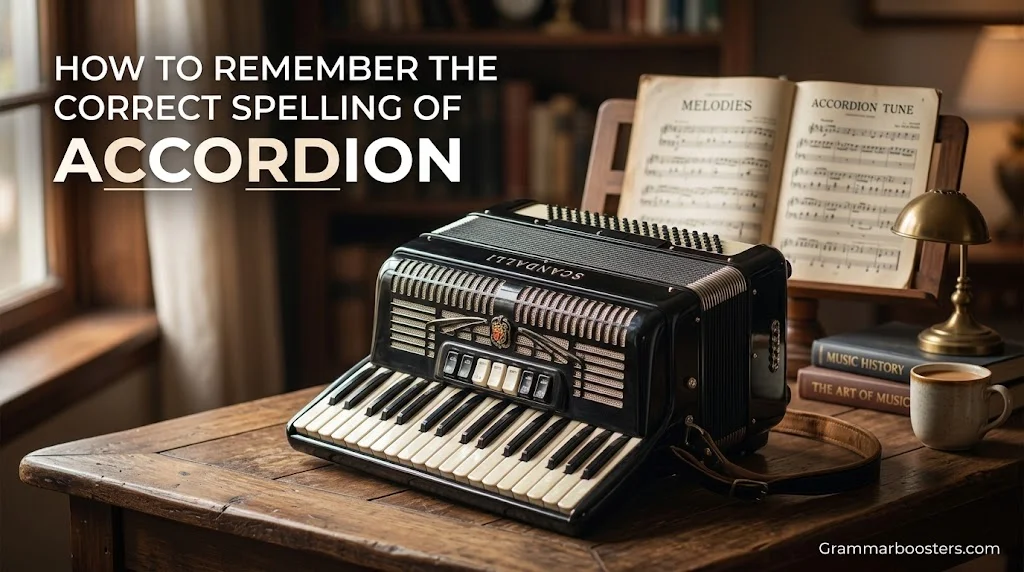
The easiest way to remember accordion is to focus on its final three letters:
I-O-N
Think:
accordi + on
Not:
accordi + an
Use the “-ion” memory trick.
When you’re unsure, remember:
Accordion ends in -ion.
That single detail separates the correct spelling from the common misspelling.
| Correct | Incorrect |
| accordion | accordian |
| I-O-N | I-A-N |
| accordion | accordian |
Break the word into parts
You can also remember the word as:
ac-cor-di-on
This makes the spelling easier to visualize.
The final chunk is especially important:
on
That gives you:
ac-cor-di-on
rather than:
ac-cor-di-an
Put the spelling into a sentence.
A word is often easier to remember when you see it used naturally.
Try these:
She plays the accordion.
The accordion player performed a traditional song.
The website uses an accordion menu.
I keep old documents in an accordion folder.
Repeated exposure to the correct spelling helps build recognition.
Accordion in Context
Accordion appears in several different areas of everyday English. Understanding these contexts makes the word easier to recognize and spell.
The most familiar context is music. However, the word also appears in printing, office supplies, interior design, and web development.
| Context | Example | Meaning |
| Music | accordion player | A person who plays the instrument |
| Office supplies | accordion folder | An expandable folder with compartments |
| Printing | accordion fold | A folding method using connected panels |
| Interior design | accordion door | A folding door or partition |
| Web design | accordion menu | Expandable and collapsible content |
The spelling remains accordion in every context.
Accordion as a musical instrument
The traditional meaning is the easiest to recognize.
The accordion is a portable musical instrument with a folding bellows and reeds.
Examples:
- He learned to play the accordion at school.
- The band included an accordion player.
- She carried her accordion into the theater.
- The accordion added a distinctive sound to the performance.
The plural is:
accordions
For a person who plays one, the standard noun is:
accordionist
So you might write:
The accordionist performed three songs.
Not:
The accordianist performed three songs.
Accordion as a physical structure
The word can describe something that expands and contracts through connected sections.
For example:
The accordion folder has twelve compartments.
The folder is not a musical instrument. It is called an accordion folder because of its expandable structure.
Other examples include:
- accordion file
- accordion folder
- accordion fold
- accordion door
- accordion partition
These terms are common because the folding mechanism resembles the movement of an accordion’s bellows.
Accordion in printing
An accordion fold is a folding technique in which panels fold back and forth in alternating directions.
This type of fold can be useful for:
- Brochures
- Maps
- Menus
- Leaflets
- Instruction sheets
- Marketing materials
For example:
The travel brochure uses an accordion fold so readers can unfold the entire map.
The spelling is still accordion.
Accordion folders
An accordion folder contains expandable sections for organizing documents.
Unlike a simple folder with one main compartment, it can separate papers into multiple categories.
For example:
I use an accordion folder to organize receipts by month.
You might also see:
- accordion file
- accordion organizer
- expanding accordion folder
- expandable file folder
These expressions all use accordion, not accordian.
Accordion in Web Design
Modern digital writing has given accordion another common meaning.
A web accordion is an interface component that lets users expand and collapse sections of content.
A simple FAQ might look like this:
What is your return policy?
Click to expand.
When the visitor selects the heading, the answer appears.
This approach allows a page to present several topics without displaying every answer at once.
How an accordion interface works
A typical accordion contains several headings or panels.
For example:
| Section | Initial state | User action |
| Shipping | Collapsed | Click to open |
| Returns | Collapsed | Click to open |
| Warranty | Collapsed | Click to open |
| Payment | Collapsed | Click to open |
The user can expand a section when they want more information.
This design pattern commonly appears in:
- Frequently asked questions
- Help centers
- Product information
- Documentation
- Mobile interfaces
- Troubleshooting guides
- Settings panels
“Accordion menu” or “accordian menu”?
The standard term is:
accordion menu
Not:
accordian menu
For example:
The FAQ page uses an accordion menu to organize its answers.
The same spelling applies to related expressions:
- accordion component
- accordion panel
- accordion section
- accordion interface
- accordion navigation
This is particularly important in technical writing because developers, designers, and content teams need consistent terminology.
Accordion Usage Examples in Sentences
Seeing the word in different contexts is one of the best ways to reinforce its spelling.
Examples about music
She plays the accordion in a local band.
The accordion player entertained the audience before the show.
He bought an accordion after taking several music lessons.
The song features accordion and guitar.
Her accordion has a piano-style keyboard.
Examples about folders and organization
I keep my receipts in an accordion folder.
The accordion file has a separate compartment for each client.
She bought an accordion organizer for her documents.
Examples about printing
The brochure uses an accordion fold.
The designer created an accordion-fold leaflet with six panels.
Examples about websites
The FAQ uses an accordion to display answers.
Click the accordion heading to see more information.
The developer added an accessible accordion component to the page.
These examples demonstrate an important point: the spelling never changes because the context changes.
Whether you’re talking about music, office supplies, printing, or web design, the word remains accordion.
Accordion vs. Accordian: Common Mistakes to Avoid
The most common error is replacing the o in the final part of the word with an a.
Incorrect
accordian
Correct
accordion
This mistake can occur in longer phrases too.
| Incorrect | Correct |
| accordian player | accordion player |
| accordian music | accordion music |
| accordian folder | accordion folder |
| accordian file | accordion file |
| accordion fold | accordion fold |
| accordian door | accordion door |
| accordian menu | accordion menu |
| accordian interface | accordion interface |
Don’t change the spelling based on context
A common misunderstanding is that accordion might be acceptable in a particular context.
It isn’t.
For example:
- Musical instrument → accordion
- Web interface → accordion
- Folding folder → accordion
- Printing technique → accordion
- Folding door → accordion
The spelling is consistent.
Is “Accordian” Ever Correct?
For standard English writing, accordian is not the spelling to use for the musical instrument or the related terms discussed here.
If you encounter accordian online, you’re most likely seeing a spelling error.
This is an important distinction when researching language. A form can appear frequently on the internet without being a standard dictionary spelling.
Online content contains:
- Typos
- User-generated spelling errors
- Automatically generated text
- Product-listing mistakes
- Informal writing
- Repeated copies of older errors
So frequency alone isn’t proof that a spelling is correct.
For formal writing, use an accordion.
Why Does Correct Spelling Matter?
A single spelling error usually won’t prevent a reader from understanding your meaning. However, repeated errors can affect how readers judge the quality of your writing.
Consider a professional website that repeatedly uses:
accordion menu
Readers who know the standard terminology may immediately notice the mistake.
The problem becomes more significant in:
- Academic writing
- Business documents
- Educational materials
- Product descriptions
- Technical documentation
- Website content
- Resumes and professional profiles
- Published articles
Correct spelling creates a cleaner reading experience and makes your terminology more credible.
Spelling matters even more in technical writing
Suppose a developer is reading documentation about an accordion component.
If the document consistently uses accordian, the reader may wonder whether the writer is using a different technical term or simply making an error.
Using the established spelling removes that uncertainty.
This is one reason professional editors check specialized vocabulary carefully. A small spelling error can become more noticeable when it appears in a repeated technical phrase.
Accordion vs. Accordian: A Practical Spelling Test
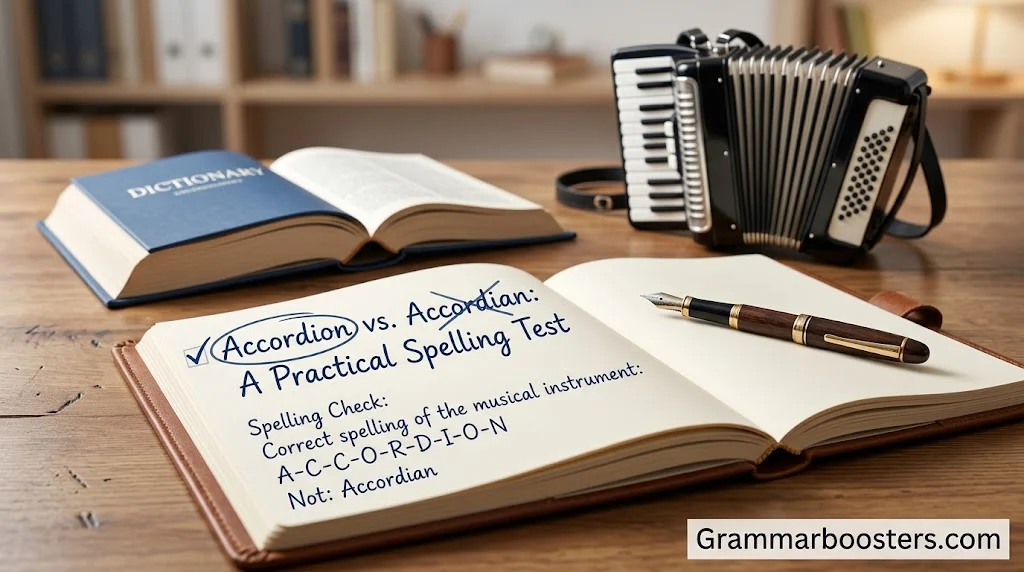
If you’re writing quickly and suddenly can’t remember whether the word contains o or a, use a simple test.
Ask:
Does accordion end with I-O-N?
Yes.
The correct sequence is:
I-O-N
So:
accordion
If you’ve written:
accordian
look at the final three letters. You’ll see:
I-A-N
That’s your signal to correct it.
A five-second proofreading trick
When editing a long document, use your browser or word processor’s Find feature.
Search for:
accordian
If you find it, replace it with:
accordion
This is especially useful if you’ve written the word several times.
You can also search for common phrases such as:
- accordian menu
- accordian folder
- accordian fold
- accordian player
That catches errors that may be hiding inside longer phrases.
Accordion vs. Accordian for English Learners
For English learners, this spelling pair is useful because it demonstrates a broader principle: English spelling and pronunciation don’t always match one letter for one sound.
You may correctly understand a word when you hear it but still struggle to reproduce its written form.
That’s normal.
A better strategy is to learn frequently used words as complete spelling patterns.
For accordion, memorize:
accordi + on
rather than trying to derive the spelling from pronunciation every time.
A useful learner exercise
Write these sentences from memory:
I play the accordion.
She bought an accordion folder.
The website has an accordion menu.
Then cover the word and write it again.
This creates three associations:
- Music
- Physical objects
- Digital interfaces
The spelling stays identical in all three.
Common learner question
“If I hear an ending that sounds like ‘-ian,’ why shouldn’t I spell it that way?”
Because English spelling represents established written forms, not just sounds.
There are many cases where pronunciation alone doesn’t tell you exactly which letters to use. That’s why dictionaries provide both spelling and pronunciation information.
Accordion vs. Accordian in Formal and Informal Writing
The correct spelling doesn’t change between formal and informal English.
What can change is the surrounding vocabulary.
For example, an informal sentence might be:
My uncle plays the accordion.
A more formal sentence might be:
The accordionist performed several traditional pieces during the ceremony.
Both use accordion correctly.
In professional writing, however, avoid using the misspelled form even if the overall tone is casual.
Business example
Incorrect:
Our website’s accordion menu contains the full pricing information.
Correct:
Our website’s accordion menu contains the full pricing information.
Educational example
Incorrect:
Students can organize their notes in an accordion folder.
Correct:
Students can organize their notes in an accordion folder.
Technical example
Incorrect:
Click the accordian panel to display the instructions.
Correct:
Click the accordion panel to display the instructions.
The rule is simple: tone can change, but the spelling doesn’t.
Accordion vs. Accordian: Quick Answer
Accordion is the correct spelling. Accordian is a common misspelling.
The correct spelling is:
A-C-C-O-R-D-I-O-N
The incorrect form is:
A-C-C-O-R-D-I-A-N
Quick reference
| Question | Answer |
| Correct spelling | accordion |
| Common misspelling | accordian |
| Correct final sequence | -ion |
| Incorrect final sequence | -ian |
| Main meaning | A musical instrument |
| Related meanings | Folding or expandable structures |
| Digital meaning | A collapsible interface component |
| Person who plays one | accordionist |
| Plural | accordions |
The easiest memory cue
Remember:
Accordion ends in -ion.
That’s enough to distinguish the correct spelling from accordian.
Conclusion:
When it comes to accordion vs. accordian, the correct spelling is accordion. The form accordian is a common misspelling, often caused by the way the word sounds or by familiarity with words that end in “-ian.” Once you remember that accordion ends with “-ion,” the spelling becomes much easier to recognize and use correctly.
Whether you’re writing about the musical instrument, an accordion folder, an accordion door, or an accordion menu on a website, the same spelling applies. Correct word choice matters because small spelling errors can make otherwise polished writing look less professional.
The simplest rule to remember is this: accordion = A-C-C-O-R-D-I-O-N. If you’re ever unsure, check the ending. It’s -ion, not -ian. Keep that pattern in mind, and you’ll be able to avoid one of the most common spelling mistakes involving this useful and versatile word.
FAQs
Is “accordion” or “accordian” correct?
Accordion is the correct spelling. Accordian is a common misspelling and should be avoided in standard English. The word is spelled A-C-C-O-R-D-I-O-N, with -ion at the end. This spelling applies whether you’re talking about the musical instrument, a folding object, or a web-design element.
Why do people spell accordion as “accordian”?
People often write accordian because the pronunciation can make the final syllable sound like “-ian.” English also contains many familiar words ending in “-ian,” which can reinforce the mistake. Remembering the written form accordion and focusing on its final -ion can help prevent this spelling error.
What does accordion mean?
An accordion is primarily a musical instrument played by expanding and compressing bellows while pressing keys or buttons. The instrument produces sound through reeds. The word is also used for things with a similar folding or expanding structure, including accordion folders, accordion doors, and accordion-style sections on websites.
How do you spell accordion correctly?
The correct spelling is accordion: A-C-C-O-R-D-I-O-N. A useful memory trick is to focus on the final three letters, I-O-N. If you write accordian, you have changed the ending incorrectly. Think accordion = -ion whenever you need to spell the word.
Is “accordian” a real word?
Accordian is generally not considered the standard spelling of the word. It is a common misspelling of accordion. In formal writing, academic work, business communication, and published content, use accordion instead. If you see “accordian” elsewhere, it most likely represents a spelling error rather than a separate English word.
How do you pronounce accordion?
Accordion is commonly pronounced with the stress on the final syllable, approximately like uh-KOR-dee-uhn. Pronunciation can vary slightly by accent and region. Because the ending may sound like “-ian,” some writers spell it accordian. Hearing the word correctly is useful, but remembering its written form is the best way to spell it accurately.
What is an accordion used for?
An accordion is commonly used as a musical instrument. Beyond music, the word describes objects or structures that fold, expand, or contract in a similar way. Examples include accordion folders, accordion doors, and accordion-style website menus. In each context, the standard spelling remains accordion.
Is accordion only used for a musical instrument?
No. Although the musical instrument is the most familiar meaning, accordion can describe anything with a folded or expandable structure. You might encounter terms such as accordion folder, accordion door, accordion fold, or accordion menu. The broader meaning comes from the instrument’s characteristic bellows-like folding shape.
How can I remember the spelling of accordion?
A simple memory trick is to remember that accordion ends in “-ion,” not “-ian.” You can also break the word into smaller parts: ac-cor-di-on. When proofreading, look specifically at the final three letters. If you see -ian, change it to -ion.
Is accordion spelled differently in American English?
No. Accordion is the standard spelling in American English. The same spelling is also used in standard British English. The pronunciation may differ slightly depending on the speaker’s accent, but the spelling remains accordion. The alternative form accordian is still considered a misspelling rather than a regional spelling variation.

I’m Sarah M, an English content specialist dedicated to helping people improve their grammar, spelling, vocabulary, and writing skills. I love answering common language questions and turning difficult grammar concepts into simple, reader-friendly lessons. My goal is to make English learning enjoyable and accessible for anyone who wants to become a better communicator.