
Is it “of course” or “ofcourse”? If you’ve ever hesitated before typing the phrase, you’re not alone. The words often sound closely connected in everyday speech, which makes the spelling easy to blur together.
The correct form is of course, always written as two words in standard English. Ofcourse is a misspelling and shouldn’t be used in school assignments, professional emails, formal writing, or edited content. There’s more to this expression than its spelling, though.
Of course can mean certainly, naturally, obviously, or yes, depending on the situation. Its position in a sentence, punctuation, and even the speaker’s tone can change how readers interpret it. This guide explains exactly when and how to use “of course,” why “ofcourse” is incorrect, how to punctuate the expression, and how it differs from similar phrases such as “certainly,” “sure,” “obviously,” and “off course.”
Quick answer
Of course is correct. Ofcourse is incorrect in standard English. Write of course as two separate words.
Understanding “Of Course” or “Ofcourse”: Which Is Correct?
“Of course” is the correct spelling, while “ofcourse” is a misspelling. The expression contains two separate words, even though they can sound connected when spoken naturally.
| Form | Correct? | Meaning | Example |
| of course | Yes | Certainly, naturally, or obviously | Of course, I’ll help you. |
| ofcourse | No | Nonstandard spelling | Of course, I’ll help you. |
| off course | Yes | Away from an intended route or direction | The boat went off course. |
The distinction between of course and off course deserves special attention because the phrases look and sound similar.
Compare:
Of course, I’ll call you tonight.
Here, of course means certainly.
The plane drifted off course during the storm.
Here, off course means away from its intended direction.
So if you’re expressing agreement, certainty, or something expected, choose of course.
Is “Ofcourse” Ever Correct?
In standard English, ofcourse isn’t the accepted spelling of this expression.
You may still see the one-word form online. It can appear in usernames, informal posts, search queries, comments, or simple typing mistakes. Internet usage doesn’t automatically make a spelling standard.
For polished writing, use of course in:
- School assignments
- Essays and reports
- Professional emails
- Business documents
- Articles and blog posts
- Resumes and applications
- Academic writing
- Formal correspondence
One small space makes the difference.
What Does “Of Course” Mean?
Of course usually means certainly, naturally, definitely, or as expected. The exact meaning depends on the context in which you use it.
For example:
Of course, I remember you.
The speaker considers remembering the person natural or expected.
Now look at this short exchange:
“Can I borrow your notes?”
“Of course!”
Here, of course means certainly or yes.
The expression can also appear after a statement:
She knew about the meeting, of course.
In this sentence, the speaker suggests that her knowledge shouldn’t be surprising.
“Of Course” Meaning When Something Is Obvious
Of course can signal that the speaker considers something obvious or predictable.
For example:
Of course, the roads will be busy during rush hour.
The speaker expects heavy traffic because rush hour normally brings more vehicles onto the roads.
In conversation, the expression is often much shorter:
“Are you coming with us?”
“Of course!”
The response suggests that coming along was already expected.
However, there’s an important point about tone. Saying “Of course!” warmly can sound reassuring. Saying “Of course” with irritation can imply, “Obviously. Why would you even ask?”
The words stay the same. The social meaning changes.
“Of Course” as a Way to Agree
Of course can express clear agreement or willingness.
“Could you send me the document?”
“Of course.”
“Would you like to come with us?”
“Of course!”
In these examples, the phrase communicates more than a bare yes. It can make the response sound cooperative and reassuring.
“Of Course” for Permission or Willingness
When someone asks for permission, of course can provide a friendly affirmative response.
“May I sit here?”
“Of course.”
“Can I ask another question?”
“Of course.”
“Could I use your computer for a moment?”
“Of course.”
The expression doesn’t always mean that something is literally obvious. In these situations, it mainly communicates permission, willingness, or polite agreement.
The Origin and History of “Of Course”
The expression of course comes from the ordinary English word course, which has long been associated with ideas such as a route, direction, progression, sequence, or customary way.
Over time, of course developed into an established expression used to describe something viewed as natural, expected, or certain.
Modern speakers generally don’t interpret the phrase literally. When someone says:
Of course, she’s coming.
they aren’t talking about a physical course or route. They’re expressing the idea that her arrival is expected or unsurprising.
This development is common in English. Frequently used combinations can acquire meanings that go beyond the literal meanings of their individual words.
That doesn’t mean the phrase became one word, however.
Its meaning became idiomatic, but its spelling remained two words.
Why Do People Misspell “Of Course” as “Ofcourse”?
The most likely reason is pronunciation.
In natural conversation, English speakers often connect words rather than pronouncing every word as a separate, carefully isolated unit. As a result, of course can sound like a single flowing phrase.
That creates a familiar spelling trap.
People may hear the phrase as one sound unit and then reproduce it as:
ofcourse
The problem is that spoken rhythm doesn’t determine written word boundaries.
English has many expressions that sound tightly connected when spoken but remain separate in writing:
- at least
- in fact
- a lot
- of course
- for example
- in general
Another reason involves visual familiarity. Because of course appears so frequently, writers may incorrectly assume that it has become a compound word.
It hasn’t.
Frequent use doesn’t turn two words into one word.
Is “Of Course” One Word or Two Words?
“Of course” is two words.
Grammatically, of is a preposition and course is a noun. Together, they form an established expression that commonly functions as an adverbial phrase.
| Expression | Standard spelling |
| of course | Two words |
| in fact | Two words |
| at least | Two words |
| for example | Two words |
| in general | Two words |
The important lesson is that a phrase can behave like a single unit in meaning without becoming a single written word.
That’s exactly what happens with of course.
How to Use “Of Course” in a Sentence
Of course can appear at the beginning, middle, or end of a sentence. Its placement affects emphasis and sometimes punctuation.
“Of Course” at the Beginning of a Sentence
When of course begins a sentence as an introductory expression, a comma commonly follows it.
Of course, you can ask questions.
Of course, we need more information before making a decision.
Of course, nobody expected the weather to change so quickly.
Here, of course comments on the statement that follows.
“Of Course” in the Middle of a Sentence
When of course interrupts a sentence as a parenthetical expression, commas can set it apart.
The project will, of course, require careful planning.
She was, of course, pleased with the result.
Removing the expression leaves the basic sentence intact:
The project will require careful planning.
That is a useful test. If of course functions as an aside, commas often make its role clearer.
“Of Course” at the End of a Sentence
The expression can also appear at the end.
You can come with us, of course.
He knew about the change, of course.
This position often gives the phrase an afterthought-like or conversational quality.
“Of Course” as a Standalone Response
Of course can also function as a complete response.
“Can I borrow your pen?”
“Of course.”
“Are you sure?”
“Of course.”
In these cases, the phrase doesn’t need to be attached grammatically to a longer sentence.
“Of Course” in Formal and Informal English
Of course is acceptable in both formal and informal English. It isn’t grammatically restricted to casual conversation.
You’ll encounter it in:
- Everyday speech
- Professional emails
- Business communication
- Educational writing
- Journalism
- General nonfiction
- Formal correspondence
The real issue is purpose and tone, not simply formality.
In Casual Conversation
“Can you help me?”
“Of course.”
This sounds natural and friendly.
In Professional Communication
Of course, I’d be happy to provide the updated figures.
This sounds polite and cooperative.
In Academic Writing
Of course, these findings require further investigation.
This is grammatically acceptable. However, academic writers should consider whether the phrase adds useful meaning.
Compare:
Of course, the results require further investigation.
with:
The results require further investigation.
The second version is more direct. If the writer doesn’t need the conversational emphasis, removing of course may improve precision.
Common Ways to Use “Of Course”
The expression appears in several recurring patterns.
“Of Course, I Can”
This usually expresses willingness.
Of course, I can help you with the assignment.
“Of Course You Can”
This often gives permission or reassurance.
Of course you can ask another question.
“Of Course Not”
This expresses a strong negative response.
Of course not. I would never do that.
“Of Course!”
As a standalone response, it usually means certainly or yes.
“Would you like some coffee?”
“Of course!”
“Of Course, There’s a Catch”
This construction can introduce a qualification or complication.
The plan sounds perfect. Of course, there’s a catch.
Here, of course helps shift the reader from an attractive idea toward a limitation.
“As a Matter of Course”
This related expression should not be confused with ordinary of course.
Safety checks are performed as a matter of course.
As a matter of course means something happens routinely or as part of normal procedure.
“Of Course” vs. “Certainly”
Of course and certainly can both express agreement or certainty, but they don’t always sound identical.
Compare:
Of course, I’ll help you.
Certainly, I’ll help you.
The first generally sounds more conversational. The second can sound more formal or deliberate.
In customer service, for example:
Certainly. I’ll check that for you.
can sound polished and professional.
Among friends:
Of course! I’ll check.
Usually feels more relaxed.
Neither expression is universally better. Choose according to the relationship and setting.
“Of Course” vs. “Sure”
Sure is particularly common in casual American English.
“Can you help me?”
“Sure.”
“Can you help me?”
“Of course.”
Both responses communicate agreement. However, sure tends to be shorter and more casual, while of course can add a stronger sense of reassurance or willingness.
A coworker might say:
“Sure, I’ll send it over.”
A slightly warmer response could be:
“Of course. I’ll send it over.”
The difference is subtle, but native speakers often notice these shades of tone.
“Of Course” vs. “Absolutely”
Absolutely usually expresses stronger enthusiasm or emphasis.
“Would you like to join us?”
“Of course.”
This sounds positive and natural.
“Would you like to join us?”
“Absolutely!”
The second response sounds more energetic.
Use of course for straightforward confirmation. Use absolutely when you want stronger enthusiasm or emphasis.
“Of Course” vs. “Obviously”
These words can overlap in meaning, but they can create very different impressions.
Compare:
Of course, she knew about the meeting.
Obviously, she knew about the meeting.
The first can sound neutral or conversational.
The second may suggest that the answer should have been unmistakable. In some contexts, obviously can sound blunt or even insulting.
For example:
Obviously, you should have checked the instructions.
That wording may make the listener feel criticized.
A softer alternative might be:
Of course, checking the instructions first is important.
The exact effect still depends on context and tone.
“Of Course” vs. “Naturally”
Naturally can also express the idea that something is expected.
Naturally, she wanted to celebrate.
Of course, she wanted to celebrate.
Both sentences suggest that her reaction wasn’t surprising.
However, naturally can sound somewhat more formal or literary, while of course usually feels more conversational.
“Of Course” vs. “Off Course”
This distinction is especially important because of course and off course look almost identical.
“Of Course”
Of course means:
- Certainly
- Naturally
- Obviously
- As expected
Example:
Of course, I’ll remember your birthday.
“Off Course”
Off course means away from an intended route, direction, plan, or target.
Example:
The plane went off course because of strong winds.
The expression also has figurative uses:
The project has gone off course.
Here, the project has moved away from its intended plan.
A Simple Comparison
| Phrase | Meaning | Example |
| of course | Certainly or naturally | Of course, I’ll help. |
| off course | Away from the intended direction | The boat went off course. |
If you’re expressing certainty, use of course.
If you’re describing deviation from a route or plan, use off course.
Common Mistakes With “Of Course”
Several errors appear frequently in student writing and online communication.
Writing “Ofcourse”
Ofcourse, I’ll be there.
Of course, I’ll be there.
Confusing “Of Course” With “Off Course”
Off course, I remember her.
Of course, I remember her.
Splitting the Phrase With a Comma
Of, course, I’ll help.
Of course, I’ll help.
Overusing the Expression
Consider:
Of course, the manager arrived. Of course, she checked the report. Of course, she spoke to the team. Of course, everyone listened.
The repetition makes the paragraph sound mechanical.
A stronger version varies the structure:
The manager arrived and immediately checked the report. She then spoke to the team, who listened carefully.
The problem isn’t grammatical correctness. It’s style and economy.
Using “Of Course” When It Sounds Dismissive
Consider:
“Of course you don’t understand.”
Although grammatically correct, the sentence can sound condescending.
A more considerate alternative might be:
“It’s understandable if that part isn’t clear yet.”
Good communication considers not only what a sentence means but also how the reader is likely to receive it.
Practical Examples of “Of Course” in Everyday English
Asking for Permission
A: Can I use your charger?
B: Of course.
Meaning: Yes, you can.
Offering Help
A: Could you look over my application?
B: Of course. Send it over.
Meaning: I’d be happy to help.
Confirming Information
A: Is Sarah coming with us?
B: Of course. She already bought her ticket.
Meaning: Yes, as expected.
Strong Denial
A: Did you delete the file?
B: Of course not!
Meaning: Definitely not.
Expressing Something Expected
A: The highway will be busy at 5 p.m.
B: Of course.
Meaning: That’s expected.
These examples show why a dictionary definition alone doesn’t fully explain of course. The expression gets much of its meaning from the situation around it.
“Of Course” in Workplace Communication
Professional communication often requires a balance between warmth and precision.
For example:
Of course, I’ll send the revised document before the meeting.
This response sounds cooperative without becoming overly formal.
Another example:
Of course, we can discuss the budget during tomorrow’s call.
Again, the phrase creates a helpful and agreeable tone.
However, professional writing shouldn’t use of course simply because it sounds polite.
Compare:
Of course, as you already know, we need to submit the report before Friday.
with:
We need to submit the report before Friday.
The second sentence is cleaner if the acknowledgment adds nothing.
There’s also a potential tone problem with of course when someone asks a reasonable question.
Of course, you need to complete the form first.
Depending on context, this could sound like the writer thinks the answer should have been obvious.
A neutral alternative is:
Please complete the form before submitting it.
The best professional writing is clear without sounding dismissive.
“Of Course” in Emails
Of course can work very well in professional emails when it genuinely adds warmth or cooperation.
For example:
Of course, I’d be happy to provide the updated figures. I’ll send them by Friday.
That’s friendly and direct.
However, consider the recipient and situation before using it.
If someone asks for clarification, replying:
Of course, you should have read the instructions first.
could sound critical.
Instead:
Please review the instructions first, and feel free to let me know if anything remains unclear.
The second version communicates the same practical information without implying that the question was foolish.
Is “Of Course” Appropriate in Academic Writing?
Yes. Of course is grammatically acceptable in academic writing, but academic style often favors precise, evidence-based statements.
For example:
Of course, these findings require further investigation.
This can work when the writer deliberately signals that the qualification is expected.
But if the phrase merely fills space, remove it:
These findings require further investigation.
Academic writing should avoid presenting a claim as self-evident when the evidence still needs to support it.
This is especially important when discussing research, statistics, or contested ideas. Of course can accidentally make a debatable statement sound unquestionable.
How Tone Changes the Meaning of “Of Course”
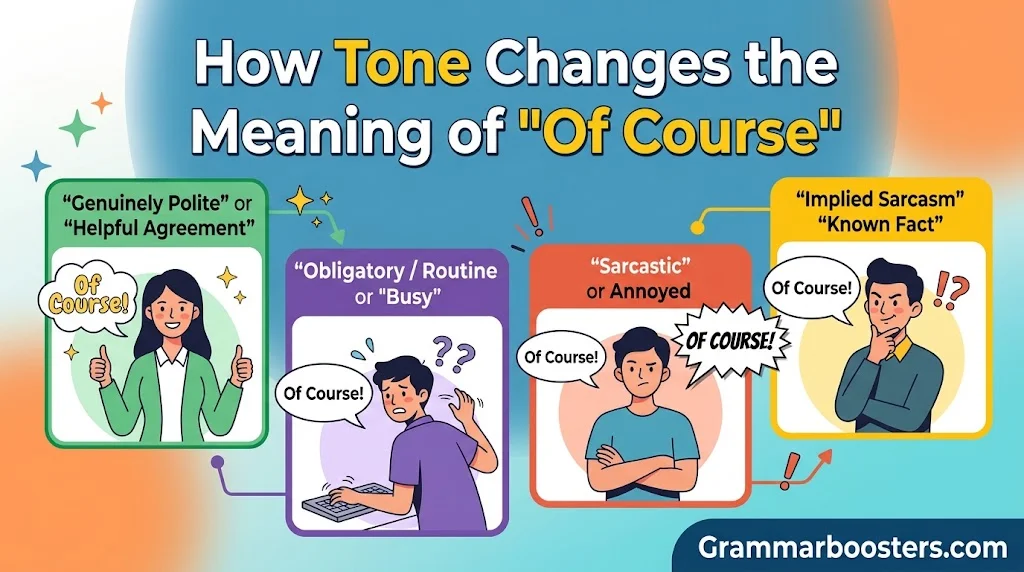
One of the most interesting features of of course is its sensitivity to tone.
The same two words can communicate warmth, certainty, irritation, or sarcasm.
Friendly
Of course! I’d love to help.
This sounds enthusiastic and welcoming.
Neutral
Of course. The meeting begins at nine.
This simply confirms information.
Reassuring
Of course not. Don’t worry about it.
Here, the phrase helps reassure the listener.
Sarcastic
Of course. Because that always works.
The speaker is clearly not expressing sincere agreement.
Potentially Dismissive
Of course you knew that.
Depending on delivery, this can imply that the other person’s knowledge was obvious.
This is why written communication requires care. Readers can’t hear facial expressions, vocal stress, or sarcasm.
Is “Ofcourse” Correct in Texting?
Of course remains the standard spelling even in texting.
Informal digital communication often contains abbreviations and shortcuts. Someone might write:
ofc, I’ll come
Here, ofc is an informal abbreviation for of course.
That doesn’t make ofcourse a standard spelling.
It’s useful to distinguish between:
Informal abbreviation:
ofc
Standard spelling:
of course
Misspelling:
ofcourse
A casual text may tolerate shortcuts that wouldn’t belong in formal writing. Still, if you’re practicing standard English, of course is the form to learn and use.
Is “Of Course” American or British English?
Of course is standard in both American and British English.
There is no American-versus-British spelling difference here.
| Variety of English | Correct form |
| American English | of course |
| British English | of course |
| Canadian English | of course |
| Australian English | of course |
English learners sometimes assume that every spelling question has an American and British version. This one doesn’t.
Whether you’re writing for a US classroom or communicating with someone in the UK, the standard spelling remains of course.
When Should You Avoid “Of Course”?
The expression is useful, but it isn’t necessary in every sentence.
Consider avoiding it when:
- It repeats information unnecessarily.
- It makes a statement sound condescending.
- It weakens a sentence that should be direct.
- It adds conversational filler to formal writing.
- It makes an unsupported claim sound self-evident.
- You have already used it several times nearby.
For example:
Of course, the report needs more data.
If the sentence simply states a requirement, you can write:
The report needs more data.
However, don’t remove of course mechanically. If the expression communicates reassurance, agreement, or expectedness, it may deserve to stay.
The goal is purposeful usage, not zero usage.
Case Study: Choosing the Right Response
Imagine a coworker sends this message:
“Could you send me the presentation before lunch?”
Several responses are possible.
| Response | Likely tone |
| Of course. | Friendly and willing |
| Certainly. | Polite and somewhat formal |
| Sure. | Casual |
| Absolutely. | Enthusiastic |
| Yes. | Direct and neutral |
| Obviously. | Potentially dismissive |
All six responses can communicate agreement, but they don’t create the same impression.
This small example demonstrates an important principle in English: grammar and vocabulary communicate both information and attitude.
Choosing the right expression means considering the relationship, setting, purpose, and likely interpretation.
Quick Comparison: “Of Course” vs. “Ofcourse” vs. “Off Course”
| Form | Correct? | Meaning | Example |
| of course | Certainly; naturally; obviously | Of course, I’ll help. | |
| ofcourse | Misspelling | Ofcourse, I’ll help. | |
| off course | Away from an intended route or plan | The ship went off course. |
This table provides the simplest answer to the spelling question.
If you mean certainly, write of course.
If you mean away from a route or plan, write off course.
If you’re considering of course, separate the words.
Easy Ways to Remember “Of Course”
A few simple memory tricks can make the correct spelling automatic.
Remember the Two-Word Pattern
Think:
of + course = of course
The expression contains two words.
Compare It With Similar Expressions
Remember other common phrases that stay separate:
- in fact
- at least
- for example
- in general
- of course
Their frequency doesn’t turn them into single words.
Use a Quick Proofreading Test
If you’ve typed ofcourse, stop and ask:
“Would I normally combine of with this noun?”
For course, the answer is no.
Change it to:
of course
Memorize One Correct Sentence
Of course, I’ll help you.
A familiar model sentence can make the correct spelling easier to recall.
Common Learner Questions About “Of Course”
Is “of course” one word or two?
Of course is two words. The expression is written with a space between of and course in standard English.
Is “ofcourse” grammatically correct?
No. Ofcourse isn’t the standard written form. It may appear as an online typo or informal error, but standard English uses of course.
What is the correct spelling of “of course”?
The correct spelling is of course. For example: “Of course, I’ll be there.”
What does “of course” mean?
Of course can mean certainly, naturally, definitely, obviously, or yes. Its exact meaning depends on the context.
Should “of course” have a comma?
A comma often follows of course when it begins a sentence as an introductory expression. Commas can also surround it when it interrupts a sentence as a parenthetical expression. Punctuation depends on its role.
Can “of course” begin a sentence?
Yes. For example: “Of course, we can discuss the issue tomorrow.” When it functions as an introductory aside, a comma commonly follows it.
Is “of course” formal or informal?
Of course works in both formal and informal English. It’s common in conversation, professional communication, and general writing. In formal writing, use it when it adds genuine meaning rather than filler.
What’s the difference between “of course” and “certainly”?
Both can express certainty or agreement. Of course generally sounds more conversational, while certainly can sound more formal or deliberate.
What’s the difference between “of course” and “off course”?
Of course means certainly, naturally, or obviously. Off course means away from an intended route, direction, plan, or target.
Can “of course” sound rude or sarcastic?
Yes. Context and tone can change its effect. “Of course!” may sound warm, while “Of course you did” can sound sarcastic or dismissive.
Final Takeaway: “Of Course” or “Ofcourse”?
The correct choice is simple: of course.
Write the expression as two words when you mean certainly, naturally, obviously, or as expected. Ofcourse is a misspelling in standard English and should be corrected in professional, academic, and polished writing.
Don’t confuse it with off course, either. The two phrases have entirely different meanings. Of course expresses certainty or expectation, while off course describes movement away from an intended direction or plan.
There’s also more to using of course well than getting the spelling right. Pay attention to punctuation, context, tone, and audience. The phrase can sound friendly and reassuring in one sentence yet sarcastic or dismissive in another.
The easiest rule to remember is:
Correct: of course
Incorrect: ofcourse
Different meaning: off course
Keep of and course separate; use the phrase when it adds real meaning, and you’ll have both the spelling and usage right.
Conclusion:
When it comes to Of Course or Ofcourse, the correct standard spelling is “of course” always written as two separate words. The phrase is common in everyday English and can express agreement, obviousness, permission, or willingness depending on the context. Understanding its meaning and tone helps you use it naturally in conversations, emails, academic writing, and professional communication.
Remember that “ofcourse” is a common spelling mistake, not the standard form used in correct English. If you’re unsure, simply think of “of course” as a phrase made up of two words. Paying attention to this small detail can make your writing look cleaner and more polished. Whether you’re answering a question, agreeing with someone, or politely offering help, “of course” remains a useful and natural expression. Once you remember the two-word spelling, you won’t have to second-guess it again.
FAQs
Is “of course” or “ofcourse” correct?
“Of course” is the correct standard spelling in English. It consists of two separate words and should not normally be written as “ofcourse.” The one-word form is generally considered a spelling error. Use “of course” in formal writing, professional emails, academic work, social media posts, and everyday conversations.
Is “of course” one word or two words?
“Of course” is two words. The word “of” is a preposition, while “course” is a noun. Together, they form a common phrase with meanings related to certainty, agreement, obviousness, permission, or willingness. Although people sometimes type “ofcourse,” standard English requires the words to remain separate.
What does “of course” mean?
“Of course” can mean “certainly,” “naturally,” or “yes.” Its exact meaning depends on the context and tone. You might use it to agree with someone, show that something seems obvious, give permission, or express willingness to help. For example, “Of course I can help” shows agreement and willingness.
Can “of course” be used in a sentence?
Yes, “of course” can appear at the beginning, middle, or end of a sentence. For example, you could say, “Of course, I’ll help you,” or “She will, of course, attend the meeting.” It can also stand alone as a response, such as when someone asks, “Can I come with you?”
Should there be a comma after “of course”?
A comma is often appropriate when “of course” functions as an introductory or parenthetical expression. For example, “Of course, you’re welcome to join us.” However, punctuation depends on how the phrase functions in the sentence. When “of course” flows naturally without a pause, a comma may not always be necessary.
Is “ofcourse” ever correct English?
In standard modern English, “ofcourse” is not the accepted spelling of the phrase. You should write “of course” as two words. You may occasionally see “ofcourse” in informal online writing, usernames, or accidental misspellings, but those uses don’t make it a standard English word.
Is “of course” formal or informal?
“Of course” works in both formal and informal English. It’s common in everyday conversation and can also appear in professional communication. However, its tone depends on context. In some situations, alternatives such as “certainly” or “absolutely” may sound more formal or precise, especially in polished business writing.
What is the difference between “of course” and “off course”?
“Of course” and “off course” have completely different meanings. “Of course” expresses certainty, agreement, or willingness. “Off course” means that something has moved away from its intended route or direction. For example, “Of course, I’ll attend” differs completely from “The ship went off course.”
Can I use “of course” in a professional email?
Yes. “Of course” is perfectly acceptable in professional emails when the tone fits the situation. You might write, “Of course, I’d be happy to provide the report.” However, avoid using it in a way that could sound sarcastic, dismissive, or overly obvious. In sensitive situations, “certainly” may provide a more neutral tone.
How can I remember the correct spelling of “of course”?
An easy way to remember it is to treat “of course” as a two-word phrase, just like other common expressions. Think of the phrase as meaning “certainly” or “naturally.” Whenever you’re tempted to type “ofcourse,” pause and separate the words: of + course. This simple habit helps prevent the common spelling mistake.

I’m Nauman Anwer, a passionate English language writer dedicated to making grammar, idioms, vocabulary, and writing concepts easy to understand for everyone. Through my articles, I simplify complex language topics into clear, practical lessons with real-world examples that readers can apply immediately. My goal is to help students, professionals, writers, and English learners build confidence in their communication skills. I focus on creating well-researched, accurate, and engaging content that follows current language usage while remaining easy to read. Whether you’re learning a new idiom, improving your grammar, or expanding your vocabulary, I strive to provide trustworthy resources that make English more approachable and enjoyable. Every article I publish is written with clarity, authenticity, and the reader’s success in mind.