Fair vs. good can be confusing because both words can describe something positively, but they don’t usually express the same level of approval. When fair describes quality, condition, or performance, it often means acceptable, average, or adequate. Good usually signals a stronger positive judgment.
For example, if someone says, “The used car is in fair condition,” you should expect noticeable wear or some limitations. If they say, “The car is in good condition,” they usually mean it has fewer problems and remains well-maintained. There’s another important distinction. Fair can also mean reasonable, just, or impartial. In “That’s a fair price,” the speaker isn’t saying the price is average. They’re saying it’s reasonable.
So, the short answer is: When fair and good describe quality on the same scale, good usually ranks higher. But fair can have a completely different meaning when it describes fairness, justice, or reasonableness. This guide explains fair vs. good in everyday English, product descriptions, reviews, workplace feedback, grading, credit scores, and other common contexts.
Fair vs. Good at a Glance
Fair usually means acceptable, average, or reasonable. Good usually means satisfactory, positive, or better than merely acceptable.
| Aspect | Fair | Good |
| General quality | Acceptable or average | Solid or satisfactory |
| Overall tone | Neutral to mildly positive | Clearly positive |
| Product condition | Noticeable wear or limitations may exist | Generally well-maintained |
| Performance | Adequate but may need improvement | Meets expectations well |
| Review | Lukewarm approval | Positive approval |
| Price | Reasonable or just | Favorable or attractive |
| Decision | Just or impartial | Not normally used to express fairness |
| Quality scale | Usually below good | Usually above fair |
The most important word in this table is context.
You can’t always decide what fair means by comparing it directly with good. In “fair condition,” the word describes quality. In “fair price,” it usually describes reasonableness.
What Does “Fair” Mean?
Fair has several meanings in English, but when it describes quality, it generally means acceptable without being especially impressive.
For example:
The hotel room was in fair condition.
This tells you the room was usable, but you probably shouldn’t expect it to look new or luxurious.
Similarly:
Her performance was fair.
This usually means her performance met a basic standard but had room for improvement.
However, fair can have a much more positive meaning:
The company offered a fair price.
Here, fair means reasonable or appropriate. It doesn’t mean the price was mediocre.
Other common meanings include:
- fair treatment = just or impartial treatment
- fair decision = a decision made without unfair bias
- fair opportunity = an opportunity that is reasonably equal
- fair weather = pleasant or reasonably favorable weather
- fair skin = relatively light skin
Because fair has several meanings, the surrounding words are essential.
What Does “Good” Mean?
Good is a broad adjective that usually describes something positively.
It can refer to quality, performance, health, usefulness, behavior, or results.
For example:
This is a good laptop.
The speaker considers the laptop satisfactory or pleasing in some important way.
She did a good job.
Her work met a positive standard.
He’s in good health.
His health is generally favorable.
That’s a good idea.
The idea appears useful or worthwhile.
Unlike fair, good usually communicates straightforward approval when it describes quality.
That doesn’t mean good equals perfect.
A good product can have minor flaws. A good performance can still have weak moments. A good meal doesn’t have to be unforgettable.
The Core Difference Between Fair and Good
When both words describe quality, performance, or condition, the main difference is the level of approval they communicate.
Fair = acceptable, average, or adequate.
Good = satisfactory, positive, or solid.
A useful general scale is:
Poor → Fair → Good → Very Good → Excellent
This isn’t a universal scoring system. A particular company or institution may define its ratings differently.
Still, the scale reflects the way many English speakers understand these words when they appear together.
Consider:
The service was fair.
This sounds restrained. The service was probably adequate, but the speaker isn’t enthusiastic.
Now compare:
The service was good.
This sounds clearly positive.
The difference isn’t dramatic in every situation, but it matters when someone is trying to communicate a precise judgment.
Why “Fair” Usually Ranks Below “Good”
When a rating system uses fair and good as levels of quality, fair normally comes first.
Imagine a used laptop listed as:
Fair condition
A buyer would reasonably expect more visible wear than from one listed as:
Good condition
Likewise:
His work was fair.
sounds less complimentary than:
His work was good.
The important qualification is “when they describe the same type of quality.”
You can’t apply this ranking to every use of the words.
For example:
That’s a fair decision.
doesn’t mean the decision is lower quality than a “good decision.” Here, fair means just or impartial.
Fair vs. Good in Everyday English
In ordinary conversation, fair often sounds more cautious than good.
Fair and Good Weather
Both expressions can describe favorable weather, but they aren’t identical.
We had fair weather during the trip.
This suggests the weather was reasonably pleasant or suitable.
We had good weather during the trip.
This sounds more positive and often suggests that the conditions worked well for the speaker’s plans.
For example:
The weather was fair, so we went for a short walk.
The conditions were acceptable.
The weather was good, so we spent the entire afternoon outside.
The conditions were favorable.
Fair and Good Performance
Performance provides one of the clearest contrasts.
His performance was fair.
This suggests an adequate result with noticeable room for improvement.
His performance was good.
This suggests he performed successfully and met expectations more strongly.
The same distinction works in sports:
The team had a fair season.
This sounds like an average or mixed season.
The team had a good season.
This suggests a successful season.
Fair and Good Results
Suppose someone asks about an exam:
How did you do?
I did fairly well.
This means the result was reasonably good.
But:
I got a good result.
gives clearer positive approval.
Notice that fairly well is different from simply saying something was fair. The adverb fairly can mean to a moderate degree.
That’s another reason learners should pay attention to the exact form of the word.
Fair and Good Service
Customer reviews often reveal the difference naturally.
The restaurant’s service was fair.
This sounds lukewarm. The basic service may have been acceptable, but the reviewer wasn’t impressed.
The restaurant’s service was good.
This communicates a more favorable experience.
If you want to write a useful review, however, don’t stop with the adjective.
Instead of:
The service was fair.
you could write:
The staff handled our order correctly, but the food took nearly 40 minutes to arrive.
The second version gives the reader something they can actually use.
Fair vs. Good as Quality Ratings
When fair and good appear in a rating system, their meaning becomes more structured.
A typical quality scale might look like this:
| Rating | General meaning |
| Poor | Serious problems or below an acceptable standard |
| Fair | Acceptable but noticeably limited |
| Good | Solid and satisfactory |
| Very Good | Strongly positive |
| Excellent | Exceptional |
This is a general model, not a universal standard.
A company may use its own definitions. A marketplace may have different condition categories. A school may use descriptive terms differently from a business.
What a Fair Rating Suggests
A fair rating commonly tells the reader:
- The item or performance is usable.
- It meets a basic standard.
- Noticeable weaknesses exist.
- Improvement may be needed.
- Expectations should remain moderate.
For example:
The camera received a fair rating because it works properly but has significant cosmetic wear and limited battery life.
That’s more informative than simply saying “fair.”
What a Good Rating Suggests
A good rating generally tells the reader that:
- The item performs satisfactorily.
- Major problems aren’t expected.
- The overall experience is positive.
- It meets ordinary expectations.
- Minor imperfections may still exist.
For example:
The camera received a good rating because it produces clear images, operates reliably, and has only minor cosmetic wear.
The rating becomes much more useful when the writer explains the reasons behind it.
Fair vs. Good Condition
Fair condition and good condition are especially important in secondhand buying and selling.
A condition label summarizes an item’s state, but it doesn’t tell the whole story.
What “Fair Condition” Means
A product described as being in fair condition generally has noticeable signs of use or limitations.
Depending on the product, that might include:
- visible scratches
- dents
- fading
- worn surfaces
- older components
- minor functional problems
- repairs
- stains
- reduced battery life
A fair-condition item can still work perfectly well.
For example:
The desk is in fair condition. It’s sturdy, but the surface has several deep scratches and some discoloration.
The desk isn’t necessarily defective. Its appearance simply shows considerable use.
What “Good Condition” Means
An item in good condition generally has fewer or less noticeable imperfections.
For example:
The desk is in good condition. It has a few light scratches but no structural damage.
The item doesn’t need to look brand-new to qualify as good.
That’s an important point for buyers.
Good condition does not mean perfect condition.
Fair vs. Good Condition in Used Products
Here’s how the distinction might work across common products:
| Product | Fair Condition | Good Condition |
| Smartphone | Visible scratches, worn battery, cosmetic damage | Minor wear and reliable operation |
| Laptop | Noticeable exterior wear or small issues | Well-maintained with minor marks |
| Car | Significant cosmetic wear or maintenance needs | Normal wear with good overall upkeep |
| Furniture | Scratches, stains, or visible wear | Clean with limited signs of use |
| Clothing | Fading, stains, or small defects | Lightly worn and generally clean |
These descriptions aren’t universal grading rules. The seller or marketplace may define its own categories.
Why Specific Details Matter More Than the Label
Imagine two listings.
Listing A:
Fair condition.
Listing B:
Fair condition. Screen works normally, but the phone has deep scratches on the back and the battery doesn’t last a full day.
Listing B is much more useful.
The condition label gives you a quick summary. The details tell you what you’re actually buying.
Fair vs. Good in Buying and Selling
The difference can affect a buyer’s expectations, price comparisons, and willingness to purchase.
Used Cars
A fair-condition car might have:
- noticeable body damage
- worn upholstery
- older tires
- faded paint
- deferred maintenance
- higher mileage
A good-condition car may still show ordinary use, but its overall condition is likely stronger.
However, condition alone doesn’t determine a vehicle’s value.
A rare model in fair condition could be worth more than an ordinary vehicle in good condition. Mileage, service records, accident history, age, demand, and mechanical condition all matter.
Electronics
For electronics, functionality deserves more attention than appearance.
A phone with scratches but excellent battery performance may be more useful than a beautiful phone with a failing battery.
So when you see:
Good condition
look for information about:
- battery health
- screen damage
- ports
- cameras
- speakers
- buttons
- charging
- software
- included accessories
The adjective is only a starting point.
Furniture and Clothing
For furniture, inspect structural problems as well as appearance.
For clothing, look for:
- stains
- tears
- missing buttons
- fading
- stretched fabric
- altered seams
A seller who describes these details builds more trust than one who relies on a broad condition label.
Fair vs. Good Price
This is where the two words can mean something very different.
A fair price means a reasonable or justified price. A good price often means a favorable price for the buyer.
Compare:
$800 is a fair price for the laptop.
This means $800 seems reasonable given the laptop’s features, age, condition, and market value.
$800 is a good price for the laptop.
This suggests the buyer considers $800 attractive or better than expected.
A price can be both fair and good.
For example:
The laptop normally sells for $1,000, so $800 is a fair price and a good deal.
Here, fair emphasizes reasonableness, while good emphasizes the buyer’s advantage.
Fair vs. Good in Financial and Credit Contexts
Financial terminology requires extra care because Fair and Good can be formal categories rather than casual descriptions.
Fair and Good FICO Scores
According to FICO’s published score ranges, a standard FICO score from 580 to 669 is categorized as Fair, while 670 to 739 is categorized as Good. FICO’s score range runs from 300 to 850.
The categories are:
| FICO score | FICO category |
| Below 580 | Poor |
| 580–669 | Fair |
| 670–739 | Good |
| 740–799 | Very Good |
| 800–850 | Exceptional |
So in this specific system, moving from 669 to 670 crosses the published boundary between Fair and Good.
That doesn’t mean one point automatically transforms a person’s financial situation. It simply means the score falls into a different FICO category.
Why Credit Categories Need Context
A credit-score label isn’t a universal financial verdict.
Different lenders may use different scoring models, versions, data sources, and underwriting criteria. The Consumer Financial Protection Bureau explains that consumers can have multiple credit scores because different scoring models and lenders can produce different results.
Therefore, “good credit” doesn’t guarantee approval for every loan or the same interest rate from every lender.
The score is one part of a larger lending decision.
Fair vs. Good Credit: The Practical Difference
In the FICO framework, a Fair score generally indicates a weaker credit profile than a Good score.
That can matter because lenders use credit information when assessing risk.
However, the exact effect on:
- loan approval
- interest rates
- credit limits
- insurance pricing
- mortgage terms
depends on the specific lender, product, jurisdiction, and scoring model.
Don’t treat a score category as a promise.
Fair vs. Good in Workplace Feedback
The distinction matters in professional communication because descriptive words can affect how feedback is understood.
Compare:
Your report was fair.
and:
Your report was good.
The first sounds like the report met a basic standard but needs improvement.
The second sounds more clearly positive.
A Better Way to Give Professional Feedback
Instead of relying on one rating word, combine the evaluation with a specific observation.
For example:
Your report was good. The analysis was clear, but the conclusion could be more concise.
Or:
Your report was fair. You covered the required information, but several claims need stronger supporting evidence.
This approach is more useful because the employee knows what worked and what needs attention.
Fair vs. Good in Job Evaluations
In a formal workplace evaluation, never assume that fair and good have universal meanings.
An employer may define performance categories such as:
Needs Improvement → Meets Expectations → Exceeds Expectations
Another organization may use:
Unsatisfactory → Fair → Good → Excellent
The organization’s evaluation policy determines the official meaning.
Fair vs. Good in School and Academic Writing
Students encounter these words in teacher comments, grading rubrics, essays, and performance evaluations.
What “Fair” May Mean in Teacher Feedback
If a teacher writes:
Fair effort.
the comment may suggest that the student completed some of the work but could have shown greater effort.
If a teacher writes:
Good effort.
the comment is more clearly positive.
However, fair is not a universal grade.
It doesn’t automatically equal a particular letter grade or percentage.
Why Specific Feedback Works Better
Compare:
Fair essay.
with:
Your essay presents a clear argument, but the evidence needs stronger explanation.
The second comment gives the student a practical next step.
For ESL learners especially, specific feedback helps distinguish between quality, accuracy, clarity, and completeness rather than lumping everything into one vague label.
Fair vs. Good in Reviews
Reviews often rely on these words to communicate a quick overall judgment.
“It Was Fair”
If someone says:
The movie was fair.
the likely meaning is:
It was acceptable, but it wasn’t especially impressive.
The statement sounds restrained.
“It Was Good”
If someone says:
The movie was good.
the speaker is giving clearer approval.
They may recommend it, although the word itself doesn’t guarantee strong enthusiasm.
Why Tone Matters
Context and tone can change how a sentence feels.
It was fair.
Sounds neutral or lukewarm.
It was pretty fair.
Sounds moderately positive or reserved.
It was good.
Sounds positive.
It was really good.
Sounds more enthusiastic.
This is why English learners shouldn’t rely only on dictionary definitions. Pragmatic meaning—the meaning suggested by context and tone—matters too.
Fair vs. Good in Business Communication
The distinction can become especially useful in emails, reports, negotiations, and customer communication.
Talking About a Price
The proposed price is fair.
This sounds professional and diplomatic. You’re saying the price is reasonable.
The proposed price is good.
This can sound less precise. It may mean the price is favorable, but it doesn’t clearly communicate whether it’s reasonable for both sides.
For negotiations, fair is often the better choice when you mean reasonable.
Talking About Performance
Sales were good this quarter.
This clearly communicates a positive result.
Sales were fair this quarter.
This suggests an acceptable but less impressive result.
The words therefore serve different purposes even in the same professional setting.
Fair Does Not Always Mean Bad
A common mistake is assuming:
fair = bad
That’s incorrect.
The word often describes something that falls between poor and good when discussing quality, but it can also express a positive idea.
Consider:
The contractor gave us a fair estimate.
That’s not criticism.
The speaker means the estimate was reasonable.
Likewise:
The employee received fair treatment.
This means the employee was treated justly.
Fair Can Mean “Reasonable”
That’s a fair offer.
The offer seems reasonable.
Fair Can Mean “Just”
Everyone deserves a fair chance.
Everyone deserves a reasonable and impartial opportunity.
Fair Can Mean “Adequate”
His performance was fair.
His performance was acceptable but not outstanding.
The same spelling represents several related but distinct meanings.
Good Does Not Always Mean Excellent
Another common mistake is treating good as the highest possible compliment.
It isn’t.
A useful quality ladder is:
Poor → Fair → Good → Very Good → Excellent
For example:
The restaurant was good.
means the restaurant was satisfactory or enjoyable.
The restaurant was excellent.
means the experience was exceptional.
Good can therefore be strong praise without suggesting perfection.
A product can be good while still having:
- minor flaws
- ordinary features
- small cosmetic defects
- occasional limitations
That’s normal.
Fair vs. Good vs. Excellent
These three words often appear together in rating systems, but they represent different levels of evaluation.
| Word | Typical meaning |
| Fair | Acceptable but limited or average |
| Good | Clearly satisfactory or positive |
| Excellent | Outstanding or exceptional |
Imagine evaluating someone’s presentation.
Fair: The main information is present, but the presentation needs work.
Good: The information is clear, organized, and useful.
Excellent: The presentation is exceptionally clear, engaging, accurate, and polished.
The boundaries aren’t fixed. Still, this framework helps learners understand the usual progression.
Can Fair and Good Mean the Same Thing?
Sometimes their meanings can overlap, but they aren’t generally interchangeable.
For example:
The price is fair.
means the price is reasonable.
The price is good.
could mean the price is attractive or favorable.
Those ideas can coexist, but they aren’t identical.
Similarly:
The service was fair.
and:
The service was good.
both indicate that the service wasn’t necessarily terrible, but good expresses stronger approval when both are being used as quality judgments.
Common Mistakes With Fair and Good
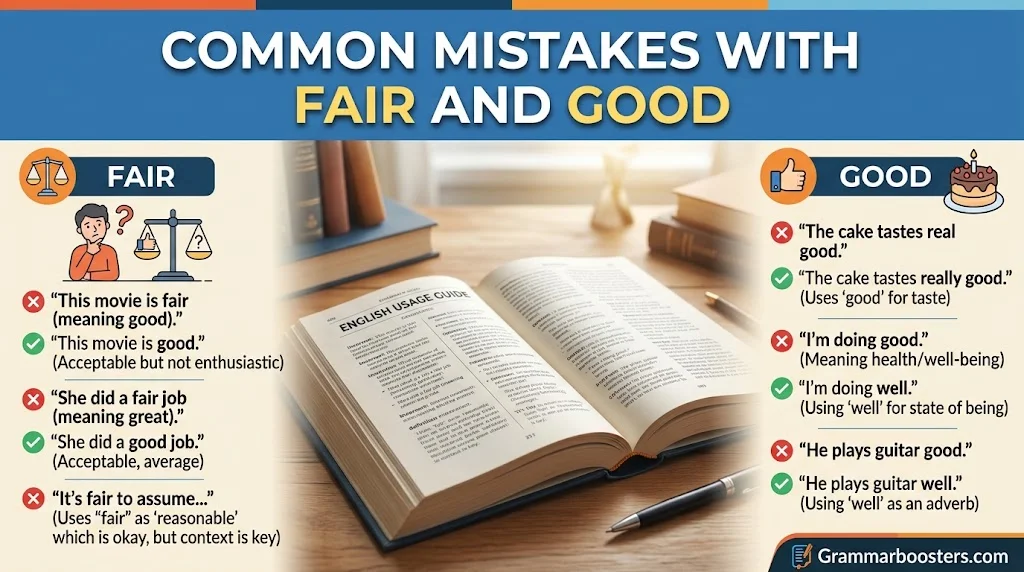
Understanding the difference becomes easier when you know the traps.
Mistake: Assuming Fair Always Means Low Quality
Incorrect:
Fair always means bad.
Better:
Fair can mean acceptable, average, reasonable, or just.
Mistake: Assuming Good Means Excellent
Incorrect:
Good means the best possible quality.
Better:
Good expresses positive quality but doesn’t necessarily mean exceptional.
Mistake: Treating “Fair Price” as an Average Price
Incorrect interpretation:
The price is fair = the price is average.
More accurate interpretation:
The price is fair = the price is reasonable or justified.
Mistake: Assuming Every Rating System Uses the Same Scale
A marketplace, school, employer, or financial institution may define its labels differently.
Always check the system’s own criteria when the rating has formal consequences.
Fair vs. Good: Choosing the Right Word
Use fair when you mean:
- acceptable
- average
- adequate
- reasonable
- just
- impartial
Use good when you mean:
- satisfactory
- positive
- useful
- favorable
- healthy
- successful
- high in quality
The right choice depends on what you actually want to say.
Use “Fair” for Reasonable Offers
That’s a fair offer.
Use this when you think the offer is reasonable.
Use “Good” for Favorable Offers
That’s a good offer.
Use this when the offer is attractive or favorable.
Use “Fair” for Moderate Quality
The apartment is in fair condition.
This suggests noticeable limitations.
Use “Good” for Stronger Quality
The apartment is in good condition.
This suggests better overall condition.
A Simple Decision Guide
When you’re unsure which word to use, ask yourself one question:
Am I talking about reasonableness, or am I rating quality?
If you’re talking about reasonableness or justice, fair is often correct.
That’s a fair deal.
If you’re rating quality or performance, good usually expresses stronger approval.
That’s a good deal.
If you’re describing a moderate or acceptable level of quality, fair may be more accurate.
The furniture is in fair condition.
If you’re describing stronger overall quality, use good.
The furniture is in good condition.
This simple distinction solves many common usage problems.
Quick Examples: Fair vs. Good
| Sentence | Meaning |
| The car is in fair condition. | The car is usable but shows noticeable wear or limitations. |
| The car is in good condition. | The car is generally well-maintained and has fewer significant problems. |
| That’s a fair price. | The price is reasonable. |
| That’s a good price. | The price is favorable or attractive. |
| Her performance was fair. | Her performance was acceptable but could improve. |
| Her performance was good. | Her performance was clearly satisfactory. |
| The movie was fair. | The movie was acceptable but not especially impressive. |
| The movie was good. | The movie was enjoyable or satisfactory. |
| He received fair treatment. | He was treated justly. |
| He is in good health. | His health is generally favorable. |
What Native Speakers Usually Hear
Native speakers generally understand fair and good through context rather than through a rigid numerical scale.
If someone says:
“The food was fair.”
the listener may infer that the food was okay but not memorable.
If someone says:
“The food was good.”
the listener hears a clearer positive judgment.
But:
“The restaurant charged a fair price.”
doesn’t sound like criticism at all.
It means the price was reasonable.
This contextual flexibility is one reason the words can confuse English learners. The dictionary meaning is only the starting point; the noun and situation complete the message.
Fair vs. Good: The Easiest Way to Remember It
Keep these two rules in mind:
Fair = acceptable, reasonable, or just.
Good = positive, satisfactory, or desirable.
When both words appear on a quality scale, fair normally comes below good:
Fair → Good → Very Good → Excellent
But when fair means reasonable or impartial, don’t put it on that quality ladder.
For example:
The price is fair.
means:
The price is reasonable.
It doesn’t mean:
The price is mediocre.
That distinction is the key to using the word naturally.
Conclusion:
Understanding Fair vs. Good becomes much easier when you focus on context. When these words describe quality, condition, or performance, fair usually means acceptable, average, or adequate, while good suggests a stronger and more positive result. However, fair can also mean reasonable, just, or impartial, as in “a fair price” or “fair treatment.” That meaning has little to do with a quality rating.
In everyday English, choosing the right word depends on what you want to communicate. If something meets a basic standard but has noticeable limitations, fair may be the better choice. If it performs well or creates a clearly positive impression, good usually fits better. Once you recognize these context clues, the distinction becomes straightforward. Whether you’re writing a review, describing a product, giving feedback, or improving your English, using fair and good precisely makes your meaning clearer.
FAQs
Is fair better than good?
When fair and good describe quality or performance on the same scale, good is generally considered better. Fair usually suggests something is acceptable or average, while good communicates stronger approval. For example, a fair performance meets a basic standard, whereas a good performance usually meets expectations more successfully. However, this comparison doesn’t apply when fair means reasonable or just.
Does fair mean bad?
No, fair does not necessarily mean bad. It can mean acceptable, average, reasonable, just, or impartial. For example, “The service was fair” may suggest adequate service with room for improvement. However, “The price was fair” usually means the price was reasonable. The meaning depends on the context and the noun that fair describes.
Is fair the same as average?
Fair can sometimes mean average, particularly when describing quality, ability, or performance. However, the two words aren’t always interchangeable. “His performance was fair” may suggest an acceptable but moderate result. In contrast, “a fair price” means a reasonable price rather than an average one. Always consider the surrounding context before interpreting fair.
What is the difference between fair and good quality?
Fair quality generally means acceptable quality with noticeable limitations, weaknesses, or signs of wear. Good quality suggests a stronger standard with fewer significant problems. For example, a used phone in fair condition may have visible scratches or reduced battery life, while a phone in good condition typically has fewer noticeable issues and remains well-maintained.
What does fair condition mean?
Fair condition usually means an item is still usable but shows noticeable wear, damage, age, or other imperfections. A used car might have cosmetic damage, worn upholstery, or maintenance needs while remaining functional. Because condition labels vary between sellers and marketplaces, look for specific details about defects rather than relying on the word fair alone.
What does good condition mean?
Good condition generally means an item is functional and relatively well-maintained with limited signs of use. It doesn’t necessarily mean the item looks brand-new or has no imperfections. A laptop, for example, can be in good condition while having a few light scratches. The phrase usually creates a more favorable expectation than fair condition.
Can fair and good mean the same thing?
Fair and good can overlap in some contexts, but they usually communicate different ideas. Fair often means acceptable, reasonable, or adequate, while good generally expresses stronger positive approval. For example, “a fair price” means a reasonable price, whereas “a good price” often suggests an attractive deal. Context determines whether the meanings are close.
What is the difference between fair, good, and excellent?
When used as quality ratings, fair, good, and excellent usually form a progression. Fair suggests acceptable or moderate quality, good indicates solid and satisfactory quality, and excellent describes outstanding quality. These labels aren’t universal, though. A company, school, marketplace, or organization may define its rating categories differently, so check the specific system when accuracy matters.
Is good the same as excellent?
No. Good and excellent both express positive quality, but excellent is stronger. Something good generally meets expectations or performs well. Something excellent goes beyond ordinary expectations and stands out for exceptional quality or performance. For example, a good presentation may be clear and organized, while an excellent presentation may be exceptionally engaging, polished, and memorable.
Should I use fair or good in a review?
Use fair when an experience was acceptable but had noticeable weaknesses or limitations. Use good when the overall experience was clearly positive. However, the most helpful review goes beyond either word. Explain what worked, what didn’t, and whether the experience met your expectations. Specific details make your review more useful and trustworthy.

I’m Sarah M, an English content specialist dedicated to helping people improve their grammar, spelling, vocabulary, and writing skills. I love answering common language questions and turning difficult grammar concepts into simple, reader-friendly lessons. My goal is to make English learning enjoyable and accessible for anyone who wants to become a better communicator.