If you’re wondering whether “much better” is grammatically correct, the short answer is yes. It’s a standard and very common English expression used to show that something has improved significantly or that one thing is noticeably better than another.
You’ll hear it much more often in everyday American conversations, professional discussions, classrooms, emails, reviews, and countless other situations. For example, someone might say, “I feel much better today,” or “This version is much better than the original.”
The confusion usually starts with the word much. Since better already compares two things, learners sometimes wonder whether adding another word before it creates a grammatical problem. It doesn’t. In fact, much + comparative adjective is a well-established grammatical pattern. This guide explains exactly how much better works, why more better is incorrect, when to use the phrase, how it differs from similar expressions, and how native American English speakers use it naturally.
Quick Answer: Is “Much Better” Grammatically Correct?
Yes, “much better” is grammatically correct.
The phrase combines:
- much — an intensifier that strengthens a comparison
- better — the comparative form of good and well
So, much better means considerably better, noticeably better, or significantly improved.
Compare these examples:
| Expression | Meaning |
| Good | Positive quality |
| Better | Higher quality than something else |
| Much better | Considerably higher quality than something else |
| Best | Highest quality among three or more possibilities |
For example:
This phone is better than my old one.
This simply tells you that the new phone has a higher level of quality.
This phone is much better than my old one.
Now the speaker emphasizes that the difference is substantial.
The phrase works perfectly in both speech and writing. You don’t need to replace it simply because it sounds conversational.
What Does “Much Better” Mean?
Much better describes a substantial improvement or a clear advantage over another condition, person, thing, method, or result.
The exact meaning depends on context.
Consider:
I feel much better today.
Here, much better means the person’s condition has improved noticeably.
Now consider:
This explanation is much better than the first one.
The phrase indicates that the second explanation provides a significantly better result.
In another situation, someone could say:
Your second draft is much better.
The speaker doesn’t necessarily mean the first draft was terrible. Instead, the second version shows a meaningful improvement.
Definition of “Much Better”
The basic structure is:
much + comparative adjective
In much better, better is the comparative form, while much increases the degree of comparison.
The phrase can express:
- significant improvement
- a noticeable difference
- stronger quality
- greater effectiveness
- increased comfort
- improved performance
- stronger preference
For example:
The new design looks much better.
She feels much better after resting.
This solution works much better.
The revised sentence sounds much better.
Each sentence describes an improvement or advantage.
“Much Better” in Simple English
A simple way to understand much better is:
“Better by a noticeable amount.”
Imagine two versions of the same product. Version A works reasonably well. Version B works dramatically better. You could describe Version B as much better.
The word much tells the reader that the difference isn’t tiny.
Compare:
The second explanation is better.
with:
The second explanation is much better.
The first statement identifies an improvement. The second emphasizes the size of that improvement.
Why Is “Much Better” Grammatically Correct?
The grammar becomes easier to understand once you look at how English forms comparisons.
The Comparative Form of “Good”
Good has an irregular comparative form.
It doesn’t become gooder.
Instead:
good → better → best
The three forms serve different purposes.
| Degree | Form | Example |
| Positive | good | This book is good. |
| Comparative | better | This book is better than that one. |
| Superlative | best | This is the best book here. |
The same basic pattern applies to well when it functions as an adverb:
She sings well.
She sings better than I do.
She sings the best in the group.
This irregular pattern is worth remembering because English learners sometimes try to construct gooder or more good. Standard English normally uses better instead.
How “Much” Modifies a Comparative
English allows certain degree words to strengthen comparative adjectives.
For example:
- much better
- much bigger
- much smaller
- much easier
- much harder
- much faster
- much slower
- much stronger
- much weaker
- much more useful
Here, much doesn’t create the comparison. The comparative adjective already does that.
Instead, much tells us the degree of difference.
Consider:
This route is faster.
That’s a basic comparison.
This route is much faster.
That’s a stronger comparison.
The same principle applies to better.
The new method is better.
The new method is much better.
The grammar remains completely sound.
“Much Better” vs. “Better”
The difference is mainly one of degree and emphasis.
| Sentence | What it communicates |
| The new version is better. | The new version has an advantage. |
| The new version is much better. | The new version has a noticeably larger advantage. |
| The new version is slightly better. | The improvement is small. |
| The new version is far better. | The improvement is substantial and strongly emphasized. |
This distinction matters because much better isn’t simply a longer way to say better. It adds information about the size of the difference.
“Much Better” vs. “More Better”: Which Is Correct?
One of the most common mistakes involving this expression is “more better.”
The standard form is:
much better ✓
Not:
more better ✗
Why “More Better” Is Incorrect
The problem is that better already expresses comparison.
The adjective good changes to better when it takes its comparative form. Adding more creates an unnecessary second comparative marker.
Think of it this way:
good → better
Once you have better, you don’t need more to make it comparative.
However, you can use much because it doesn’t duplicate the comparative. It intensifies it.
So:
much better ✓
more better ✗
much more better ✗
The last expression combines multiple comparative markers and isn’t standard English.
Common Double Comparative Mistakes
The same mistake appears with regular comparative adjectives.
For example:
| Incorrect | Correct |
| more easier | easier |
| more faster | faster |
| more bigger | bigger |
| more smaller | smaller |
| more stronger | stronger |
| more better | better |
You can use much to intensify these comparatives:
much easier
much faster
much bigger
much smaller
much stronger
much better
That’s the key distinction.
How to Use “Much Better” in a Sentence
The expression appears in several useful sentence patterns.
“Much Better Than” for Direct Comparisons
The most obvious structure is:
A + is + much better than + B
Examples:
This restaurant is much better than the one downtown.
Her second presentation was much better than the first.
This explanation is much better than the previous one.
Walking is much better than driving for this short trip.
The word than introduces the thing being compared.
“Much Better” Without “Than”
You don’t always need than.
When the comparison is already obvious from context, speakers often leave it unstated.
For example:
How are you feeling today?
Much better.
The listener understands that the speaker means much better than before.
Similarly:
What do you think of the revised design?
It’s much better.
The comparison is understood from the conversation.
This usage is especially common in everyday American English.
“Much Better Than Before”
This pattern clearly describes improvement over an earlier state.
Examples include:
The new system works much better than before.
I understand the topic much better than before.
The website loads much better than before.
She feels much better than before.
This construction works particularly well when discussing progress.
“Much Better at” + Activity or Skill
You can also use much better at before a noun or gerund.
Examples:
I’m much better at writing than I was last year.
She’s much better at explaining difficult ideas.
He’s much better at math now.
They’re much better at solving problems as a team.
Here, at connects the comparative phrase to the skill or activity.
“Much Better” in Everyday American English

Native speakers use much better in ordinary conversations all the time.
It doesn’t sound strange or excessively formal. In fact, it’s one of the easiest ways to communicate noticeable improvement.
Using “Much Better” in Conversations
Someone might ask:
“How’s your headache?”
You could respond:
“Much better.”
A coworker might ask:
“How does the new software work?”
You could say:
“Much better than the old version.”
A friend might ask:
“Do you like the new restaurant?”
You might answer:
“Yeah. It’s much better.”
These examples show why context matters. The phrase doesn’t always need a complete comparison because listeners can infer what you’re comparing.
“Much Better” for Describing Improvement
The phrase works especially well when something changes over time.
You might say:
Your pronunciation is much better.
The second draft is much better.
The patient feels much better today.
The new version performs much better.
The room looks much better after the renovation.
The underlying idea remains the same: the current state compares favorably with an earlier or alternative state.
“Much Better” for Opinions and Preferences
You can also use it when expressing a preference.
For example:
I think the blue one looks much better.
This title sounds much better.
The second option is much better for beginners.
Homemade bread tastes much better.
The speaker isn’t necessarily measuring the difference numerically. The phrase can communicate a strong subjective judgment.
“Much Better” in Formal and Informal Writing
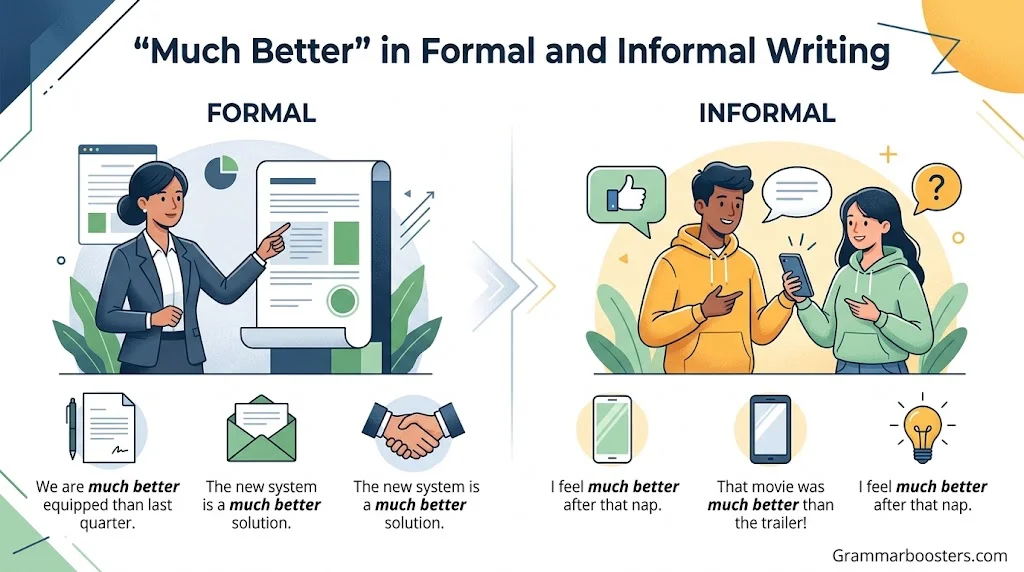
A common misconception is that much better sounds too casual for professional writing.
That’s not true.
The phrase is grammatically standard and can appear in formal writing when the context calls for it.
Is “Much Better” Appropriate in Formal Writing?
Yes.
For example:
The revised procedure produced much better results.
That’s perfectly acceptable in a professional report.
However, formal writing sometimes benefits from more precise language.
Instead of:
The new system is much better.
A technical report might say:
The new system produced significantly better results.
The second sentence provides a more analytical tone.
The choice depends on what you want to communicate.
Professional Alternatives to “Much Better”
When you need a more formal or precise expression, consider:
- significantly better
- considerably better
- substantially better
- markedly better
- noticeably better
- dramatically better
- meaningfully improved
These aren’t perfect substitutes in every sentence. Each carries a slightly different tone.
| Expression | Typical tone |
| much better | Neutral and conversational |
| a lot better | Conversational |
| way better | Very informal |
| far better | Strong, polished |
| significantly better | Formal or analytical |
| considerably better | Formal |
| substantially better | Formal and quantitative-sounding |
| markedly better | Formal and precise |
“Much Better” in Academic Writing
Academic writers can use much better, particularly when the comparison is clear.
Still, academic writing often benefits from explaining how something improved.
Instead of:
The second method is much better.
A stronger academic sentence might be:
The second method produced more consistent results and required less processing time.
That sentence doesn’t merely claim improvement. It explains the evidence behind the comparison.
This principle matters in professional and academic writing: specific evidence is usually stronger than vague evaluation.
“Much Better” vs. Similar Expressions
Several expressions communicate a similar idea. However, their tone and strength aren’t identical.
Much Better vs. Far Better
Both phrases indicate a significant difference.
This approach is much better than the old one.
This approach is far better than the old one.
Far better often sounds stronger and somewhat more polished.
Much better feels more neutral and conversational.
Much Better vs. A Lot Better
These expressions are often interchangeable in everyday American English.
This version is much better.
This version is a lot better.
Both indicate a noticeable improvement.
A lot better generally feels more conversational.
Much Better vs. Way Better
Way better is common in informal American speech.
For example:
This pizza is way better than the frozen one.
It’s natural in casual conversation, but it can sound too informal for a formal report or academic essay.
Use much better when you want a neutral option.
Much Better vs. Significantly Better
Significantly better sounds more formal and analytical.
For example:
The revised treatment produced significantly better results.
The word significantly can also suggest that the difference has been measured or supported by evidence, particularly in scientific contexts.
That’s why you shouldn’t automatically treat significantly better as an exact synonym for much better.
Much Better vs. Considerably Better
Considerably better communicates a substantial difference while maintaining a formal tone.
For example:
The revised process is considerably better for large-scale production.
It fits naturally in professional reports, evaluations, and analytical writing.
“Much Better” vs. “So Much Better”
At first glance, these expressions seem nearly identical. They are close, but so much better often carries more emotional emphasis.
What Does “So Much Better” Mean?
So much better emphasizes the speaker’s reaction.
Compare:
The new version is much better.
with:
The new version is so much better!
The second sentence often sounds more enthusiastic.
The word so adds emotional force.
“Much Better” vs. “So Much Better” in Conversation
Consider a friend trying two versions of a recipe.
“This one is much better.”
This sounds like a straightforward evaluation.
“This one is so much better!”
This sounds more excited or emphatic.
The grammatical structure is still correct in both cases.
“So Much Better” in Informal American English
You’ll frequently encounter so much better in conversations, reviews, social media, and personal writing.
For example:
The new layout is so much better!
I feel so much better now.
This explanation makes so much better sense.
One caution: the phrase doesn’t mean that so much and much are always interchangeable. The surrounding sentence determines the natural construction.
Other Natural Ways to Express “Much Better”
English gives you several options for expressing improvement.
A Lot Better
A lot better is natural and conversational.
This version is a lot better than the first one.
It works especially well in speech and informal writing.
Far Better
Far better is stronger and often sounds more polished.
The revised approach is far better for large projects.
It’s useful when you want to emphasize a clear difference.
Way Better
Way better is strongly conversational.
This one tastes way better.
It sounds natural among friends but may not suit formal documents.
Significantly Better
Significantly better works well when you want a formal or analytical tone.
The updated model delivered significantly better performance.
Considerably Better
Considerably better emphasizes a substantial difference.
The revised plan offers considerably better protection.
Common Mistakes With “Much Better”
Understanding the correct form is easier when you recognize the errors learners often make.
Using “Much Better” Without a Clear Comparison
This isn’t always an error.
In conversation, context can supply the missing comparison.
“How do you feel?”
“Much better.”
Everyone understands the implied comparison with the person’s earlier condition.
However, in formal writing, an unclear comparison can weaken the sentence.
Instead of:
The new policy is much better.
You might write:
The new policy is much better for small businesses because it reduces reporting requirements.
Now the reader understands better in what way.
Confusing “Much Better” With “Much Good”
The phrase much good doesn’t normally function as the comparative equivalent of much better.
You might encounter much good in specific constructions, such as:
This won’t do much good.
Here, good functions as a noun.
But when comparing quality, use better:
This method is much better.
Not:
This method is much good.
Saying “More Better”
As discussed earlier, more better is a double comparative.
Use:
much better ✓
far better ✓
considerably better ✓
significantly better ✓
Avoid:
more better ✗
Confusing “Better” and “Best”
Better and best aren’t interchangeable.
Better is comparative.
This option is better than that one.
Best is superlative.
This is the best option available.
You can say:
This option is much better than the other one.
But you wouldn’t normally say:
This option is much better than the other one.
The correct superlative construction is simply:
This is the best option.
Using “Much Better” When “Best” Is Needed
Consider three restaurants:
- Restaurant A is good.
- Restaurant B is better.
- Restaurant C is the best.
If you’re comparing A and B, better works.
If you’re saying C ranks highest among all three, best works.
Much better still compares two things or two states:
Restaurant B is much better than Restaurant A.
It doesn’t replace best.
“Much Better” in Different Sentence Patterns
The phrase fits several grammatical structures.
Affirmative Sentences
The new version is much better.
She is much better at explaining grammar now.
This solution works much better.
The revised paragraph reads much better.
Negative Sentences
You can place not before the phrase:
The second option isn’t much better.
This means the difference is small or insignificant.
Compare:
The second option is much better.
with:
The second option isn’t much better.
The second sentence suggests that the improvement isn’t substantial.
Questions
You can use the phrase naturally in questions:
Is this version much better?
Does the new system work much better?
Are you feeling much better now?
These questions ask whether a noticeable improvement has occurred.
Answers and Short Responses
Much better can function as a short conversational response.
“How’s your ankle?”
“Much better.”
The complete meaning is understood from the context.
This is a common feature of spoken English. People don’t always repeat information that their listener already understands.
Degrees of Comparison: Where “Much Better” Fits
Understanding degrees of comparison makes the phrase especially easy to remember.
Positive Degree: Good
The base adjective is good.
The movie is good.
There is no explicit comparison.
Comparative Degree: Better
The comparative form is better.
This movie is better than the first one.
Now the sentence compares two things.
Intensified Comparative: Much Better
Add much to strengthen the comparison.
This movie is much better than the first one.
The phrase now communicates a larger difference.
Superlative Degree: Best
The superlative form is best.
This is the best movie in the series.
The sentence identifies the highest level within a relevant group.
A useful visual summary is:
good → better → much better → best
However, remember that much better isn’t a separate degree of comparison. Grammatically, it remains a comparative phrase. The word much simply modifies the comparative adjective.
Real-World Examples of “Much Better”
The phrase becomes easier to understand when you see it in realistic situations.
At Work
Imagine an employee revising a report after receiving feedback.
“The first report had several unclear sections. The revised version is much better.”
The phrase communicates meaningful improvement without claiming perfection.
Another example:
“The new workflow is much better than the old process because it saves time.”
Here, the speaker gives the reason for the comparison.
In School
A teacher might say:
“Your second essay is much better organized.”
A student could say:
“I understand this concept much better now.”
Both examples describe improvement over an earlier state.
In Everyday Conversations
You might hear:
“This coffee is much better.”
“I feel much better today.”
“The weather is much better than yesterday.”
“This chair is much better for my back.”
These are completely natural uses in everyday American English.
In Customer Service
Suppose a customer receives a replacement product.
“The replacement works much better than the original.”
That’s a clear comparison between two products.
A customer-service representative might also say:
“I’m glad the replacement is working much better for you.”
The phrase remains polite, natural, and grammatically correct.
A Practical Case Study: Choosing the Right Comparative
Imagine that a student writes three versions of the same sentence:
Version A: The second explanation is better.
Version B: The second explanation is much better.
Version C: The second explanation is more better.
Only the first two are standard.
Version A says the second explanation has an advantage.
Version B emphasizes that the advantage is substantial.
Version C contains a double comparative and should be corrected to much better or simply better.
Now imagine that the student wants a formal academic tone:
The second explanation is significantly clearer and more effective.
That version provides more specific information than a general statement about something being “much better.”
The lesson is simple: choose the expression according to both grammar and purpose.
Quick Comparison Table: Which Expression Should You Use?
| Phrase | Correct? | Tone | Best use |
| much better | Yes | Neutral | Everyday and professional English |
| better | Yes | Neutral | Basic comparisons |
| far better | Yes | Strong/polished | Strong comparisons |
| a lot better | Yes | Conversational | Everyday speech |
| way better | Yes | Informal | Casual conversation |
| significantly better | Yes | Formal | Analytical writing |
| considerably better | Yes | Formal | Professional writing |
| more better | No | — | Avoid |
| much more better | No | — | Avoid |
How to Choose Between “Better” and “Much Better”
When you’re deciding which expression to use, ask one simple question:
How large is the difference?
If the difference is simply greater, use better.
This explanation is better.
If the difference is clearly noticeable, much better is appropriate.
This explanation is much better.
If you’re writing formally and need a more precise tone, choose a suitable alternative.
This explanation is significantly clearer.
The goal isn’t to make every comparison sound stronger. Good writing communicates the right degree of difference.
A Simple Rule to Remember
Keep this formula in mind:
good → better → much better
And remember:
much intensifies the comparative.
It doesn’t create another comparative.
That’s why:
much better ✓
works perfectly, while:
more better ✗
doesn’t.
You can use the same grammatical idea with many other comparative adjectives:
much easier
much faster
much stronger
much smaller
much more useful
The pattern is productive and completely normal in standard English.
Conclusion:
“Much better” is a completely correct and natural expression in American English. It combines the comparative adjective better with much, which strengthens the comparison and shows that the difference is noticeable or substantial. Whether you’re talking about health, performance, writing, appearance, quality, or personal preferences, the phrase fits comfortably into everyday and professional communication.
The key point to remember is that better already serves as the comparative form of good and well. That’s why “more better” isn’t standard English. When you want stronger emphasis, choose much better, far better, or significantly better depending on the tone and context.
Once you understand this simple pattern, using much better becomes easy. Listen to how the phrase works in real conversations, pay attention to the size of the comparison, and choose the wording that best matches your meaning. In most situations, “much better” is clear, natural, and perfectly grammatical.
FAQs
Is “Much Better” grammatically correct?
Yes, “much better” is grammatically correct in standard American English. The word better is the comparative form of good and well, while much intensifies the comparison. The phrase can describe a significant improvement or a clear difference between two things, situations, conditions, or results. It works naturally in both speech and writing.
What does “Much Better” mean?
“Much better” means noticeably or significantly better than something else or than before. The comparison may involve quality, condition, performance, appearance, comfort, or ability. For example, “I feel much better today” suggests a clear improvement from an earlier condition. The exact comparison can be stated directly or understood from the surrounding context.
Is “More Better” correct English?
No, “more better” is not standard English. The word better already expresses the comparative form, so adding more creates a double comparative. Instead, use better for a normal comparison or much better when you want to emphasize a substantial difference. For example, “This version is much better” is correct.
What is the comparative form of “Good”?
The comparative form of good is better, not gooder or more good. The complete comparison is good → better → best. Use good for a positive quality, better when comparing two things, and best when identifying the highest level within a relevant group. This irregular pattern is important to remember.
Can “Much Better” be used in formal writing?
Yes, “much better” can appear in formal writing because it is grammatically standard. However, professional or academic writing may sometimes benefit from greater precision. Depending on the context, expressions such as significantly better, considerably better, or substantially better can communicate a more analytical tone and may explain the degree of improvement more precisely.
What is the difference between “Much Better” and “A Lot Better”?
Both “much better” and “a lot better” can describe a noticeable improvement. The main difference is tone. Much better sounds neutral and works across many contexts, while a lot better tends to feel more conversational. For example, “The revised plan is much better” sounds neutral, while “The revised plan is a lot better” sounds more informal.
What is the difference between “Much Better” and “So Much Better”?
“Much better” usually gives a straightforward comparison, while “so much better” often adds stronger emotional emphasis. Compare “This version is much better” with “This version is so much better!” The second sentence sounds more enthusiastic. Both are correct, and your choice depends on whether you want a neutral evaluation or a more expressive reaction.
Can “Much Better” stand alone as a sentence?
Yes, “much better” can work as a conversational response when the comparison is clear from context. For example, someone might ask, “How are you feeling?” and the answer could be “Much better.” The complete meaning is understood as something like “I feel much better than before.” This shortened response is common in natural spoken English.
Is “Way Better” grammatically correct?
Yes, “way better” is common in informal American English. It emphasizes a substantial difference but sounds more casual than much better. For example, “This restaurant is way better than the other one” sounds natural in everyday conversation. In formal, academic, or professional writing, much better, far better, or significantly better may be more appropriate.
What is the difference between “Better” and “Much Better”?
“Better” indicates that one thing has a higher quality or level than another. “Much better” emphasizes that the difference is substantial or clearly noticeable. For example, “The second draft is better” gives a basic comparison, while “The second draft is much better” highlights greater improvement. The choice depends on how large the difference seems.

I’m Sarah M, an English content specialist dedicated to helping people improve their grammar, spelling, vocabulary, and writing skills. I love answering common language questions and turning difficult grammar concepts into simple, reader-friendly lessons. My goal is to make English learning enjoyable and accessible for anyone who wants to become a better communicator.