
Have you ever written “fullproof” and then stopped to wonder whether it should actually be “foolproof”? You’re not alone. These two spellings look and sound close enough to confuse, especially when you hear the word in fast conversation.
The correct spelling is foolproof when you mean something extremely reliable, easy to use, or unlikely to fail because of a mistake. Fullproof is generally a misspelling of foolproof when written as one word. There’s an important wrinkle, though. The phrase “full proof” can exist as two separate words when full describes the noun proof. That meaning differs completely from foolproof.
This distinction matters because English often contains words that sound alike or nearly alike while carrying different meanings. The spelling foolproof makes sense once you understand where the word comes from. So, if you need to describe a method that almost anyone can follow successfully, write “foolproof method,” not “fullproof method.”
Foolproof vs. Fullproof: The Quick Answer
Foolproof is the standard English spelling. It describes something designed to work correctly even when someone uses it incorrectly, makes mistakes, or has little experience.
Fullproof, written as one word, isn’t the standard spelling for this meaning.
Here’s the simplest comparison:
| Term | Correct? | Meaning |
| Foolproof | Yes | Very reliable, simple, or difficult to misuse |
| Fullproof | Generally no | Usually a misspelling of foolproof |
| Full proof | Sometimes | Complete or sufficient proof, depending on context |
Consider these examples:
This recipe is foolproof.
The recipe is so simple and reliable that it’s difficult to get wrong.
We need a foolproof system for checking every order.
The system should minimize mistakes and work reliably.
Now compare that with:
The evidence provides full proof of the claim.
Here, full modifies proof. The phrase means complete or sufficient proof. It doesn’t describe something difficult to misuse.
The easiest rule to remember
Foolproof = designed to prevent mistakes.
Full proof = complete or sufficient proof.
Fullproof = usually the wrong spelling when you mean foolproof.
That one distinction will solve most spelling questions involving these terms.
What Does “Foolproof” Mean?
Foolproof is an adjective that describes something designed to prevent errors or make failure unlikely, even when someone uses it carelessly or doesn’t have much experience.
The word can describe physical products, instructions, procedures, plans, methods, systems, recipes, strategies, and many other things.
For example:
- a foolproof recipe
- a foolproof plan
- a foolproof method
- a foolproof system
- a foolproof strategy
- a foolproof solution
- a foolproof way to organize files
- foolproof instructions
The word often carries the idea of simplicity plus reliability.
Imagine a coffee machine with only one button. You press it, and the machine produces coffee correctly every time. Someone might call that machine foolproof because the design leaves little room for user error.
The term can also have a broader figurative meaning.
If someone says:
“She has a foolproof plan for preparing for the exam.”
They aren’t claiming that the plan is literally impossible for a foolish person to break. They mean the plan is carefully designed, practical, and highly reliable.
Foolproof meaning in simple English
In simple terms, foolproof means very easy to use correctly or very unlikely to fail because of ordinary mistakes.
It often suggests that the person using something doesn’t need special skill.
For example:
The instructions are foolproof.
This means the instructions are so clear that most people can follow them without confusion.
However, foolproof doesn’t always mean literally impossible to fail. English speakers often use the word as an informal way to emphasize strong reliability.
That distinction is important.
A plan can be called foolproof while still having some theoretical possibility of failure. The word usually expresses confidence rather than a mathematical guarantee.
Foolproof Examples in Sentences
Seeing the word in different contexts makes its meaning much easier to recognize.
Everyday examples
This is a foolproof way to remember your passwords without writing them down.
My grandmother has a foolproof recipe for homemade bread.
The teacher created a foolproof system for collecting homework.
We need a foolproof way to keep track of customer orders.
His foolproof packing method saves him time before every trip.
Workplace examples
The company introduced a foolproof checklist to reduce shipping errors.
We need a foolproof process for reviewing invoices.
Her foolproof filing system makes every document easy to find.
Technology examples
The setup guide isn’t completely foolproof, but it works for most beginners.
The software includes a foolproof backup process that runs automatically.
Cooking examples
This foolproof cake recipe uses only a few ingredients.
The chef shared a foolproof method for cooking rice without burning it.
Notice how naturally foolproof comes before a noun. That’s one of its most common grammatical patterns.
Is “Fullproof” a Correct Word?
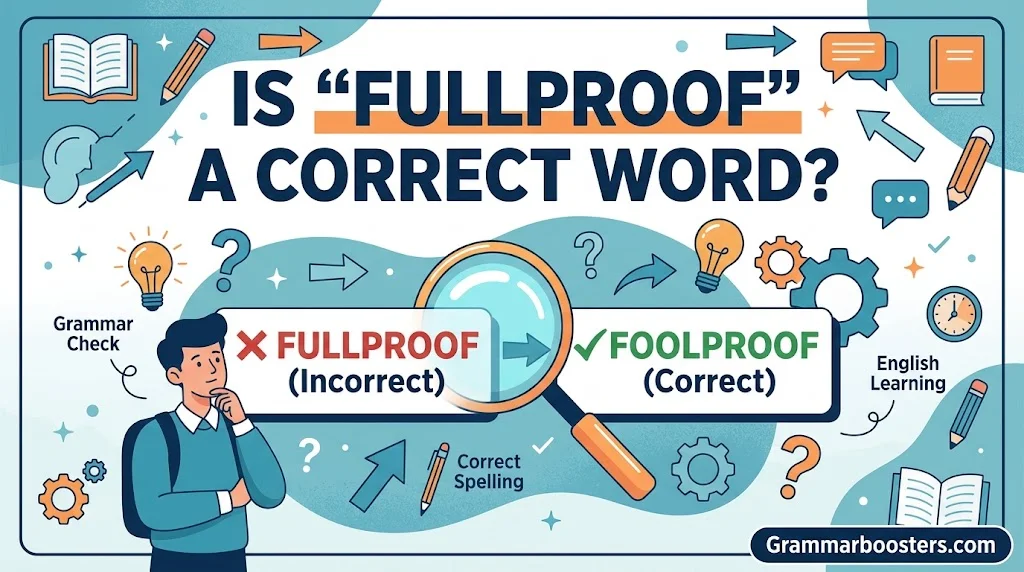
When you mean reliable, easy to use, or difficult to get wrong, fullproof is not the standard spelling.
The standard word is:
foolproof
So this sentence is incorrect:
This is a fullproof method.
The standard version is:
This is a foolproof method.
The confusion usually comes from the fact that fool and full can sound similar in ordinary speech. A listener may hear foolproof and mentally reconstruct it as fullproof.
English spelling doesn’t always follow pronunciation perfectly. That’s especially true when two familiar words sound close enough to overlap in casual speech.
Why do people spell foolproof as “fullproof”?
Several factors can encourage the mistake.
First, full is an extremely common English word. People already know phrases such as full proof, full payment, full coverage, and full support. The brain may therefore interpret foolproof as full + proof.
Second, foolproof contains the familiar word fool, but its meaning isn’t immediately obvious to every learner. Someone who hasn’t encountered the word in writing may naturally assume that fullproof means “completely proven.”
Third, pronunciation can blur the distinction. In many accents, the vowel sounds in fool and full are close enough to create confusion for listeners.
That doesn’t make the spellings interchangeable.
Foolproof vs. Fullproof: Key Differences
The clearest way to understand the difference is to put the terms side by side.
| Feature | Foolproof | Fullproof |
| Standard one-word spelling | Yes | No, for this meaning |
| Part of speech | Adjective | Not standard as a one-word adjective in this sense |
| Main meaning | Reliable and difficult to misuse | Usually a misspelling of foolproof |
| Example | “This is a foolproof plan.” | “This is a fullproof plan.” |
| Correct alternative | — | Use foolproof |
| Related phrase | — | full proof can have a separate literal meaning |
The difference becomes especially clear when you replace the word with a synonym.
This is a foolproof method.
You could say:
This is a reliable method.
Or:
This is a straightforward method.
But foolproof “ doesn’t carry that standard meaning.
Why Is “Foolproof” Spelled With “Fool”?
At first glance, foolproof can look like an unusual combination. Why would fool be connected with proof?
The compound makes sense when you think about the original idea behind the word.
Something described as foolproof is designed so that even a person who makes mistakes or lacks experience is unlikely to cause it to fail.
In other words, the design provides a kind of protection against ordinary human error.
The word combines:
- fool — a person who may make poor decisions or mistakes
- proof — resistant to a particular influence or condition
English has many compounds built around -proof:
- waterproof
- fireproof
- bulletproof
- soundproof
- weatherproof
- childproof
- foolproof
The ending -proof generally means “resistant to” or “protected against” whatever comes before it.
For example:
waterproof = resistant to water
fireproof = resistant to fire
soundproof = designed to block or resist sound
childproof = designed to reduce the risk of a child operating something improperly
foolproof = designed to resist mistakes or misuse
That pattern makes the spelling easier to remember.
The Etymology and History of “Foolproof”

Foolproof is a compound formed from fool and proof.
Historical dictionary sources place the word in the early twentieth century. The Oxford English Dictionary records early uses from the 1900s, while etymological references commonly date the word to around 1902.
The original concept was fairly literal: a mechanism, system, or design could be made so simple that even someone inexperienced or likely to make mistakes would have difficulty using it incorrectly.
Over time, the meaning expanded.
Today, people use foolproof in both practical and figurative contexts.
A physical device can be foolproof:
The lock has a foolproof safety mechanism.
A set of instructions can be foolproof:
The instructions are foolproof.
A strategy can be foolproof:
She developed a foolproof study routine.
The modern figurative sense is especially common in everyday English.
Why the word’s history helps with spelling
Understanding the original compound gives you a useful memory clue.
It isn’t:
full + proof
It’s:
fool + proof
The idea is that the thing is proof against foolish mistakes.
That connection is far more useful than memorizing the spelling letter by letter.
How to Use “Foolproof” Correctly
Foolproof functions primarily as an adjective.
It usually appears before a noun:
a foolproof method
a foolproof plan
a foolproof system
It can also appear after a linking verb:
The process is foolproof.
Her method seems foolproof.
The instructions aren’t completely foolproof.
Common grammatical patterns
Here are several patterns worth remembering:
foolproof + noun
We need a foolproof solution.
be + foolproof
The system is almost foolproof.
seem + foolproof
The procedure seems foolproof.
make + something + foolproof
The company redesigned the form to make it more foolproof.
almost/completely/nearly + foolproof
The new process is nearly foolproof.
These patterns work naturally in both everyday and professional writing.
Foolproof as an Adjective
Because foolproof is an adjective, it describes a noun or subject.
Compare:
The method is foolproof.
Here, foolproof describes method.
You can also place it before the noun:
The foolproof method saves time.
Both structures are grammatical.
However, don’t turn the word into an unnecessarily complicated phrase when a simple sentence works better.
Instead of:
The implementation of a foolproof methodology was undertaken by the team.
Write:
The team created a foolproof method.
The second version is clearer, shorter, and more natural.
Foolproof in Everyday English
The word appears across many areas of modern life because people constantly look for ways to reduce mistakes.
Cooking
Recipes often receive the label foolproof when they use simple steps and produce consistent results.
This is a foolproof recipe for beginners.
The word doesn’t guarantee that the dish can never go wrong. It suggests that the recipe makes common mistakes less likely.
Studying
A student might describe a study routine as foolproof if it provides a dependable sequence of tasks.
Her foolproof study plan starts with reviewing notes before attempting practice questions.
Work
Businesses often create checklists and procedures to reduce human error.
The manager introduced a foolproof checklist for closing the store.
Travel
A traveler might develop a foolproof packing system.
His foolproof packing list ensures that he never forgets his passport, charger, or medications.
Technology
Software designers often try to make interfaces as easy to use as possible.
The new setup process is almost foolproof.
This use highlights an important idea: foolproof design is often about reducing opportunities for error.
Foolproof vs. Fail-Safe: Are They the Same?
Foolproof and fail-safe overlap, but they aren’t exact synonyms.
Foolproof focuses mainly on preventing users from making mistakes or making something difficult to misuse.
Fail-safe focuses more on what happens when something fails.
Consider a machine.
A foolproof machine might have controls that make incorrect operation difficult.
A fail-safe machine might automatically shut down when a dangerous fault occurs.
Here’s the distinction:
| Term | Main Focus | Example |
| Foolproof | Preventing user mistakes | Simple controls prevent incorrect operation |
| Fail-safe | Limiting harm after failure | A machine shuts down during a dangerous fault |
| Reliable | Consistent performance | A system works correctly over time |
| Straightforward | Ease of understanding | Instructions are easy to follow |
The distinction becomes important in technical or safety-related writing.
Calling a safety system foolproof may sound informal. Fail-safe, fault-tolerant, or another technical term may communicate the engineering concept more precisely.
Foolproof vs. Idiot-Proof: Which Is Better?
You may also encounter idiot-proof.
The two expressions have similar meanings, but idiot-proof can sound insulting or unnecessarily harsh because it uses a negative label for a person.
Foolproof is usually the better choice when you want a neutral everyday expression.
For professional writing, even foolproof may sometimes sound informal.
Depending on the context, alternatives include:
- easy to use
- simple
- reliable
- straightforward
- error-resistant
- user-friendly
- fail-safe
- robust
For example:
The new interface is foolproof.
could become:
The new interface is easy to use.
Or, in technical documentation:
The system is designed to minimize user error.
The best choice depends on what you actually want to communicate.
Foolproof vs. Similar English Words
Several words overlap with foolproof, but each carries a slightly different shade of meaning.
| Word | Meaning | Example |
| Foolproof | Difficult to misuse or get wrong | A foolproof recipe |
| Reliable | Consistently performs well | A reliable car |
| Dependable | Can be trusted to work or perform | A dependable employee |
| Straightforward | Simple to understand or do | Straightforward instructions |
| Robust | Strong enough to handle problems | A robust software system |
| Fail-safe | Designed to limit danger after failure | A fail-safe mechanism |
| User-friendly | Easy and pleasant for users | A user-friendly website |
| Error-resistant | Designed to reduce mistakes | An error-resistant interface |
These aren’t always interchangeable.
For example, a person can be dependable, but calling a person foolproof would usually sound odd.
Likewise, software can be robust without being particularly easy to use.
Choosing the precise word makes your writing stronger.
Common Mistakes With “Foolproof”
The spelling problem is only one issue. Writers also sometimes misunderstand how the word works.
Writing “fullproof”
This is the most common error.
The instructions are fullproof.
The instructions are foolproof.
Writing “fool proof”
When you use the established adjective, write it as one word:
a fool proof system
a foolproof system
The two-word phrase can occasionally appear in historical or unusual contexts, but modern standard usage overwhelmingly favors foolproof as the compound adjective.
Assuming foolproof means absolutely impossible to fail
The word often expresses strong confidence. It doesn’t necessarily constitute a literal guarantee.
If a product has a tiny chance of malfunctioning, calling it foolproof can still work in casual language.
However, technical writing should use precise language when safety or performance guarantees matter.
Confusing foolproof with fail-safe
These terms overlap but describe different design goals.
A foolproof system tries to prevent misuse.
A fail-safe system tries to reduce danger when something goes wrong.
Using foolproof when “simple” is enough
Sometimes writers use foolproof when they simply mean easy.
For example:
The website has a foolproof design.
could be more precise as:
The website has a simple, user-friendly design.
Good writing depends on choosing the word that expresses the intended idea most accurately.
Foolproof in a Sentence: Correct vs. Incorrect Examples
Seeing incorrect and corrected sentences side by side makes the rule easy to remember.
| Incorrect | Correct |
| This is a fullproof plan. | This is a foolproof plan. |
| We need a fullproof method. | We need a foolproof method. |
| She created a fullproof system. | She created a foolproof system. |
| The recipe is fullproof. | The recipe is foolproof. |
| His strategy is almost fullproof. | His strategy is almost foolproof. |
More correct examples
The teacher developed a foolproof system for organizing assignments.
This foolproof recipe takes less than thirty minutes.
We need a foolproof backup plan before the event begins.
Her method isn’t completely foolproof, but it greatly reduces mistakes.
The app has a straightforward setup process that beginners can follow.
That last example also demonstrates an important point: sometimes straightforward communicates the idea better than foolproof.
Can “Full Proof” Ever Be Correct?
Yes, but full proof is different from foolproof.
This distinction causes much of the confusion.
When written as two separate words, full can modify the noun proof.
For example:
The lawyer presented full proof of the transaction.
Here, full means complete or sufficient. The phrase isn’t describing a system that is difficult to misuse.
However, full proof isn’t a replacement for foolproof.
Compare these sentences:
The company created a foolproof security procedure.
The procedure is designed to prevent mistakes.
The investigators requested full proof of ownership.
The investigators want complete evidence or proof.
The spelling changes because the meanings change.
Foolproof vs. full proof
| Expression | Meaning |
| foolproof | Reliable and difficult to misuse |
| full proof | Complete or sufficient proof |
| fullproof | Usually an incorrect spelling of foolproof |
This is a classic example of why spaces can matter in English.
Why Pronunciation Can Cause the Foolproof/Fullproof Confusion
English spelling often preserves historical forms that pronunciation doesn’t make obvious.
The words fool and full are particularly easy to confuse for some learners.
In many varieties of American English, they have different vowel sounds:
- fool contains the /uː/ vowel, as in food
- full contains the /ʊ/ vowel, as in book
The difference can be subtle for English learners, especially when speakers talk quickly.
That creates a common pathway for the spelling mistake:
Hear the word → interpret the sound → connect it with “full” → write “fullproof.”
The problem isn’t simply poor spelling. It comes from the complicated relationship between English pronunciation and English orthography.
That’s why seeing a word in context matters.
How to Remember the Correct Spelling of Foolproof
The easiest memory trick is to connect the spelling with the meaning.
Think:
Foolproof = fool + proof
The idea is that the design is proof against foolish mistakes.
You can also connect it to other -proof compounds:
- waterproof
- fireproof
- soundproof
- childproof
- foolproof
Once you recognize fool as the first part, the spelling becomes much easier.
A simple foolproof spelling trick
Remember this sentence:
A foolproof method protects against mistakes.
The word fool appears directly inside foolproof.
Don’t think:
full + proof
Think:
fool + proof
That small mental connection can prevent the spelling error.
Foolproof and the “-Proof” Word Family
Understanding the suffix -proof provides another useful spelling clue.
In English, -proof often means resistant to something.
Consider:
Waterproof
Designed to resist water.
Fireproof
Designed to resist fire or withstand high temperatures.
Soundproof
Designed to block or reduce sound.
Childproof
Designed to reduce the likelihood that a child can operate or access something improperly.
Foolproof
Designed to reduce the likelihood of mistakes or misuse.
This pattern isn’t perfectly literal in every modern use. English compounds evolve. Still, the pattern gives you a strong semantic clue.
Foolproof in Professional and Academic Writing
Foolproof is perfectly understandable in professional English, but it has an informal flavor.
In a business email, you might write:
I’ve created a foolproof checklist for the process.
That sounds natural and friendly.
In formal technical documentation, however, you may want something more precise:
The procedure is designed to minimize user error.
In an academic paper, alternatives such as reliable, robust, validated, or error-resistant may communicate the intended meaning more precisely.
Choose the word based on context.
Conversational:
This is a foolproof way to organize the files.
Professional:
This process provides a reliable way to organize the files.
Technical:
The interface is designed to minimize user input errors.
Academic:
The procedure provides a consistent method for reducing procedural errors.
All four sentences can describe a similar idea. Their tone and precision differ.
Foolproof vs. Reliable
These words often overlap, but foolproof emphasizes resistance to mistakes.
Consider a car.
The car is reliable.
This means the car generally works well and doesn’t frequently break down.
But:
The controls are foolproof.
This means the controls are easy to understand and difficult to operate incorrectly.
A thing can be reliable without being foolproof.
Likewise, something can be foolproof for beginners without being exceptionally durable or reliable over many years.
That’s why context matters.
Foolproof vs. Straightforward
Straightforward means easy to understand, uncomplicated, or direct.
Foolproof goes a step further by suggesting that the method is especially resistant to mistakes.
Compare:
The instructions are straightforward.
The instructions are easy to understand.
The instructions are foolproof.
The instructions are designed so that users are unlikely to make mistakes while following them.
The first focuses on clarity.
The second focuses more strongly on reliability and error prevention.
Foolproof vs. Robust
The word robust has become especially common in technical, business, and software contexts.
A robust system can handle unexpected conditions, errors, heavy workloads, or changes without breaking down easily.
A foolproof system is designed to make incorrect user actions difficult or unlikely.
For example:
The database has a robust backup architecture.
That tells readers about strength and resilience.
The application has a foolproof setup process.
That tells readers about ease of use and resistance to user error.
The distinction is subtle but valuable.
A Practical Case Study: Why “Foolproof” Matters
Imagine a restaurant that receives dozens of delivery orders each day.
Originally, employees write orders on paper. During busy periods, someone occasionally forgets a drink or enters the wrong quantity.
The manager creates a simple checklist:
- Confirm the customer’s name.
- Verify each item.
- Check quantities.
- Confirm drinks.
- Review special instructions.
- Mark the order complete.
The new checklist doesn’t make mistakes physically impossible.
Instead, it reduces the number of opportunities for mistakes.
Employees begin calling the system foolproof.
That usage captures the modern meaning perfectly.
The system works because it anticipates common human errors and makes them easier to catch.
The lesson
A foolproof design doesn’t need to assume that people are stupid.
In fact, good design recognizes something much more realistic:
People are busy, distracted, inexperienced, and occasionally forgetful.
A strong process accounts for those ordinary conditions.
That’s why the word appears so often in discussions about instructions, systems, procedures, and user experience.
Why “Foolproof” Doesn’t Mean “Impossible”
One subtle point deserves attention.
The word foolproof can sound absolute, but everyday English often uses strong adjectives less literally.
If someone says:
This recipe is foolproof.
They usually mean:
This recipe is extremely difficult to mess up.
They aren’t necessarily making a scientific claim that failure has a zero-percent probability.
This matters when writing about safety, engineering, medicine, finance, or other areas where absolute claims can mislead readers.
In those contexts, more precise wording may be better:
- designed to reduce errors
- minimizes user mistakes
- highly reliable
- resistant to common errors
- designed to prevent incorrect operation
Precision beats exaggeration when the stakes are high.
Common Collocations With Foolproof
Learning common word combinations can make your English sound more natural.
Here are some frequent combinations:
| Collocation | Example |
| foolproof method | We need a foolproof method for sorting the data. |
| foolproof plan | She developed a foolproof plan for the event. |
| foolproof system | The company created a foolproof ordering system. |
| foolproof solution | They found a nearly foolproof solution. |
| foolproof strategy | He used a foolproof strategy to prepare for the interview. |
| foolproof instructions | The manual contains foolproof instructions. |
| foolproof way | Here’s a foolproof way to organize your schedule. |
| foolproof recipe | This is a foolproof recipe for beginners. |
| foolproof process | The team designed a foolproof process for quality checks. |
| foolproof design | The device has a simple, foolproof design. |
These combinations are useful because they show how native English speakers commonly use the adjective.
Synonyms for Foolproof
Depending on the context, several alternatives can replace foolproof.
Reliable
Use reliable when something consistently works well.
The new system is reliable.
Dependable
Use dependable when you want to emphasize trust.
We need a dependable backup system.
Straightforward
Use straightforward when something is easy to understand or perform.
The application process is straightforward.
User-friendly
Use user-friendly when discussing products, software, websites, or interfaces.
The new website has a user-friendly layout.
Robust
Use robust when something can withstand problems or demanding conditions.
The company needs a robust security system.
Error-resistant
Use error-resistant when you specifically want to emphasize prevention of mistakes.
The form uses an error-resistant design.
Fail-safe
Use fail-safe when the system is designed to reduce danger or damage if something fails.
The machine has a fail-safe shutdown mechanism.
These alternatives aren’t interchangeable in every sentence. Choose based on the exact meaning you want to express.
Foolproof or Fullproof: A Quick Editing Checklist
Before publishing or submitting your writing, use this quick check.
- Do you mean difficult to misuse or get wrong?
- Write foolproof.
- Are you describing something as complete proof?
- You may need full proof as two words.
- Did you write fullproof to mean reliable?
- Change it to foolproof.
- Are you describing a technical safety mechanism?
- Consider whether fail-safe is more precise.
- Are you simply saying something is easy?
- Straightforward or easy to use may be better.
- Are you writing formal technical material?
- Consider error-resistant, robust, or another precise term.
Foolproof vs. Fullproof: Frequently Asked Questions
Is “foolproof” one word?
Yes. Foolproof is normally written as one word when it functions as the adjective meaning reliable, simple, or difficult to misuse.
For example:
She created a foolproof plan.
Is “fullproof” a real English word?
Fullproof is generally not the standard one-word spelling when you mean foolproof. In that context, use foolproof.
The separate phrase full proof can occur when full modifies the noun proof, but that has a different meaning.
Is “foolproof” or “fullproof” correct?
Foolproof is correct when you mean something very reliable or difficult to get wrong.
This is a foolproof method.
Fullproof is normally a misspelling in this context.
Why do people write “fullproof”?
The mistake often comes from pronunciation and meaning. Fool and full sound similar to many English learners, while fullproof may seem logically connected to the idea of “complete proof.”
The established spelling, however, is foolproof.
Does foolproof mean impossible to fail?
Not necessarily. In everyday English, foolproof usually means extremely reliable or difficult to misuse.
It often expresses strong confidence rather than a literal guarantee that failure is impossible.
Can “full proof” be correct?
Yes. Full proof can be grammatically possible when full means complete or sufficient and modifies the noun proof.
It doesn’t mean the same thing as foolproof.
Is foolproof formal English?
Foolproof is standard English, but it often has a conversational or informal tone.
In formal technical writing, alternatives such as reliable, robust, error-resistant, or designed to minimize user error may offer greater precision.
What is another word for foolproof?
Depending on the context, alternatives include reliable, dependable, straightforward, user-friendly, robust, error-resistant, and fail-safe.
Each carries a slightly different meaning, so choose the one that best matches your context.
Is foolproof the same as fail-safe?
No. Foolproof generally focuses on preventing user mistakes or misuse. Fail-safe focuses on limiting danger or damage when a system fails.
The terms can overlap, but they’re not exact synonyms.
How can I remember the spelling of foolproof?
Break it into:
fool + proof
Think of something designed to be proof against foolish mistakes. This connection makes the correct spelling easier to remember.
Can foolproof describe a person?
Usually, foolproof describes a method, system, process, plan, device, set of instructions, or similar thing.
It generally doesn’t describe a person naturally.
Instead of:
She is foolproof.
say:
She is reliable.
or:
Her method is foolproof.
Final Takeaway: Foolproof or Fullproof?
When you’re deciding between foolproof or fullproof, the answer is straightforward: foolproof is the standard spelling when you mean something that’s highly reliable, simple to use, or difficult to get wrong.
The spelling makes more sense when you break the word apart: fool + proof. The original idea centers on creating something that remains usable even when someone makes ordinary mistakes or lacks experience.
Fullproof, written as one word, is generally a misspelling in this context. Don’t use it when describing a reliable plan, method, system, recipe, or process.
There is one useful exception to remember. Full proof can appear as two separate words when full means complete or sufficient and modifies proof. That’s a different construction with a different meaning.
So the quick rule is simple:
Foolproof = difficult to misuse or get wrong.
Full proof = complete or sufficient proof.
Fullproof = usually incorrect when you mean foolproof.
Once you connect foolproof with its meaning and word structure, the spelling becomes much easier to remember.
Conclusion:
When choosing between foolproof and fullproof, the correct spelling depends on the meaning you want to express. If you mean something reliable, simple, or difficult to use incorrectly, the correct word is foolproof. It combines fool and proof and describes something designed to reduce mistakes or prevent misuse. Fullproof, written as one word, is generally a misspelling of foolproof.
There is, however, a useful distinction to remember. Full proof can appear as two separate words when full means complete or sufficient and describes the noun proof. That meaning has nothing to do with a foolproof method or system. The easiest way to remember the difference is simple: foolproof means difficult to get wrong. Whether you’re describing a recipe, plan, process, system, or set of instructions, use foolproof when reliability and ease of use are the main ideas.
FAQs
Is foolproof or fullproof correct?
Foolproof is the correct standard spelling when you mean something that is reliable, easy to use, or difficult to get wrong. Fullproof is generally a misspelling in this context. For example, “This is a foolproof method” is correct. The separate phrase full proof can have a different meaning when full describes complete or sufficient proof.
What does foolproof mean?
Foolproof means something is designed to be very reliable, simple to use, or difficult to misuse. It often describes methods, plans, systems, instructions, recipes, and processes. For example, “She created a foolproof plan” means her plan is carefully designed to prevent common mistakes and make successful results more likely.
Why do people confuse foolproof and fullproof?
People often confuse foolproof and fullproof because the words fool and full can sound similar, especially in fast speech or for English learners. The spelling fullproof may also seem logical because “full” can suggest completeness. However, the established English word meaning reliable or difficult to misuse is foolproof.
Why is foolproof spelled with fool?
Foolproof comes from the combination of fool and proof. The original idea describes something designed to remain effective even when someone makes mistakes or lacks experience. The word follows a pattern found in compounds such as waterproof and fireproof. Thinking of it as fool + proof makes the spelling easier to remember.
Can full proof ever be correct?
Yes, full proof can be correct when written as two separate words and used literally. In that construction, full describes proof and means complete or sufficient. It doesn’t mean reliable or difficult to misuse. Therefore, “full proof” and “foolproof” should be treated as different expressions with different meanings.
Is foolproof formal or informal English?
Foolproof is standard English and works well in everyday and professional communication. However, it can sound somewhat conversational. In highly technical or formal writing, alternatives such as reliable, robust, error-resistant, or designed to minimize user error may provide greater precision, especially when discussing safety, engineering, or software systems.
Is foolproof the same as fail-safe?
Not exactly. Foolproof usually describes something designed to prevent users from making mistakes or misusing it. Fail-safe refers to a system designed to reduce danger or damage when something fails. The terms can overlap, but they emphasize different ideas. Choose foolproof for usability and error prevention, and fail-safe for failure protection.
What are some synonyms for foolproof?
Depending on the context, useful alternatives include reliable, dependable, straightforward, user-friendly, robust, error-resistant, and fail-safe. These words aren’t perfect substitutes in every sentence. For example, user-friendly emphasizes ease of use, while robust emphasizes strength and resilience. Choose the synonym that best matches the specific quality you want to describe.
How can I remember the spelling of foolproof?
The easiest way to remember foolproof is to break it into fool + proof. Think of something that is “proof against foolish mistakes.” This connects the spelling directly to the meaning. Whenever you mean a method or system that’s difficult to get wrong, remember that the correct form contains fool, not full.

I’m Sarah M, an English content specialist dedicated to helping people improve their grammar, spelling, vocabulary, and writing skills. I love answering common language questions and turning difficult grammar concepts into simple, reader-friendly lessons. My goal is to make English learning enjoyable and accessible for anyone who wants to become a better communicator.