
At first glance, tear and tare sound the same, making them easy to confuse. However, these homophones have completely different meanings and are used in very different contexts. Tear usually refers to a drop of liquid from the eye, a rip in something, or the act of ripping. Tare, on the other hand, is a technical term used to describe the weight of an empty container that is subtracted from the total weight to calculate the net weight of its contents. Learning when to use each word correctly will improve your spelling, writing, and overall English communication.
Whether you’re an English learner, student, teacher, writer, or someone working in shipping or manufacturing, understanding the difference between tear and tare will help you avoid common mistakes. In this guide, you’ll learn their meanings, pronunciation, grammar, real-life examples, memory tricks, and practical usage tips so you can choose the correct word with confidence.
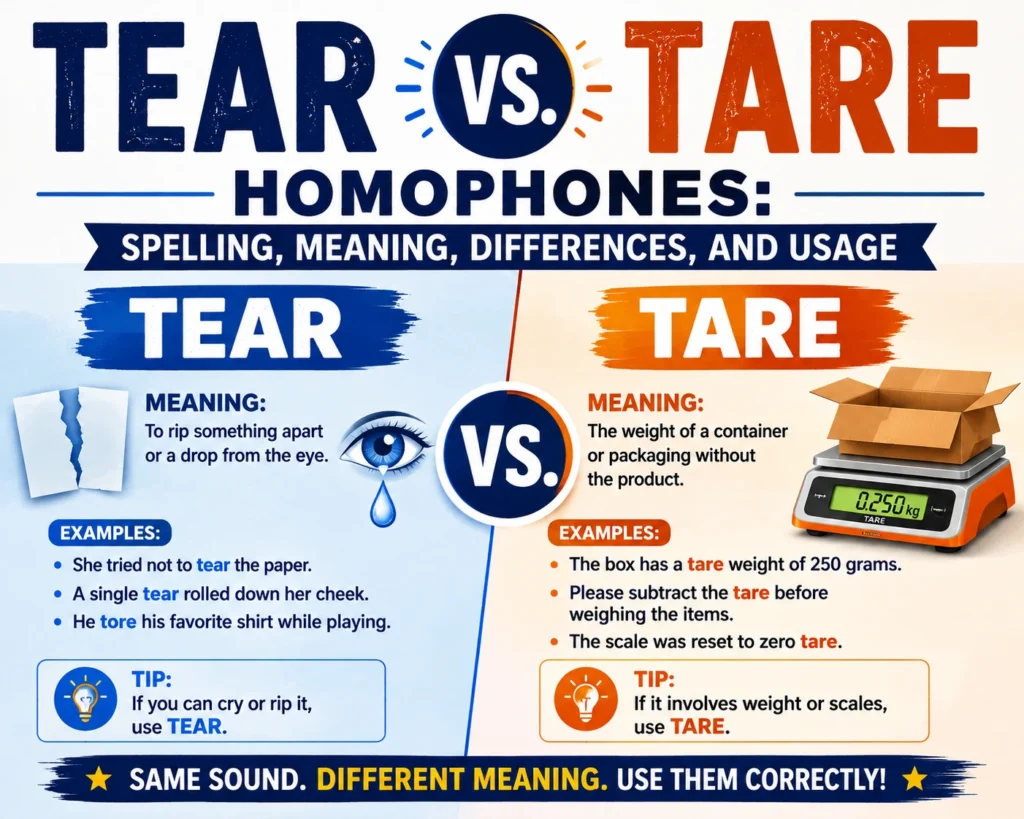
Tear vs. Tare at a Glance
The table below highlights the key differences between these commonly confused homophones.
| Feature | Tear | Tare |
| Pronunciation | /teər/ | /teər/ |
| Part of Speech | Noun, Verb | Noun, Verb (technical) |
| Primary Meaning | A drop from the eye or to rip something | The weight of an empty container |
| Common Context | Everyday English, emotions, literature | Shipping, logistics, manufacturing, weighing |
| Frequency | Very common | Less common and technical |
| Example | She wiped away a tear. | Remove the tare weight before weighing the shipment. |
| Quick Answer: Although tear and tare are pronounced the same, they are never interchangeable. The correct choice depends entirely on the context of the sentence. |
Why People Confuse Tear and Tare
The main reason these words are confused is that they are homophone words that share the same pronunciation but differ in spelling and meaning. When you hear them spoken, only the surrounding context tells you which word is intended.
Several factors make this pair especially challenging:
- They have identical pronunciation.
- Their spellings differ by only one letter.
- Tear has multiple meanings in everyday English.
- Tare is mainly used in technical fields such as shipping, logistics, retail, and manufacturing.
- Spell-check tools often fail to detect the mistake because both words are correctly spelled English words.
Compare these examples: - Correct: She wiped away a tear after hearing the news.
- Correct: The warehouse deducted the tare weight before calculating the shipment.
Replacing one word with the other completely changes the meaning of the sentence.
Why Learning Homophones Matters
Homophones are a common source of spelling errors because they sound alike but represent different ideas. Understanding them helps you:
- Write more accurately.
- Communicate more clearly.
- Avoid embarrassing mistakes in school or at work.
- Improve reading comprehension.
- Build stronger English vocabulary.
Instead of memorizing definitions alone, connect each word with the situations where it naturally appears. This makes remembering the correct spelling much easier and more reliable.
What Does “Tear” Mean?
Quick Answer: The word tear has several meanings in English. It can refer to a drop of liquid from the eye, the act of ripping something apart, or damage caused by ripping. The intended meaning depends entirely on the context of the sentence.
Because tear functions as both a noun and a verb, it is one of the most versatile words in everyday English. You’ll encounter it in conversations, books, newspapers, academic writing, and professional communication. Learning its different meanings helps you understand English more naturally and avoid confusion with its homophone, tare.
Tear as a Noun: A Drop from the Eye
The most familiar meaning of tear is a small drop of liquid produced by the eyes. Tears keep the eyes moist and healthy, but they also appear when people experience strong emotions such as sadness, happiness, relief, fear, or laughter.
Examples:
- A single tear rolled down her cheek.
- The happy news brought everyone to tears.
- He quickly wiped away a tear before speaking.
People produce tears for different reasons:
| Type of Tear | Purpose |
| Basal Tears | Keep the eyes lubricated and protect the surface of the eye. |
| Reflex Tears | Wash away dust, smoke, or other irritants. |
| Emotional Tears | Express feelings such as joy, sadness, relief, or frustration. |
Understanding these types can help learners recognize why the word tear often appears in emotional or descriptive writing.
Tear as a Verb: To Rip or Pull Apart
As a verb, tear means to pull, rip, or split something using force. The action may be accidental or intentional.
Examples:
- Please don’t tear the envelope.
- She accidentally tore her favorite jacket.
- Strong winds can tear roofs from buildings.
Because tear is an irregular verb, its forms change with tense:
| Tense | Form |
| Base Form | tear |
| Present Participle | tearing |
| Past Tense | tore |
| Past Participle | torn |
These forms are common in both spoken and written English, so practicing them will improve your grammar and vocabulary.
Other Common Meanings of “Tear”
English also uses tear in several extended meanings and expressions.
For example:
- A tear in fabric means a rip or hole.
- Someone on a tear is performing exceptionally well or acting with great energy.
- A vehicle may tear down the road, meaning it moves very quickly.
Although these meanings differ, the surrounding words make the intended meaning clear.
Common Expressions with Tear
Many everyday idioms include the word tear because it is closely connected with emotions and movement.
| Expression | Meaning |
| In tears | Crying heavily |
| Tear apart | Rip into pieces or strongly criticize |
| Tear up | Become emotional or begin crying |
| Tear down | Demolish a building or structure |
| Tear through | Move quickly through something |
| Learning these expressions will make your English sound more natural and help you understand conversations, movies, books, and news reports more easily. |
Real-Life Examples of Tear
Context makes the meaning of tear easy to recognize.
Emotion:
“She looked at the old photograph, and a tear slowly rolled down her face.”
Here, tear refers to a drop of liquid from the eye.
Damage:
“Be careful with the bag because the sharp edge could tear it.”
In this sentence, tear means to rip or damage something.
How Context Helps You Choose the Correct Meaning
Whenever you see the word tear, ask yourself these simple questions:
- Is someone crying?
- Is something being ripped or damaged?
- Is the sentence describing a hole or split?
- Is it part of a common expression?
Answering these questions usually reveals the correct meaning immediately. Instead of focusing only on spelling, pay attention to the surrounding words, because context is the key to understanding homophones accurately.
Quick Facts About Tear
| Fact | Information |
| Pronunciation | Same as tare in this guide |
| Part of Speech | Noun and Verb |
| Everyday Use | Extremely common |
| Main Meanings | Eye liquid, rip, damage |
| Common Contexts | Everyday English, literature, education, healthcare, media |
| Since tear appears far more often than tare in everyday English, mastering its meanings first gives you a solid foundation before learning the technical uses of tare. |
What Does “Tare” Mean?
Quick Answer: Tare is a technical term that refers to the weight of an empty container, package, or pallet. This weight is subtracted from the total (gross) weight to calculate the actual weight of the product, known as the net weight.
Unlike tare, which appears in everyday conversations, tare is mainly used in shipping, logistics, manufacturing, retail, laboratories, and other industries where accurate weight measurements are essential. Although most people don’t use the word daily, understanding it is valuable because it appears on digital scales, shipping documents, and product labels.
Tare Definition
A tare is the weight of an empty container that holds a product. Before determining how much the product itself weighs, the container’s weight must be removed from the total measurement.
For example:
- A box of coffee weighs 12 kg.
- The empty box weighs 2 kg.
- The tare weight is 2 kg.
- The net weight of the coffee is 10 kg.
By subtracting the tare weight, businesses measure only the product rather than its packaging.
Understanding Tare Weight
Every weighing process typically involves three measurements.
| Weight Type | Meaning |
| Gross Weight | Total weight of the product and its container |
| Tare Weight | Weight of the empty container or packaging |
| Net Weight | Weight of the product after subtracting the tare |
| The relationship between these measurements is simple: | |
| Net Weight = Gross Weight − Tare Weight | |
| This calculation is used worldwide in industries that rely on accurate weight measurements. |
Why Tare Weight Matters
Removing the tare weight ensures customers and businesses pay only for the product, not the packaging. Accurate tare calculations also improve business operations by reducing costly mistakes.
Benefits include:
- Accurate product pricing.
- Fair shipping charges.
- Better inventory management.
- Consistent product measurements.
- Improved customer trust.
- Compliance with industry regulations.
Even a small weighing error can become expensive when thousands of shipments are processed every day.
Tare in Shipping and Logistics
The shipping industry depends heavily on tare weight. Every container, crate, pallet, or carton adds extra weight that should not be included when calculating the weight of the goods.
Example:
A shipping container weighs 2,300 kg when empty. After loading cargo, the total weight becomes 18,900 kg.
| Measurement | Weight |
| Gross Weight | 18,900 kg |
| Tare Weight | 2,300 kg |
| Net Weight | 16,600 kg |
| Accurate tare measurements help shipping companies calculate freight costs, maintain inventory records, and meet transportation regulations. |
Tare in Manufacturing
Manufacturers regularly use tare weight to maintain precision during production.
Examples include:
- A bakery tares a mixing bowl before adding ingredients.
- A pharmaceutical company tares bottles before filling medicine.
- A paint manufacturer tares metal cans before packaging products.
This process improves product consistency while reducing waste.
Tare in Retail Stores
Many supermarkets and grocery stores use digital scales with a Tare button.
A typical process looks like this:
- Place the empty container on the scale.
- Press the Tare button.
- The display resets to zero.
- Add the product.
- The scale measures only the product’s weight.
This ensures customers pay only for the food or item they purchase rather than the container.
How the Tare Function Works
Modern electronic scales automatically subtract the container’s weight after the tare function is activated.
| Step | Action |
| 1 | Place the empty container on the scale. |
| 2 | Wait until the reading stabilizes. |
| 3 | Press the Tare button. |
| 4 | The display returns to zero. |
| 5 | Add the product. |
| 6 | Read the net weight directly. |
| This simple feature eliminates manual calculations and improves accuracy. |
Real-World Examples of Tare
Although many people don’t notice it, tare weight is used every day in many industries.
Examples include:
- Shipping companies weighing freight.
- Grocery stores selling fresh produce.
- Coffee shops measuring coffee beans.
- Laboratories weighing chemicals.
- Farmers weighing harvested crops.
- Jewelry stores measuring precious metals.
Wherever products are weighed inside a container, the tare function helps ensure accurate measurements and fair pricing.
Tear vs. Tare: Side-by-Side Comparison
Quick Answer: The easiest way to distinguish tear and tare is by their context. Tear relates to emotions, eyes, or ripping something apart, while tare refers to the weight of an empty container used in weighing and shipping.
The comparison below highlights their key differences.
| Feature | Tear | Tare |
| Pronunciation | /teər/ | /teər/ |
| Spelling | Tear | Tare |
| Main Meaning | A drop from the eye, a rip, or to rip something | The weight of an empty container |
| Part of Speech | Noun, Verb | Noun, Verb (technical) |
| Common Context | Everyday English, emotions, literature | Shipping, logistics, retail, manufacturing |
| Frequency | Very common | Less common and technical |
| Example | She shed a tear. | Remove the tare before weighing the package. |
| Although these words sound identical, their meanings never overlap. Reading the surrounding words will quickly reveal which spelling is correct. |
Pronunciation: Why Tear and Tare Sound the Same
Quick Answer: Tear and tare are homophones because they share the same pronunciation even though they have different spellings and meanings.
In wide varieties of English, both words are pronounced:
/teər/
Since pronunciation cannot distinguish them, readers and listeners must rely on context.
Compare these sentences:
- The little girl wiped away a tear.
- The operator entered the tare weight before shipping.
Although the words sound the same, the surrounding vocabulary makes their meanings clear.
What Is a Homophone?
A homophone is a word that has the same pronunciation as another word but differs in spelling, meaning, or both.
Here are a few common examples:
| Homophone Pair | Difference |
| Tear / Tare | Crying or ripping vs. container weight |
| Their / There | Possession vs. location |
| Brake / Break | Stop a vehicle vs. separate into pieces |
| Bear / Bare | Animal vs. uncovered |
| Weather / Whether | Climate vs. expressing a choice |
| Homophones often cause spelling mistakes because writers choose the word they hear instead of the one the sentence requires. |
Tips for Remembering the Difference
Simple memory tricks can make these homophones much easier to remember.
- If the sentence mentions eyes, crying, or emotions, choose tear.
- If it discusses ripping, fabric, or damage, choose tear.
- If it mentions a scale, container, package, or shipping, choose tare.
- If the topic is weight measurement, the correct word is tare.
Reading complete sentences rather than isolated words is the most reliable way to choose the correct spelling.
Spelling Differences Explained
Although only one letter changes, each spelling represents a completely different concept.
| Word | Associated Idea |
| Tear | Eyes, emotions, ripping, damage |
| Tare | Weight, scales, containers, packaging |
| A helpful memory trick is to connect the “a” in tare with amount or added packaging, both of which relate to weighing. Connect the “e” in tare with eye, since tears come from your eyes. |
Common Spelling Mistakes
Because both words are correctly spelled English words, spell-check software often fails to detect mistakes.
Incorrect: Remove the tear weight before shipping.
Correct: Remove the tare weight before shipping.
Incorrect: A tare rolled down her cheek.
Correct: A tear rolled down her cheek.
Always proofread by considering the sentence’s meaning instead of relying solely on spelling tools.
Meaning Differences with Real Examples
The easiest way to master these homophones is to compare them in everyday situations.
| Situation | Correct Word | Example |
| Someone is crying | Tear | He wiped away a tear. |
| Paper is ripped | Tear | Don’t tear the document. |
| A warehouse weighs cargo | Tare | Record the tare weight first. |
| A grocery scale is reset | Tare | Press the tare button before adding vegetables. |
| These examples show that the surrounding context naturally points to the correct spelling every time. |
Tear vs. Tare in Sentences
Quick Answer: The best way to remember the difference between tear and tare is to see them used in real sentences. Context makes the correct meaning obvious, even though the words sound identical.
The examples below demonstrate how each word is naturally used in everyday and professional English.
Sentences Using “Tear”
These examples show tear as both a noun and a verb.
As a Noun (a drop from the eye):
- A single tear rolled down her cheek.
- His speech brought many people to tears.
- She smiled through her tears after hearing the good news.
- The child wiped away a tear before returning to class.
- I noticed a tear in her eye during the ceremony.
As a Verb (to rip or pull apart): - Please don’t tear the pages from the book.
- He accidentally tore his favorite shirt.
- Strong winds can tear branches from trees.
- Be careful not to tear the wrapping paper.
- The dog tore the toy into pieces.
Sentences Using “Tare”
These examples illustrate the technical meaning of tare.
- The cashier pressed the tare button before weighing the fruit.
- Always subtract the tare weight from the gross weight.
- The shipping company recorded the tare before loading the cargo.
- The laboratory technician reset the scale using the tare function.
- We entered the tare value to calculate the product’s net weight.
Side-by-Side Comparison
Reading both words together helps reinforce their different meanings.
| Sentence with Tear | Sentence with Tare |
| She wiped away a tear. | The operator entered the tare weight. |
| Don’t tear the envelope. | Press the tare button before weighing. |
| He tore his jacket on a fence. | Remove the tare to find the net weight. |
| A tear fell onto the letter. | The package includes the tare weight. |
| They were moved to tears. | The digital scale automatically applies the tare. |
| Notice how tear is connected with emotions or ripping, while tare is always related to weighing and containers. |
Common Mistakes to Avoid
Because these words sound the same, learners sometimes choose the wrong spelling.
Here are some of the most common mistakes.
| Incorrect | Correct | Why? |
| Remove the tear weight. | Remove the tare weight. | Weight measurements require tare. |
| A tare rolled down her face. | A tear rolled down her face. | Tears come from the eyes. |
| Press the tear button. | Press the tare button. | Scales use a tare function. |
| Don’t tare the paper. | Don’t tear the paper. | Tear means to rip. |
| A quick context check can prevent nearly all of these errors. |
Quick Memory Tricks
Simple memory aids make these homophones much easier to remember.
- Tear = Eyes or Rip. Think of someone crying or tearing a piece of paper.
- Tare = Scale or Container. Think of weighing products before shipping or selling them.
- Tear often appears in stories, conversations, and emotional situations.
- Tare usually appears in technical, commercial, scientific, or industrial settings.
Another useful trick is to associate tare with the Tare button found on many digital kitchen and grocery scales.
Practice Exercise
Choose the correct word to complete each sentence.
- Please don’t ______ the important document.
- The grocery clerk pressed the ______ button before weighing the vegetables.
- A ______ rolled down his face as he said goodbye.
- The shipping company deducted the ______ weight from the total.
- She accidentally ______ her new dress while climbing the fence.
Answer Key
- tear
- tare
- tear
- tare
- tore.
If you answered all five correctly, you’ve mastered the difference between tear and tare and can confidently use each word in the appropriate context.
Tear vs. Tare Quiz
Test your understanding by choosing the correct word to complete each sentence.
Multiple-Choice Questions
1. A ______ rolled down her cheek after the emotional speech.
A. tare
B. tear
Answer: B. tear
2. Before weighing the vegetables, press the ______ button on the scale.
A. tear
B. tare
Answer: B. tare
3. Please don’t ______ the pages out of the notebook.
A. tare
B. tear
Answer: B. tear
4. The warehouse deducted the ______ weight before calculating the shipment.
A. tear
B. tare
Answer: B. tare
5. He accidentally ______ his jacket while climbing over the fence.
A. tore
B. tared
Answer: A. tore
Fill-in-the-Blank Practice
Choose tear, tare, tore, or tared to complete each sentence.
- The little boy wiped away a ______.
- Always remove the ______ weight before calculating the net weight.
- She accidentally ______ the gift wrapping.
- The digital scale was ______ before the ingredients were added.
- Don’t ______ the important document.
Answer Key
- tear
- tare
- tore
- tared
- tear
Frequently Confused Homophones Related to Tear and Tare
Many English learners confuse tear and tare with other words that sound similar. Learning these word pairs will strengthen your spelling and vocabulary.
| Word Pair | Difference |
| Tear / Tare | Crying or ripping vs. container weight |
| There / Their | Location vs. possession |
| Brake / Break | Stop a vehicle vs. separate into pieces |
| Piece / Peace | Portion vs. calm or harmony |
| Allowed / Aloud | Permitted vs. spoken aloud |
| Mail / Male | Postal service vs. gender |
| Right / Write | Correct or direction vs. produce written text |
| Mastering homophones improves both writing accuracy and reading comprehension because you’ll rely on meaning rather than pronunciation alone. |
Related Grammar Topics
If you’re learning English vocabulary and commonly confused words, these grammar topics can help deepen your understanding:
- Homophones in English
- Homonyms vs. Homophones vs. Homographs
- Commonly Confused Words
- American vs. British English Spelling
- Parts of Speech
- Irregular Verbs
- Countable and Uncountable Nouns
- Common English Vocabulary Mistakes
- Formal and Informal English
- Business English Vocabulary
Exploring these related topics will strengthen your overall command of English and help you avoid similar mistakes in both speaking and writing.
Final Tips for Remembering Tear vs. Tare
Before choosing between tear and tare, ask yourself one simple question:
Is the sentence about emotions or ripping, or is it about weighing something?
If the sentence involves crying, eyes, paper, fabric, or ripping, use tear. If it involves containers, scales, shipping, packaging, or net weight, use tare.
With regular reading and practice, you’ll begin recognizing the correct word automatically. Instead of memorizing definitions alone, pay attention to how each word is used in real life situations. This approach builds lasting confidence and helps you avoid one of the most common homophone mistakes in English.
Conclusion About Tear vs. Tare
Although tear and tare are pronounced the same, they have completely different meanings and are used in entirely different contexts. Tear is a common everyday word that refers to a drop from the eye, a rip, or the act of ripping something. Tare, in contrast, is a specialized term used in weighing, shipping, manufacturing, and retail to describe the weight of an empty container that is deducted to determine the net weight of its contents.
The easiest way to choose the correct spelling is to focus on the context. If the sentence is about emotions, eyes, paper, fabric, or damage, tear is the right choice. If it involves scales, packaging, containers, or weight calculations, use tare. By practicing with real-life examples, learning common expressions, and paying attention to context, you’ll confidently distinguish these homophones in both spoken and written English.
FAQs
What is the difference between tear and tare?
Tear refers to a drop from the eye, a rip, or the act of ripping something, while tare is the weight of an empty container that is subtracted from the total weight to determine the net weight of a product.
Are tear and tare pronounced the same?
Yes. Tear and tare are homophones, meaning they have the same pronunciation but different spellings and meanings.
What does tear mean in English?
Tear can be used as a noun to mean a drop of liquid from the eye or as a verb meaning to rip, pull apart, or damage something by force.
What does tare mean on a digital scale?
The tare function resets the scale to zero after an empty container is placed on it, allowing only the contents to be weighed accurately.
Is tare used in everyday conversation?
Not usually. Tare is primarily used in technical fields such as shipping, manufacturing, laboratories, grocery stores, and logistics.
Can tear be both a noun and a verb?
Yes. Tear functions as both a noun and a verb. As a noun, it refers to a drop from the eye or a rip. As a verb, it means to rip or pull something apart.
Why do people confuse tear and tare?
People confuse them because they sound exactly alike. Since both are correctly spelled English words, spell check tools may not detect mistakes, making context especially important.
What is tare weight?
Tare weight is the weight of an empty container or package. It is subtracted from the gross weight to calculate the net weight of the product inside.
How can I remember the difference between tear and tare?
Remember that tear is associated with eyes, crying, or ripping, while tare is connected with scales, containers, shipping, and weight measurements.
Are tear and tare interchangeable?
No. Although they share the same pronunciation, they have completely different meanings and should never be used interchangeably. Always choose the word that matches the context of your sentence.

I’m Ana L, an English language educator and content writer with a passion for making grammar simple and practical. I enjoy breaking down confusing grammar rules, punctuation, sentence structure, and commonly misused words into easy-to-understand guides. My goal is to help students, professionals, and English learners build confidence in their writing and speaking through clear explanations and real-life examples.