
Non-finite verbs are one of the most important grammar topics in English because they help you build smoother, more natural sentences. Unlike finite verbs, they do not show tense or change to match the subject. Instead, they work as nouns, adjectives, or adverbs, allowing you to express ideas more clearly and avoid repetitive sentence structures.
If you’ve ever wondered why English uses forms like to study, reading, or broken, you’re already exploring non-finite verbs. These verb forms appear everywhere—from everyday conversations and emails to academic writing, business communication, and professional exams.
In this guide, you’ll learn exactly what non-finite verbs are, how they differ from finite verbs, when to use infinitives, gerunds, and participles, and the common mistakes English learners should avoid. By the end, you’ll be able to identify non-finite verbs confidently and use them naturally in your own writing.
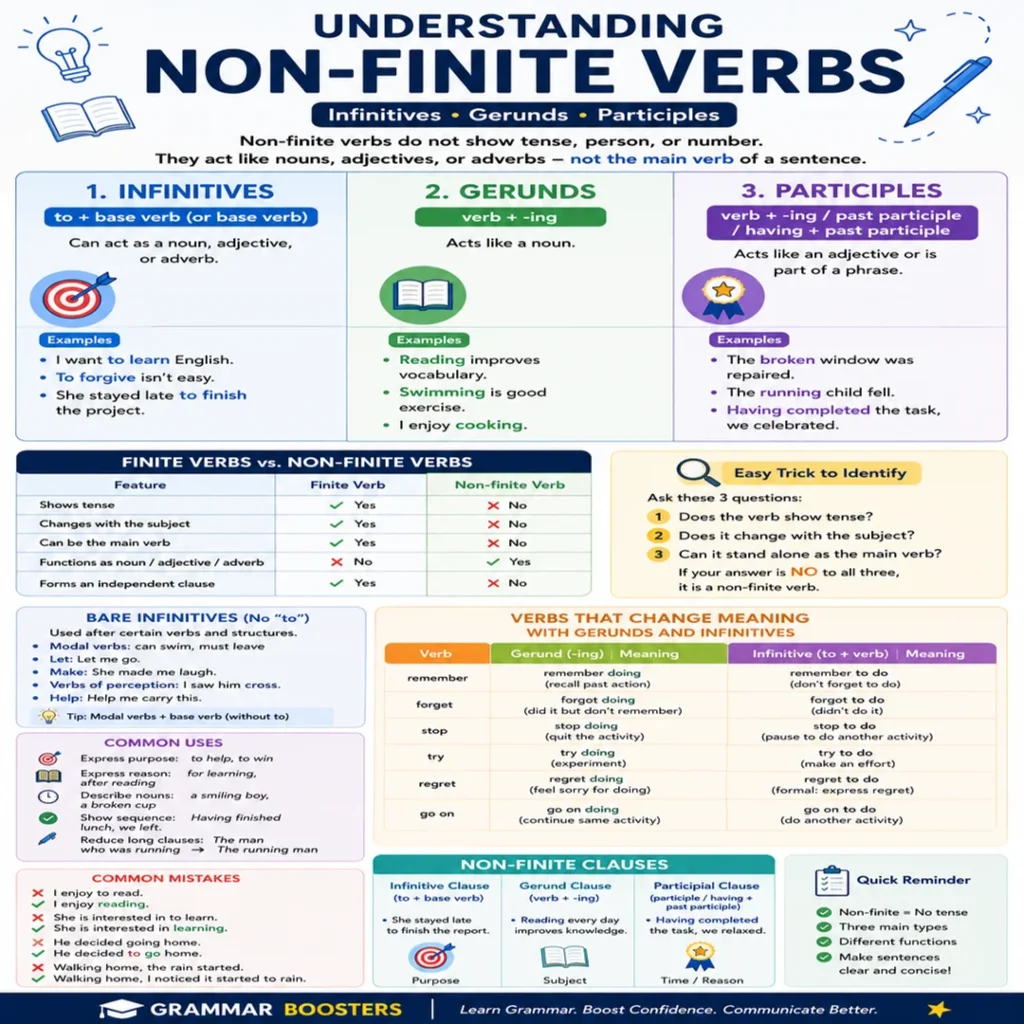
What Are Non-finite Verbs?
A non-finite verb is a verb form that does not show tense, person, or number. Instead of acting as the main verb in an independent clause, it functions as a noun, adjective, or adverb.
Unlike finite verbs, non-finite verbs remain unchanged regardless of who performs the action or when it happens. They usually depend on a finite verb to complete the meaning of a sentence.
Quick Definition
A non-finite verb does not express tense or subject agreement and cannot form a complete sentence on its own.
There are three main types of non-finite verbs:
- Infinitives (to read, to write)
- Gerunds (reading, writing)
- Participles (reading, written, having written)
Each type has a different grammatical function, but all share the same defining feature—they are not limited by tense or subject agreement.
Examples
Example 1
- She writes every day.
- She likes to write every day.
In the first sentence, writes is the finite verb because it shows the present tense and agrees with the subject she. In the second sentence, to write is a non-finite verb because it stays the same regardless of the subject or tense.
Example 2
- They are playing football.
- Playing football keeps them healthy.
In the first sentence, are playing forms the finite verb phrase. In the second, playing functions as the subject of the sentence, making it a gerund and therefore a non-finite verb.
Why Non-finite Verbs Matter
Non-finite verbs help you:
- write more naturally
- avoid repetitive sentence patterns
- combine related ideas smoothly
- express purpose, reason, and description
- improve both spoken and written English
They are especially common in academic writing, professional emails, news articles, and everyday conversation.
Quick Tip: Every complete English sentence needs at least one finite verb, but it can include several non-finite verbs.
Why Are They Called “Non-finite”?
The word finite comes from a Latin word meaning limited or restricted.
Finite verbs are “limited” because they must match:
- tense
- subject
- person
- number
Consider the verb write.
| Subject | Present | Past |
| I | write | wrote |
| He | writes | wrote |
| They | write | wrote |
Notice how writes changes when the subject changes.
Now compare the non-finite forms:
- to write
- writing
- written
These forms remain unchanged.
- I want to write.
- She wants to write.
- They wanted to write.
Although the main verb changes (want, wants, wanted), to write stays the same.
That is why these forms are called non-finite—they are not restricted by tense or subject agreement.
Remember: Finite verbs change. Non-finite verbs stay the same.
Non-finite Verbs vs. Finite Verbs
Many English learners confuse these two types because both originate from the same base verb. The easiest way to tell them apart is to ask one question:
Does the verb change to match the subject or show tense?
- Yes → Finite verb
- No → Non-finite verb
Comparison Table
| Feature | Finite Verb | Non-finite Verb |
| Shows tense | ✔ Yes | ✘ No |
| Changes with the subject | ✔ Yes | ✘ No |
| Can be the main verb | ✔ Yes | ✘ No |
| Can function as a noun | ✘ No | ✔ Yes |
| Can function as an adjective | ✘ No | ✔ Yes |
| Can function as an adverb | ✘ No | ✔ Yes |
| Forms a complete sentence | ✔ Yes | ✘ No |
Examples
| Sentence | Finite Verb | Non-finite Verb |
| She enjoys reading. | enjoys | reading |
| I decided to travel. | decided | to travel |
| The broken window needs repair. | needs | broken |
| We watched the children play. | watched | play |
A Simple Memory Trick
Think of a sentence as a car.
- The finite verb is the engine. It drives the sentence.
- The non-finite verbs are the supporting parts. They add detail, purpose, or description, but they cannot move the sentence on their own.
This simple comparison makes it much easier to identify each type while reading or writing.
Key Characteristics of Non-finite Verbs
Although infinitives, gerunds, and participles look different, they all share several important characteristics.
1. They Do Not Show Tense
Finite verbs tell you when an action happens.
- She writes every day.
- She wrote yesterday.
- She will write tomorrow.
Non-finite verbs do not indicate time by themselves.
- to write
- writing
- written
Instead, the finite verb provides the time reference.
Examples
- She hopes to write a book.
- She hoped to write a book.
The infinitive never changes.
2. They Do Not Agree with the Subject
Finite verbs change according to the subject.
- He writes.
- They write.
Non-finite verbs remain unchanged.
- He wants to write.
- They want to write.
This consistency makes them easy to recognize.
3. They Cannot Stand Alone
A non-finite verb cannot form a complete sentence by itself.
❌ To swim in the lake.
✔ They decided to swim in the lake.
✔ Swimming in the lake is refreshing.
Every complete sentence must include at least one finite verb.
4. They Perform Different Grammatical Roles
One reason non-finite verbs are so useful is their flexibility.
They can function as:
| Role | Example |
| Noun | Swimming is excellent exercise. |
| Adjective | The sleeping baby smiled. |
| Adverb | She left early to catch the train. |
This flexibility allows English speakers to express ideas more naturally and efficiently.
5. They Make Writing More Concise
Non-finite verbs often replace longer clauses without changing the meaning.
Longer version
The man who was carrying the boxes entered the building.
Improved version
The man carrying the boxes entered the building.
The second sentence is shorter, smoother, and easier to read.
This style is common in newspapers, academic writing, business reports, and professional communication because it improves readability without sacrificing clarity.
Key Takeaways
Before moving on, remember these essential points:
- Non-finite verbs do not show tense.
- They do not change with the subject.
- They cannot stand alone as the main verb of a sentence.
- They function as nouns, adjectives, or adverbs.
- They help make writing more concise, fluent, and natural.
How Non-finite Verbs Work in English Sentences
Non-finite verbs do much more than simply follow another verb. They help explain purpose, describe people or things, connect related ideas, and make writing more concise. Instead of carrying the main action, they support the sentence by adding important information without creating another independent clause.
You’ll find non-finite verbs in conversations, books, emails, academic papers, news articles, and professional documents because they make English sound more fluent and natural.
They Explain Purpose
One of the most common uses of an infinitive is to explain why someone does something.
Examples
- She opened the window to let fresh air in.
- We left early to avoid traffic.
- He studied hard to pass the exam.
- They saved money to buy a new house.
Ask yourself:
Why did she study?
To pass the exam.
Here, the infinitive expresses purpose.
Quick Tip: If you can answer the question “Why?”, you’re often looking at an infinitive.
They Can Act as the Subject
A gerund often becomes the subject of a sentence.
Instead of describing an action happening now, it names an activity.
Examples
- Reading improves vocabulary.
- Walking every morning keeps you healthy.
- Exercising regularly reduces stress.
- Learning a new language builds confidence.
Although these words come from verbs, they function as nouns.
Compare these sentences:
- She is reading a novel. (finite verb phrase)
- Reading novels improves concentration. (gerund acting as the subject)
The same -ing form performs two completely different grammatical jobs.
They Describe Nouns
Participles frequently identify or describe a person or thing.
Examples
- The girl wearing a blue jacket is my cousin.
- The broken laptop needs repair.
- We admired the painted walls.
- The sleeping baby looked peaceful.
Instead of creating a longer relative clause, participles provide the same information more efficiently.
Compare:
Long version
The girl who is wearing a blue jacket is my cousin.
Improved version
The girl wearing a blue jacket is my cousin.
The second sentence is shorter but equally clear.
They Connect Related Ideas
Non-finite verbs allow writers to combine ideas without repeating the subject or creating several short sentences.
Compare these examples.
Without non-finite verbs
The athlete finished the race. The athlete celebrated with friends. The athlete thanked the coach.
With non-finite verbs
Finishing the race, the athlete celebrated with friends before thanking the coach.
The second version flows naturally because the ideas are connected logically.
This writing style is common in books, newspapers, magazines, and business communication.
They Reduce Long Clauses
English often replaces longer clauses with participial phrases.
Full clause
The woman who lives next door is a doctor.
Reduced clause
The woman living next door is a doctor.
Another example:
Full clause
The documents that were signed yesterday are confidential.
Reduced clause
The documents signed yesterday are confidential.
Reducing clauses makes writing more concise while preserving the original meaning.
They Improve Sentence Variety
Writing every sentence with only finite verbs can sound repetitive.
Compare these paragraphs.
Less natural
I finished my homework. I went outside. I played basketball.
More natural
After finishing my homework, I went outside to play basketball.
The second version sounds smoother because the non-finite verbs connect related actions.
Professional writers regularly alternate between finite and non-finite verbs to create rhythm and improve readability.
Where Do Non-finite Verbs Appear in a Sentence?
Non-finite verbs are flexible and can appear in several positions depending on their grammatical function.
| Position | Example |
| Beginning | Reading every day improves vocabulary. |
| Middle | The student carrying a backpack smiled. |
| End | She stayed late to finish the project. |
| After an adjective | I’m happy to help. |
| After certain verbs | We enjoy traveling together. |
| After certain nouns | She had the opportunity to speak. |
Learning these common patterns makes it much easier to recognize non-finite verbs while reading.
The Three Types of Non-finite Verbs
Every non-finite verb belongs to one of three categories.
- Infinitives
- Gerunds
- Participles
Although all three originate from verbs, they perform different grammatical functions.
| Type | Common Form | Main Function | Example |
| Infinitive | to + base verb (or base verb) | Noun, adjective, adverb | I want to learn. |
| Gerund | Verb + -ing | Noun | Reading improves vocabulary. |
| Participle | Verb + -ing, past participle, or perfect participle | Adjective or participial phrase | The broken chair needs repair. |
Understanding which job each form performs is far more important than memorizing their names.
Infinitives: The Most Flexible Non-finite Verb
An infinitive is the base form of a verb. It usually begins with to, although English also uses bare infinitives, which appear without to in certain situations.
Examples include:
- to read
- to write
- to learn
- to improve
- to travel
- to understand
Unlike finite verbs, infinitives never change according to tense or subject.
Compare these examples.
- She wants to travel.
- They want to travel.
- We wanted to travel.
Only the finite verb changes. The infinitive remains the same.
What Is a To-Infinitive?
A to-infinitive has a simple structure:
to + base verb
Examples:
- to study
- to play
- to eat
- to solve
- to understand
To-infinitives are extremely versatile because they can function as nouns, adjectives, or adverbs.
Infinitives as Nouns
Sometimes an infinitive acts like a noun.
As the Subject
Examples
- To learn takes patience.
- To forgive isn’t always easy.
- To exercise regularly improves your health.
- To travel broadens your perspective.
Each infinitive serves as the subject of the sentence.
As the Object
Infinitives also function as the object of many verbs.
Examples
- I hope to succeed.
- She decided to stay.
- They agreed to help.
- We plan to expand our business.
- He promised to call.
Many common English verbs are naturally followed by an infinitive.
Infinitives as Adjectives
An infinitive can describe or modify a noun.
Examples
- I have homework to finish.
- She needs someone to trust.
- We found a place to relax.
- They bought a house to renovate.
- He has a report to complete.
In each sentence, the infinitive provides additional information about the noun.
Infinitives as Adverbs
Infinitives frequently explain purpose, reason, or result.
Examples
- She studied hard to pass the exam.
- We left early to avoid traffic.
- He exercises every day to stay healthy.
- They called ahead to confirm the reservation.
A useful question is:
Why did they leave early?
To avoid traffic.
The infinitive answers the question, so it functions like an adverb.
Common Verbs Followed by Infinitives
Many English verbs are naturally followed by a to-infinitive.
| Verb | Example |
| decide | decide to leave |
| hope | hope to win |
| plan | plan to travel |
| agree | agree to help |
| promise | promise to return |
| refuse | refuse to answer |
| manage | manage to finish |
| learn | learn to drive |
| expect | expect to succeed |
| want | want to sleep |
| choose | choose to stay |
| attempt | attempt to solve |
These verb patterns appear frequently in both spoken and written English, so they’re worth memorizing.
Common Adjectives Followed by Infinitives
Certain adjectives are commonly followed by an infinitive.
Examples include:
- happy to help
- glad to meet you
- eager to learn
- ready to begin
- proud to contribute
- willing to cooperate
- afraid to ask
- pleased to hear
Example
She was eager to start her new job.
Common Nouns Followed by Infinitives
Infinitives also modify many abstract nouns.
Common combinations include:
- chance to win
- opportunity to learn
- decision to leave
- desire to improve
- ability to solve problems
- permission to enter
- plan to expand
- invitation to attend
Example
Everyone deserves the opportunity to succeed.
Usage Tip: Infinitive or Gerund?
Some verbs always take an infinitive, while others require a gerund.
For example:
✔ decide to leave
✔ hope to succeed
✔ promise to help
But:
✔ enjoy reading
✔ avoid making
✔ consider moving
Learning these verb patterns will make your English sound much more natural than trying to translate directly from your first language.
Grammar Insight: Dictionaries for English learners often indicate whether a verb is followed by an infinitive, a gerund, or both. Checking these patterns when learning new vocabulary can prevent many common grammar mistakes.
Bare Infinitives
Although most infinitives begin with to, English sometimes uses the base form of a verb without to. This form is called the bare infinitive.
Examples
- Let him go.
- Make her apologize.
- Help me carry these boxes.
- Watch the children play.
- I heard someone knock.
- We saw the birds fly away.
In each example, the highlighted verb is a bare infinitive because it appears without to.
Quick Definition: A bare infinitive is the base form of a verb used without to after certain verbs and grammatical structures.
When Do We Use Bare Infinitives?
Bare infinitives appear in several common sentence patterns.
1. After Modal Verbs
Modal verbs are always followed by the base form of the verb.
Examples
- You should study harder.
- She can swim.
- They must leave now.
- We might arrive late.
- He will call tomorrow.
- You may enter.
Common modal verbs include:
- can
- could
- may
- might
- must
- shall
- should
- will
- would
❌ You should study harder.
✔ You should study harder.
2. After Let
The verb let is followed by an object and a bare infinitive.
Examples
- Let me explain.
- Let him finish.
- Let the children play.
- Let us begin.
- Let them decide.
3. After Make
When make means “force” or “cause,” use a bare infinitive.
Examples
- The teacher made us rewrite the essay.
- The coach made the players run.
- My parents made me clean my room.
- The movie made everyone laugh.
However, in the passive voice, to returns.
Active
The teacher made the students stay late.
Passive
The students were made to stay late.
This difference is easy to overlook, so it’s worth remembering.
4. After Verbs of Perception
Certain verbs that describe seeing, hearing, or feeling are followed by a bare infinitive when the entire action is observed.
Examples
- We watched the children play football.
- I heard someone sing.
- She saw the dog jump over the fence.
- They noticed him leave early.
- We felt the ground shake.
If you want to emphasize an action in progress, English often uses the -ing form instead.
Compare:
- I saw him cross the road. (I saw the complete action.)
- I saw him crossing the road. (I saw the action while it was happening.)
This subtle difference is common in everyday English.
5. After Help
Modern English allows both forms after help.
Examples
- Help me carry these bags.
- Help me to carry these bags.
Both are correct, although the version without to is slightly more common in everyday conversation.
Split Infinitives: Are They Really Wrong?
A split infinitive occurs when another word appears between to and the verb.
Examples
- to carefully read
- to fully understand
- to completely avoid
- to quickly respond
For many years, traditional grammar books discouraged split infinitives. Today, however, most modern grammar experts and style guides accept them when they improve clarity or make the sentence sound more natural.
Compare these examples.
Less Natural
She decided carefully to read every document.
More Natural
She decided to carefully read every document.
The second sentence is clearer because carefully naturally belongs with read.
When Should You Avoid a Split Infinitive?
No rule says you must avoid them. Instead, choose the version that sounds clearest.
Compare:
- She promised to immediately reply.
- She promised to reply immediately.
Both are grammatically correct, but the second may sound smoother depending on the context.
Writing Tip: Prioritize clarity and natural rhythm rather than following outdated grammar myths.
Common Mistakes with Infinitives
Even advanced learners sometimes confuse infinitives with gerunds or bare infinitives. Fortunately, these mistakes follow predictable patterns.
Mistake 1: Using an Infinitive After Enjoy
❌ I enjoy to swim.
✔ I enjoy swimming.
The verb enjoy is always followed by a gerund.
Mistake 2: Using To After Make
❌ She made me to laugh.
✔ She made me laugh.
After make, use a bare infinitive.
Mistake 3: Using To After a Modal Verb
❌ We should to leave now.
✔ We should leave now.
Modal verbs always take a bare infinitive.
Mistake 4: Using a Gerund After Decide
❌ He decided going home.
✔ He decided to go home.
The verb decide requires a to-infinitive.
Mistake 5: Forgetting the Infinitive After Certain Verbs
❌ They hope winning the match.
✔ They hope to win the match.
Verbs such as hope, plan, expect, agree, and promise are followed by an infinitive.
Quick Reference: Bare Infinitive vs. To-Infinitive
| Structure | Example |
| Modal + bare infinitive | You must leave now. |
| Let + object + bare infinitive | Let her speak. |
| Make + object + bare infinitive | The coach made us practise. |
| Watch/Hear + object + bare infinitive | We watched them play. |
| Help + bare infinitive | Help me carry this box. |
| Help + to-infinitive | Help me to carry this box. |
| Most ordinary verbs | She wants to learn. |
Gerunds: Verbs That Function as Nouns
A gerund is a verb ending in -ing that functions as a noun.
Although gerunds look identical to present participles, they perform a completely different grammatical role. Understanding what the word does, rather than how it looks, is the key to telling them apart.
Quick Definition
A gerund is an -ing verb form that functions as a noun in a sentence.
How to Recognize a Gerund
Ask yourself one simple question:
Is the -ing word naming an activity or behaving like a noun?
If the answer is yes, it is probably a gerund.
Examples
- Reading improves memory.
- Swimming is excellent exercise.
- Writing takes patience.
- Travelling broadens your perspective.
- Learning never stops.
Each highlighted word names an activity rather than describing something.
Gerunds as Subjects
Gerunds often appear at the beginning of a sentence as the subject.
Examples
- Reading is relaxing.
- Walking improves fitness.
- Cooking takes practice.
- Exercising regularly benefits your health.
- Learning English requires patience.
Each gerund answers the question:
What improves fitness?
Walking.
Because it functions as the subject, walking is a gerund.
Gerunds as Objects
Many verbs are followed by a gerund.
Examples
- I enjoy reading.
- She loves painting.
- They avoid arguing.
- We discussed travelling abroad.
- He finished writing the report.
- She considered changing jobs.
Here, the gerund acts as the object of the main verb.
Gerunds After Prepositions
One of the most reliable grammar rules in English is this:
A verb that follows a preposition is usually in the gerund form.
Examples:
- interested in learning
- good at solving problems
- tired of waiting
- afraid of failing
- without saying goodbye
- before leaving
- after eating
- by practising regularly
Example Sentences
- She apologised for arriving late.
- They succeeded by working together.
- He’s interested in studying medicine.
- We talked about moving abroad.
Remember the pattern:
Preposition + Gerund
This simple rule prevents many common grammar mistakes.
Common Verbs Followed by Gerunds
Many English verbs are naturally followed by a gerund rather than an infinitive.
| Verb | Example |
| enjoy | enjoy reading |
| avoid | avoid making mistakes |
| finish | finish writing |
| keep | keep trying |
| suggest | suggest visiting |
| practise | practise speaking |
| consider | consider moving |
| recommend | recommend studying |
| imagine | imagine flying |
| postpone | postpone travelling |
| miss | miss seeing friends |
| admit | admit making a mistake |
Learning these combinations will make your English sound much more natural.
Gerunds After Certain Expressions
Gerunds also follow many common expressions.
Examples include:
- It’s no use arguing.
- There’s no point waiting.
- It’s worth trying.
- I can’t help laughing.
- It’s not worth worrying.
These patterns appear frequently in both spoken and written English.
Common Mistakes with Gerunds
Mistake 1
❌ I enjoy to read books.
✔ I enjoy reading books.
Mistake 2
❌ She avoided to answer.
✔ She avoided answering.
Mistake 3
❌ They suggested to leave early.
✔ They suggested leaving early.
Mistake 4
❌ He is interested in to learn French.
✔ He is interested in learning French.
After every preposition, use a gerund.
Mistake 5
❌ We finished to clean the kitchen.
✔ We finished cleaning the kitchen.
The verb finish is followed by a gerund.
Gerund or Present Participle?
Because both forms end in -ing, learners often confuse them.
The difference depends on function, not spelling.
| Sentence | Verb Form | Function |
| Swimming is excellent exercise. | Gerund | Noun |
| The swimming fish escaped. | Present participle | Adjective |
| Reading helps you learn. | Gerund | Subject |
| The reading student smiled. | Present participle | Describes the noun |
A useful test is to replace the -ing word with another noun.
Swimming is fun.
Replace Swimming with Football.
Football is fun.
The sentence still works, confirming that swimming is functioning as a noun and is therefore a gerund.
Grammar Insight: Don’t identify gerunds by their -ing ending alone. Always look at their role in the sentence. The same spelling can represent two completely different grammatical structures depending on how it is used.
Participles: Verb Forms That Add Description
A participle is a non-finite verb that usually functions as an adjective. Instead of expressing the main action in a sentence, it describes a noun or helps create a participial phrase.
Participles make writing more vivid and concise because they often replace longer descriptive clauses.
Compare these two sentences:
- The girl who was smiling greeted everyone.
- The smiling girl greeted everyone.
Both sentences mean the same thing, but the second sounds smoother and more natural.
Quick Definition
A participle is a verb form that functions mainly as an adjective or as part of a participial phrase.
English has three types of participles:
- Present participles
(smiling, running) - Past participles
(broken, written, chosen) - Perfect participles
(having finished, having studied)
Present Participles
A present participle ends in -ing and usually describes a noun or forms a participial phrase.
Examples
- a smiling child
- running water
- glowing stars
- a barking dog
- falling leaves
In Sentences
- The crying baby needed attention.
- We saw a shining rainbow.
- The laughing children played in the park.
- A burning candle stood on the table.
Notice that these participles describe nouns.
Gerund or Present Participle?
This is one of the most common points of confusion because both forms end in -ing.
| Sentence | Function |
| Swimming is good exercise. | Gerund (noun) |
| The swimming fish escaped. | Present participle (adjective) |
| Reading helps you learn. | Gerund (subject) |
| The reading student smiled. | Present participle (describes the noun) |
Key rule: Focus on the job, not the spelling.
Past Participles
A past participle usually ends in -ed for regular verbs, but many common verbs have irregular forms.
Regular Past Participles
- painted
- cleaned
- finished
- opened
- damaged
Irregular Past Participles
| Base Verb | Past Participle |
| write | written |
| break | broken |
| choose | chosen |
| drive | driven |
| eat | eaten |
| speak | spoken |
| take | taken |
| see | seen |
In Sentences
- The broken window was repaired.
- She submitted a written report.
- We admired the painted walls.
- The damaged car was expensive to fix.
- Frozen food should be stored properly.
Past participles often describe the result or state of something after an action.
Perfect Participles
A perfect participle shows that one action happened before another.
Structure
having + past participle
Examples
- having finished
- having completed
- having studied
- having solved
- having written
In Sentences
- Having finished the project, the team celebrated.
- Having studied all week, she felt confident.
- Having completed the report, he emailed it.
- Having solved the problem, they moved on.
This structure clearly shows the sequence of events.
Participles as Adjectives
One of the most common uses of participles is modifying nouns.
Examples
- a sleeping baby
- boiling water
- a smiling teacher
- a broken chair
- a fallen tree
- an excited audience
Compare:
- The audience applauded.
- The excited audience applauded.
The second sentence creates a much clearer picture.
Participial Phrases
A participial phrase begins with a participle and includes related words.
Examples
- Walking through the forest, we heard birds singing.
- Exhausted after work, Maria went straight to bed.
- Having completed the assignment, the students relaxed.
- Carrying two heavy bags, he entered the house.
These phrases combine ideas and make writing more elegant.
Where Can Participial Phrases Appear?
Beginning
- Driving carefully, she reached home safely.
Middle
- My brother, carrying a suitcase, entered the room.
End
- The children ran across the field, laughing loudly.
Different positions create different rhythms, but the meaning stays the same.
Dangling Participles: A Common Mistake
A dangling participle occurs when the participial phrase does not clearly refer to the subject.
Incorrect
❌ Walking home, the rain started.
This suggests that the rain was walking.
Correct
✔ Walking home, I noticed that it started to rain.
✔ While I was walking home, it started to rain.
Another Example
❌ After reading the article, the homework seemed easy.
✔ After reading the article, I found the homework easy.
Rule: The subject immediately after the participial phrase should be the one acting.
Misplaced Participles
A misplaced participle modifies the wrong noun and creates confusion.
Incorrect
❌ She served sandwiches to the children wrapped in foil.
This suggests the children were wrapped in foil.
Correct
✔ She served sandwiches wrapped in foil to the children.
Good placement prevents ambiguity and accidental humour.
Present vs. Past Participles
Learners often confuse these pairs.
| Present Participle | Past Participle |
| interesting | interested |
| exciting | excited |
| confusing | confused |
| tiring | tired |
| surprising | surprised |
Meaning Difference
- The movie was exciting. (The movie caused excitement.)
- We were excited. (We felt excitement.)
A useful memory trick:
- -ing = causes the feeling
- -ed = experiences the feeling
Finite Verbs vs. Non-finite Verbs
Now that you’ve learned infinitives, gerunds, and participles, let’s compare them directly with finite verbs.
| Feature | Finite Verb | Non-finite Verb |
| Shows tense | ✔ Yes | ✘ No |
| Agrees with the subject | ✔ Yes | ✘ No |
| Can be the main verb | ✔ Yes | ✘ No |
| Functions as a noun | ✘ No | ✔ Sometimes |
| Functions as an adjective | ✘ No | ✔ Sometimes |
| Functions as an adverb | ✘ No | ✔ Sometimes |
| Forms a complete clause | ✔ Yes | ✘ No |
Example
- She writes every day. (finite)
- She wants to write every day. (non-finite)
Every complete English sentence needs at least one finite verb, but it may contain several non-finite verbs.
Verbs That Change Meaning with Gerunds and Infinitives
Some verbs can be followed by either a gerund or an infinitive, but the meaning changes.
This is an important area for exams and advanced writing.
Remember
- I remember locking the door. (I locked it and remember the action.)
- Remember to lock the door. (Don’t forget to do it.)
Stop
- She stopped smoking. (She quit the habit.)
- She stopped smoking. (She paused another activity to smoke.)
Try
- Try pressing this button. (Experiment.)
- Try to press this button. (Make an effort.)
Forget
- I forgot meeting him. (The meeting happened, but I don’t remember it.)
- I forgot to meet him. (I failed to meet him.)
Regret
- I regret telling her the secret.
- We regret to inform you that your application was unsuccessful.
The infinitive is common in formal announcements and business English.
Common Mistakes and How to Fix Them
After a Preposition
❌ She is interested in to learn.
✔ She is interested in learning.
After Certain Verbs
❌ He decided going home.
✔ He decided to go home.
After Modal Verbs
❌ You should to study.
✔ You should study.
Dangling Participle
❌ Driving to work, the traffic became heavy.
✔ Driving to work, I noticed that the traffic had become heavy.
Misplaced Participle
❌ We found sandwiches for the children wrapped in paper.
✔ We found sandwiches wrapped in paper for the children.
Quick Error Checklist
Before finishing your writing, ask yourself:
- Does every sentence have a finite verb?
- Is every gerund functioning as a noun?
- Is every participle modifying the correct noun?
- Did I use the infinitive after verbs that require it?
- Did I use a gerund after every preposition?
- Is the meaning completely clear?
These questions will help you catch most non-finite verb errors in everyday writing.
Quick Practice
Identify the non-finite verb in each sentence.
- She hopes to become a doctor.
- Reading before bed helps me relax.
- The broken vase belonged to my grandmother.
- Having completed the course, Liam received his certificate.
- We watched the children play football.
Answers
- to become — Infinitive
- Reading — Gerund
- broken — Past participle
- Having completed — Perfect participle
- play — Bare infinitive
If you identified all five correctly, you’re already developing a strong understanding of non-finite verbs.
Non-finite Clauses Explained
A non-finite clause is a group of words built around a non-finite verb. Unlike a finite clause, it does not show tense or subject agreement, so it cannot stand alone as a complete sentence.
Instead, it depends on a main clause to complete its meaning.
Quick Definition
A non-finite clause contains a non-finite verb and functions as part of a larger sentence rather than as an independent sentence.
Example
She opened the window to let in fresh air.
- She opened = finite clause
- to let in fresh air = non-finite clause
The non-finite clause explains why she opened the window.
Types of Non-finite Clauses
English has three main kinds of non-finite clauses.
1. Infinitive Clauses
These begin with an infinitive.
Examples
- to solve the problem
- to improve communication
- to save time
- to reduce costs
In sentences
- He stayed late to finish the report.
- She practised daily to improve her pronunciation.
- We met early to discuss the project.
These clauses commonly express purpose, result, or intention.
2. Gerund Clauses
Gerund clauses are built around a gerund.
Examples
- reading books every evening
- travelling around Europe
- exercising every morning
- learning a second language
In sentences
- Reading before bed helps many people relax.
- Learning English online has become increasingly popular.
- Practising every day improves fluency.
These clauses often function as the subject or object of a sentence.
3. Participial Clauses
Participial clauses begin with a present, past, or perfect participle.
Examples
- smiling warmly
- carrying heavy bags
- having completed the task
- exhausted after work
In sentences
- Having completed the interview, she thanked the committee.
- Walking through the park, we spotted several deer.
- Surrounded by mountains, the village looked peaceful.
Participial clauses often express time, reason, condition, or description.
Why Writers Use Non-finite Clauses
Professional writers frequently use non-finite clauses because they make writing:
- more concise
- easier to read
- less repetitive
- more fluent
- more engaging
Instead of adding another full clause, a non-finite clause connects related ideas smoothly.
Compare these examples.
Longer Version
After she finished the presentation, she answered several questions.
Improved Version
Having finished the presentation, she answered several questions.
The revised sentence is shorter while keeping the meaning clear.
Reduced Relative Clauses
One of the most common uses of participles is reducing relative clauses.
Full Sentence
The employees who work remotely meet every Monday.
Reduced Version
The employees working remotely meet every Monday.
Another example:
Full Sentence
The documents that were signed yesterday are confidential.
Reduced Version
The documents signed yesterday are confidential.
This structure is especially common in business writing, journalism, and academic English.
Reduced Adverbial Clauses
Adverbial clauses can also become participial phrases.
Full Sentence
Because he knew the answer, he raised his hand.
Reduced Version
Knowing the answer, he raised his hand.
Another example:
Full Sentence
After she completed the training, she accepted the new position.
Reduced Version
Having completed the training, she accepted the new position.
These reductions improve sentence flow without changing the meaning.
Real-life Examples of Non-finite Verbs
Grammar is easier to understand when you see it in everyday situations.
Everyday Conversation
Native speakers naturally use non-finite verbs all the time.
Examples
- I need to leave now.
- Thanks for helping me.
- The crying baby finally fell asleep.
- We stopped to eat lunch.
- She enjoys cooking for her family.
Most people use these structures instinctively without thinking about the grammar behind them.
Academic Writing
Academic writing often relies on non-finite verbs to connect ideas efficiently.
Examples
- Conducting careful research improves the reliability of scientific studies.
- Students are encouraged to analyse multiple sources before concluding.
- Having reviewed previous research, the author proposed a new solution.
These structures help create a formal yet readable style.
Business Communication
Professional writing regularly uses infinitives and participles.
Examples
- We plan to expand our services.
- Please remember to attach the report.
- The approved proposal has been shared with the team.
- Having reviewed the contract, the client signed it.
These patterns appear frequently in emails, reports, presentations, and proposals.
News Headlines
Journalists often shorten headlines by using non-finite verbs.
Examples
- Government Planning New Education Policy
- Scientists Discover New Marine Species
- Company Expected to Launch New Product
- Council Approves Housing Development
This concise style allows headlines to communicate more information in fewer words.
Literature and Storytelling
Authors use non-finite verbs to improve rhythm and create vivid descriptions.
Example
Watching the sunset, she realised how quickly time had passed.
Rather than writing several separate sentences, the participial phrase introduces the main action smoothly
Quick Comparison Tables
These tables summarise the most important differences between the major non-finite verb forms.
Gerunds vs. Infinitives
| Feature | Gerund | Infinitive |
| Form | Verb + -ing | to + base verb |
| Main Function | Usually a noun | Noun, adjective, or adverb |
| Common After | Prepositions and certain verbs | Certain verbs, adjectives, and nouns |
| Example | Reading improves memory. | To read regularly is beneficial. |
Gerunds vs. Present Participles
| Gerund | Present Participle |
| Functions as a noun | Functions as an adjective |
| Reading is enjoyable. | The reading student smiled. |
| Can be a subject or object | Describes a noun |
Remember: The spelling is the same, but the grammatical function is different.
Present Participles vs. Past Participles
| Present Participle | Past Participle |
| Ends in -ing | Usually ends in -ed or has an irregular form |
| Shows an ongoing quality | Shows a completed result or state |
| smiling child | broken window |
| boiling water | frozen lake |
| exciting film | excited audience |
Finite Verbs vs. Non-finite Verbs
| Feature | Finite Verb | Non-finite Verb |
| Shows tense | ✔ | ✘ |
| Changes with the subject | ✔ | ✘ |
| Can be the main verb | ✔ | ✘ |
| Functions as a noun | ✘ | ✔ Sometimes |
| Functions as an adjective | ✘ | ✔ Sometimes |
| Functions as an adverb | ✘ | ✔ Sometimes |
| Forms an independent clause | ✔ | ✘ |
Memory Tricks for Learning Non-finite Verbs
Grammar is easier to remember when you connect rules with simple patterns.
Remember the Three Types
Think of this phrase:
TO – ING – DESCRIPTION
It represents the three main forms.
- TO → Infinitive
- ING → Gerund
- DESCRIPTION → Participle
The “Job Test”
Instead of asking what the word looks like, ask what it does.
| If It Acts Like… | It’s Usually… |
| A noun | Gerund |
| An adjective | Participle |
| A purpose or reason | Infinitive |
This simple test solves many grammar problems.
The Three-question Rule
Whenever you find a verb, ask yourself:
- Does it show tense?
- Does it agree with the subject?
- Can it stand alone as the main verb?
If the answer is no to all three questions, you’ve almost certainly found a non-finite verb.
Practice Exercises
Exercise 1: Identify the Non-finite Verb
Find the non-finite verb in each sentence.
- She hopes to become a pilot.
- Reading before bed helps me relax.
- The broken vase belonged to my grandmother.
- Having completed the course, Liam received his certificate.
- We watched the children play football.
Exercise 2: Identify the Type
Write Gerund, Infinitive, or Participle.
| Sentence | Your Answer |
| Swimming improves fitness. | |
| She wants to travel abroad. | |
| The falling leaves covered the road. | |
| I enjoy cooking. | |
| The damaged bridge was repaired. |
Exercise 3: Fill in the Blanks
Choose the correct form of the verb.
- I enjoy ________ English every day. (study)
- They decided ________ early. (leave)
- She is interested in ________ photography. (learn)
- We watched the birds ________ away. (fly)
- ________ carefully, the instructions are easy to understand. (read)
Exercise 4: Correct the Errors
Rewrite each sentence correctly.
- She suggested going home.
- I’m good at solving puzzles.
- He made me laugh.
- Walking through the city, the buildings looked beautiful.
- We should finish this project today.
Exercise 5: Rewrite the Sentences
Rewrite each sentence using a non-finite verb.
- After she finished the meeting, she called her manager.
- The student who won the award thanked everyone.
- Because he wanted to improve his writing, he practised daily.
- The woman who carried the suitcase smiled politely.
- When they completed the project, they celebrated together.
Challenge Quiz
1. Which sentence contains a gerund?
A. She wants to swim.
B. Swimming is excellent exercise.
C. The swimming child waved.
D. She will swim tomorrow.
2. Which sentence contains a participle?
A. I enjoy reading.
B. Reading improves memory.
C. The reading student smiled.
D. To read every day is helpful.
3. Which sentence contains a bare infinitive?
A. I hope to win.
B. We watched him leave.
C. She enjoys singing.
D. They finished working.
4. Which sentence contains a perfect participle?
A. Having finished the report, Maya went home.
B. Maya finished the report.
C. Maya is finishing the report.
D. Maya finishes the report.
Answer Key
Exercise 1
- to become
- Reading
- broken
- Having completed
- play
Exercise 2
| Sentence | Answer |
| Swimming improves fitness. | Gerund |
| She wants to travel abroad. | Infinitive |
| The falling leaves covered the road. | Participle |
| I enjoy cooking. | Gerund |
| The damaged bridge was repaired. | Participle |
Exercise 3
- studying
- to leave
- learning
- fly
- Reading
Exercise 4
- She suggested going home.
- I’m good at solving puzzles.
- He made me laugh.
- Walking through the city, I admired the beautiful buildings.
- We should finish this project today.
Exercise 5 (Sample Answers)
- Having finished the meeting, she called her manager.
- The student winning the award thanked everyone.
- Wanting to improve his writing, he practised daily.
- The woman carrying the suitcase smiled politely.
- Having completed the project, they celebrated together.
Conclusion
Understanding non-finite verbs is one of the most effective ways to improve your English grammar. Once you know how infinitives, gerunds, and participles work, you’ll find it much easier to write concise, natural, and well-connected sentences. These verb forms appear in everyday conversations, academic writing, business communication, and professional documents, making them essential for learners at every level. Rather than memorising rules in isolation, focus on recognising how non-finite verbs function in real sentences. Pay attention to the patterns you encounter while reading books, articles, emails, and other authentic English materials. Regular practice, combined with careful observation, will help you use these structures with confidence. As your understanding grows, you’ll notice improvements in your grammar, writing style, and overall fluency. Mastering non-finite verbs isn’t just about passing grammar tests—it’s about communicating your ideas more clearly and effectively in both spoken and written English.
Frequently Asked Questions (FAQs)
What is a non-finite verb?
A non-finite verb is a verb form that does not show tense, person, or number. Instead of acting as the main verb in an independent clause, it functions as a noun, adjective, or adverb. The three main types are infinitives, gerunds, and participles.
What is the difference between finite and non-finite verbs?
Finite verbs express tense and agree with the subject, allowing them to serve as the main verb in a sentence. Non-finite verbs do not change for tense or subject agreement and usually support the main verb by adding purpose, description, or additional information.
What are the three types of non-finite verbs?
The three types are infinitives, gerunds, and participles. Infinitives usually begin with to, gerunds end in -ing and function as nouns, while participles act mainly as adjectives or form participial phrases.
Can a sentence contain more than one non-finite verb?
Yes. A sentence may contain several non-finite verbs as long as it includes at least one finite verb. Using multiple non-finite verbs helps writers connect ideas naturally without making sentences repetitive.
Why are non-finite verbs important?
Non-finite verbs improve sentence variety, reduce unnecessary repetition, and make writing more concise. They help express purpose, describe nouns, and link related ideas smoothly and naturally.
How can I identify a non-finite verb?
Ask whether the verb shows tense or changes with the subject. If it does neither and instead functions as a noun, adjective, or adverb, it is most likely a non-finite verb.
Are all -ing words gerunds?
No. Some -ing words are gerunds, while others are present participles. A gerund functions as a noun, whereas a present participle functions as an adjective or forms part of a participial phrase.
Can non-finite verbs stand alone?
No. A non-finite verb cannot form a complete sentence by itself because it does not express tense. Every complete sentence requires at least one finite verb.
What are the most common mistakes with non-finite verbs?
Common mistakes include using an infinitive after a preposition, confusing gerunds with present participles, creating dangling participles, and incorrectly using to after modal verbs or the verb make.
How can I improve my use of non-finite verbs?
Read high-quality English regularly, identify non-finite verbs in context, practise rewriting sentences, and review common verb patterns. Consistent practice will help you recognise and use these structures naturally.

I’m Nauman Anwer, a passionate English language writer dedicated to making grammar, idioms, vocabulary, and writing concepts easy to understand for everyone. Through my articles, I simplify complex language topics into clear, practical lessons with real-world examples that readers can apply immediately. My goal is to help students, professionals, writers, and English learners build confidence in their communication skills. I focus on creating well-researched, accurate, and engaging content that follows current language usage while remaining easy to read. Whether you’re learning a new idiom, improving your grammar, or expanding your vocabulary, I strive to provide trustworthy resources that make English more approachable and enjoyable. Every article I publish is written with clarity, authenticity, and the reader’s success in mind.