Moving Forward is a useful phrase for talking about future plans, progress, and the next steps in a situation. However, repeating the same expression can make your writing or conversation feel less natural. There are many other ways to say “Moving Forward”, depending on the context, tone, and relationship with your audience.
You might want a more professional phrase for a workplace email, a formal expression for academic writing, or a simple alternative for everyday conversation. Expressions such as “going ahead,” “from now on,” “looking ahead,” and “in the future” can communicate a similar idea while adding variety to your language. Choosing the right alternative helps you express progress, future intentions, change, and continued action more clearly and naturally. It also allows you to match your wording to the situation and audience.
In this guide, you’ll discover practical and natural synonyms for “Moving Forward” with clear examples to show how each expression works in real communication. Whether you’re writing an email, report, business message, academic paper, or casual conversation, the right phrase can make your message sound more polished and confident. Some alternatives suggest progress, while others focus on future decisions, new beginnings, or leaving the past behind. Understanding these differences will help you avoid repetitive language and choose expressions that fit your exact meaning. By learning these alternatives, you can make your English vocabulary more flexible, precise, and effective.
What Does “Moving Forward” Mean?
“Moving forward” generally means continuing toward the future rather than remaining focused on the past. It can describe physical progress, but in everyday English it is more often used figuratively. For example, if someone says, “We need to move forward,” they may mean that it is time to continue with a plan, make a decision, recover from a difficult situation, or focus on what comes next. The expression can communicate progress, continuation, acceptance, or a willingness to take the next step.
The exact meaning depends on context. In a workplace, “moving forward” may mean proceeding with an agreed plan. In a relationship, it can mean rebuilding trust or accepting that a chapter has ended. In personal development, it may suggest leaving past difficulties behind and concentrating on future goals. Because it is broad and flexible, the phrase works in many conversations, although a more specific alternative can sometimes communicate your intended meaning more precisely.
Common Situations Where “Moving Forward” Is Used
“Moving forward” is common in everyday conversation, professional communication, personal discussions, and written English. At work, someone might say, “Moving forward, we will review the reports every Friday,” meaning that this will be the practice from now on. In a personal conversation, someone might say, “I think we should focus on moving forward,” suggesting that they want to stop dwelling on an earlier problem.
The phrase also appears in emails, meetings, school discussions, social media posts, and conversations about relationships or personal growth. People often choose alternatives when they want to be more specific, encouraging, formal, emotional, or direct. For instance, “proceeding” may sound more formal in a business setting, while “leaving the past behind” carries more emotional meaning.
Is It Professional or Polite to Say “Moving Forward”?
Yes, “moving forward” can be professional and polite, particularly when it refers to future plans or decisions. It is common in workplace conversations, presentations, emails, and meetings. For example, “Moving forward, we will communicate any schedule changes by email” sounds clear and businesslike.
However, the phrase can sometimes feel broad or corporate when used repeatedly. In formal writing, “from this point onward,” “going ahead,” or “proceeding” may provide greater precision depending on the sentence. In personal situations, a warmer expression such as “looking ahead” or “leaving the past behind” may better communicate emotion. The best choice depends on whether you are emphasizing future action, progress, emotional recovery, or a formal decision.
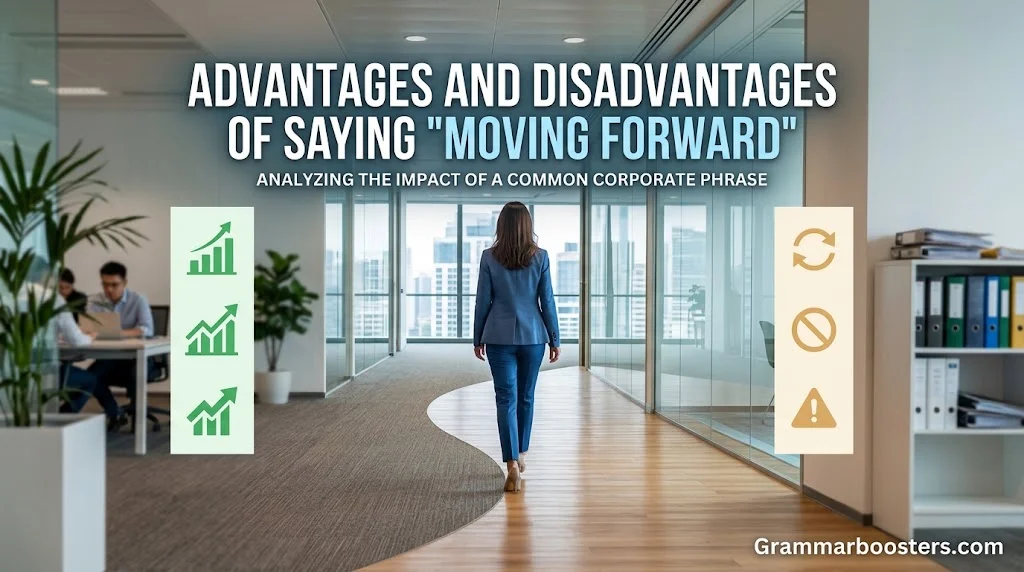
Advantages and Disadvantages of Saying “Moving Forward”
Advantages
“Moving forward” is useful because it is flexible, positive, and easy to understand. It can describe future plans without sounding overly forceful. It also works in both professional and personal contexts. When discussing a difficult situation, the expression can gently shift attention from what happened to what can happen next. Its broad meaning allows speakers to use it when they do not need to explain every detail.
Disadvantages
The main limitation is that “moving forward” can sometimes be too general. It may not tell the listener whether you mean continuing a project, making progress, starting fresh, or emotionally letting go. It can also sound somewhat corporate when repeated in workplace communication. If your intended meaning is more specific, an alternative such as “taking the next step,” “making progress,” or “leaving the past behind” may communicate your message more effectively.
Synonyms for “Moving Forward”
- Progressing
- Going Ahead
- Proceeding
- Moving Ahead
- Forging Ahead
- Pressing On
- Carrying On
- Looking Ahead
- Making Progress
- Advancing
- Taking the Next Step
- Continuing Onward
- Getting on With Things
- Leaving the Past Behind
- Turning the Page
1. Progressing
Meaning
Progressing means continuing to develop, improve, or move toward a desired result. It is closely related to “moving forward” when the emphasis is on measurable development or improvement.
Definition
Progressing means moving gradually toward a goal, better condition, or later stage.
Detailed Explanation
“Progressing” focuses more strongly on development and improvement than the broad phrase “moving forward.” It works especially well when you can identify something that is becoming better or reaching a new stage. For example, a project can progress, a student can progress in learning, or a person can progress toward a goal. It is less emotional than some alternatives and is particularly useful in professional or educational contexts.
Scenario Examples
Scenario: A manager discusses a project that is developing well. Example: “The team is progressing well, and we should meet the deadline.”
Scenario: A student talks about learning a new skill. Example: “I feel like I’m progressing every week.”
Scenario: Someone describes personal development. Example: “I’m slowly progressing toward the goals I set for myself.”
Best Use
Use progressing when you want to emphasize development, improvement, or advancement toward a goal. It works well in professional, academic, personal, and everyday communication.
Tone
Tone: Positive, neutral, purposeful
The expression sounds focused and practical because it emphasizes development and forward progress.
2. Going Ahead
Meaning
Going ahead means continuing with something or proceeding with a planned action. It often focuses on what will happen from this point onward.
Definition
Going ahead means continuing with a plan, decision, or activity.
Detailed Explanation
“Going ahead” is useful when “moving forward” refers specifically to continuing a decision or plan. It can sound natural in both spoken and written English. Compared with “progressing,” it does not necessarily suggest improvement; it simply indicates that something will continue. In workplace communication, it can make a future decision sound straightforward without being overly formal.
Scenario Examples
Scenario: A team has agreed to launch a project. Example: “We’re going ahead with the original launch date.”
Scenario: A friend decides to attend an event despite a small problem. Example: “We’re going ahead with the trip as planned.”
Best Use
Use going ahead for plans, decisions, projects, and future actions. It is particularly natural in conversations and workplace messages.
Tone
Tone: Casual, practical, confident
It sounds direct without being harsh and often suggests that a decision has already been made.
3. Proceeding
Meaning
Proceeding means continuing with an action, process, or plan. It is a more formal alternative when “moving forward” means continuing according to an agreed course of action.
Definition
Proceeding means continuing with something that has already been started or decided.
Detailed Explanation
“Proceeding” has a more formal and professional feel than “moving forward.” It is common in business, legal, academic, administrative, and official communication. Unlike “progressing,” it does not necessarily mean that something is improving. Instead, it emphasizes continuing with the next stage or action. This makes it useful when clarity and professionalism matter more than emotional warmth.
Scenario Examples
Scenario: A company confirms the next stage of a hiring process. Example: “We are proceeding with the final round of interviews next week.”
Scenario: An organization confirms a scheduled activity. Example: “The meeting will proceed as planned.”
Best Use
Use proceeding in formal emails, business communication, official notices, academic writing, and structured discussions.
Tone
Tone: Formal, professional, neutral
Its formal tone makes it appropriate when casual wording might seem too relaxed.
4. Moving Ahead
Meaning
Moving ahead means continuing toward the future, especially after a decision, change, or previous difficulty. It is very close in meaning to “moving forward.”
Definition
Moving ahead means continuing with a plan or progressing toward what comes next.
Detailed Explanation
“Moving ahead” is one of the closest alternatives to “moving forward.” The two expressions can often be used interchangeably when discussing future plans or continued progress. “Moving ahead” can sometimes sound slightly more action-oriented, particularly when a group has decided what to do next. It works naturally in professional and personal conversations without sounding overly formal.
Scenario Examples
Scenario: A project team agrees on its next phase. Example: “We have addressed the major concerns, so we can start moving ahead.”
Scenario: Someone decides to continue after a disappointment. Example: “The setback was difficult, but I’m ready to start moving ahead.”
Best Use
Use moving ahead in everyday conversation, workplace communication, personal discussions, and messages about future plans or recovery.
Tone
Tone: Neutral, positive, encouraging
It feels optimistic while remaining broad enough for many situations.
5. Forging Ahead
Meaning
Forging ahead means continuing strongly and confidently despite difficulties, uncertainty, or obstacles.
Definition
Forging ahead means making determined progress despite challenges.
Detailed Explanation
“Forging ahead” is stronger than the simple phrase “moving forward.” It suggests determination, courage, and persistence. You would normally use it when someone is not merely continuing but is actively pushing through obstacles. The expression can create an energetic or inspirational feeling, making it useful when describing ambitious goals, difficult projects, or personal resilience.
Scenario Examples
Scenario: A business continues developing after a difficult year. Example: “Despite the setbacks, the company is forging ahead with its expansion plans.”
Scenario: Someone refuses to give up on a personal goal. Example: “She faced several obstacles but kept forging ahead.”
Best Use
Use forging ahead when you want to emphasize determination and resilience. It works well in motivational writing, speeches, personal reflections, and professional discussions about challenging goals.
Tone
Tone: Determined, energetic, inspirational
The phrase suggests that obstacles exist but are not stopping the person or group.
6. Pressing On
Meaning
Pressing on means continuing despite difficulty, disappointment, tiredness, or uncertainty.
Definition
Pressing on means continuing forward even when circumstances are challenging.
Detailed Explanation
“Pressing on” highlights persistence rather than simple continuation. It is particularly useful when someone has experienced a problem but chooses not to stop. Compared with “moving forward,” it carries more emotional strength because it suggests effort in the face of resistance. It can sound encouraging without being overly dramatic.
Scenario Examples
Scenario: A team continues working despite an unexpected delay. Example: “We lost some time, but we’re pressing on and hope to finish by Friday.”
Scenario: Someone continues pursuing a goal after failure. Example: “The first attempt didn’t work, but I’m pressing on.”
Best Use
Use pressing on for difficult circumstances, perseverance, personal goals, and situations where continuing despite obstacles is important.
Tone
Tone: Resilient, encouraging, determined
It communicates the idea that difficulties are real, but giving up is not the chosen response.
7. Carrying On
Meaning
Carrying on means continuing an activity, situation, or way of life. It can also suggest continuing normally after an interruption or difficulty.
Definition
Carrying on means continuing to do something or continue with life as before.
Detailed Explanation
“Carrying on” is generally more casual and conversational than “moving forward.” It does not always suggest improvement or a specific goal. Instead, it emphasizes continuation. In personal conversations, it can mean continuing with everyday life after something difficult. In some contexts, it may also mean behaving in a particular way, so the surrounding sentence matters.
Scenario Examples
Scenario: A teacher encourages students to continue after a short interruption. Example: “The noise has stopped, so let’s carry on with the lesson.”
Scenario: Someone talks about life after a difficult period. Example: “Things changed, but we carried on and eventually found a new routine.”
Best Use
Use carrying on in casual conversation, everyday speech, and informal personal communication.
Tone
Tone: Casual, familiar, steady
It sounds natural and relaxed, making it less suitable for highly formal writing.
8. Looking Ahead
Meaning
Looking ahead means focusing attention on the future and considering what is coming next.
Definition
Looking ahead means thinking about or preparing for the future.
Detailed Explanation
“Looking ahead” differs from “moving forward” because it emphasizes future focus rather than actual progress. Someone can look ahead before taking action, while “moving forward” often suggests that action or continuation is already happening. The expression is especially useful when discussing plans, hopes, goals, and future possibilities. It can also sound warmer and more optimistic in personal communication.
Scenario Examples
Scenario: A manager discusses next year’s goals. Example: “Looking ahead, we want to expand the training program.”
Scenario: Someone reflects on a personal change. Example: “I’m trying to stop worrying about what happened and start looking ahead.”
Scenario: A family plans for an upcoming move. Example: “We’re excited about looking ahead to a new chapter.”
Best Use
Use looking ahead when the main idea is future planning, hope, preparation, or optimism.
Tone
Tone: Hopeful, thoughtful, positive
It encourages attention toward the future without necessarily suggesting that every problem has already been solved.
9. Making Progress
Meaning
Making progress means moving closer to a goal or achieving improvement over time.
Definition
Making progress means becoming closer to a desired result through continued effort or development.
Detailed Explanation
“Making progress” is more specific than “moving forward” because it suggests positive development or measurable improvement. If you are simply continuing a plan, “proceeding” may be better. If you want to show that things are actually improving, “making progress” is stronger. It works naturally in work, education, personal development, projects, and everyday conversation.
Scenario Examples
Scenario: A student improves in a difficult subject. Example: “I struggled with math at first, but I’m finally making progress.”
Scenario: A project team reports on its work. Example: “We’re making good progress on the new website.”
Scenario: Someone works toward a personal goal. Example: “I may not be where I want to be yet, but I’m making progress.”
Best Use
Use making progress when you want to emphasize improvement, achievement, or movement toward a goal.
Tone
Tone: Positive, practical, encouraging
It focuses attention on results and development rather than simply continuing.
10. Advancing
Meaning
Advancing means moving forward, developing, or progressing toward a higher level, stage, or position.
Definition
Advancing means moving toward a more developed, advanced, or later stage.
Detailed Explanation
“Advancing” can be a strong alternative when “moving forward” involves development, advancement, or movement toward a higher stage. It is common in professional, academic, technical, and formal contexts. However, it is not always a natural replacement in emotional conversations. For example, “advancing the project” works well, while “advancing after a breakup” would sound unnatural compared with more personal wording.
Scenario Examples
Scenario: A project enters a new phase. Example: “The team is advancing to the next stage of development.”
Scenario: A student reaches a higher academic level. Example: “She is advancing quickly in her language studies.”
Best Use
Use advancing for projects, skills, careers, education, technology, and structured development.
Tone
Tone: Professional, purposeful, formal
The word has a polished quality and works particularly well when discussing stages or levels of development.
11. Taking the Next Step
Meaning
Taking the next step means moving from the current situation toward a specific future action or stage.
Definition
Taking the next step means deciding or acting on what should happen next.
Detailed Explanation
This expression is more specific than “moving forward” because it focuses on a particular action or decision. It works especially well when someone has finished one stage and needs to decide what comes next. The phrase can sound encouraging in personal conversations and practical in professional settings. It is also useful when you want to avoid making the future sound vague.
Scenario Examples
Scenario: Two colleagues discuss a new project phase. Example: “We’ve finished the research, so now it’s time to take the next step.”
Scenario: Someone considers making a personal decision. Example: “I’ve thought about it carefully, and I’m ready to take the next step.”
Scenario: A couple discusses their future. Example: “We both feel ready to take the next step in our relationship.”
Best Use
Use taking the next step when you want to highlight a specific action, decision, milestone, or transition.
Tone
Tone: Encouraging, purposeful, personal
It sounds constructive because it focuses on a concrete action rather than simply telling someone to continue.
12. Continuing Onward
Meaning
Continuing onward means continuing in the same general direction toward what comes next.
Definition
Continuing onward means continuing a journey, process, or effort rather than stopping.
Detailed Explanation
“Continuing onward” emphasizes continued movement and persistence. It has a slightly more literary or reflective quality than ordinary workplace expressions such as “proceeding.” It can be useful in personal writing, motivational messages, or descriptions of a long journey. In everyday business communication, however, “continuing” or “proceeding” may sound more natural.
Scenario Examples
Scenario: Someone reflects on a difficult period in life. Example: “I’ve learned from the experience, and now I’m continuing onward.”
Scenario: A writer describes a long journey. Example: “After resting for the night, the travelers continued onward.”
Best Use
Use continuing onward in reflective writing, personal messages, storytelling, and situations involving a journey or sustained effort.
Tone
Tone: Reflective, steady, slightly literary
The expression gives continuation a thoughtful quality rather than a strictly businesslike one.
13. Getting on With Things
Meaning
Getting on with things means continuing with everyday life or responsibilities instead of remaining stuck in a problem or disappointment.
Definition
Getting on with things means continuing life or responsibilities after something has happened.
Detailed Explanation
This is a casual and conversational expression. It often appears when someone has experienced a setback and decides to continue with normal activities. Unlike “making progress,” it does not necessarily mean improvement. Instead, it communicates a practical decision to stop dwelling on something and carry on. It is especially natural in informal British English, although it can be understood more broadly.
Scenario Examples
Scenario: A friend decides not to keep worrying about an argument. Example: “We apologized to each other, so now we can get on with things.”
Scenario: Someone returns to daily responsibilities after a disappointment. Example: “It was frustrating, but there’s nothing I can change now. I just need to get on with things.”
Best Use
Use getting on with things in casual conversations, friendly messages, and personal situations where practical acceptance is the main idea.
Tone
Tone: Casual, practical, resilient
It suggests acceptance without unnecessary drama and often sounds reassuring in everyday speech.
14. Leaving the Past Behind
Meaning
Leaving the past behind means choosing not to remain emotionally or mentally focused on previous events and instead concentrating on the future.
Definition
Leaving the past behind means accepting what happened and choosing to focus on what comes next.
Detailed Explanation
This expression has a stronger emotional and personal meaning than “moving forward.” It is especially appropriate when discussing regret, disappointment, conflict, heartbreak, or difficult experiences. It does not necessarily mean forgetting the past or pretending that it never happened. Instead, it suggests refusing to let earlier events control future choices. Because of its emotional quality, it may be unsuitable for routine business decisions.
Scenario Examples
Scenario: Someone reflects after a difficult relationship ends. Example: “I’ve learned a lot from the experience, but I’m ready to leave the past behind.”
Scenario: A person decides to stop dwelling on an old mistake. Example: “I can’t change what happened, so I’m focusing on leaving the past behind.”
Scenario: A team resolves an old disagreement. Example: “We’ve addressed the issue, and now we need to leave the past behind and work together.”
Best Use
Use leaving the past behind for personal growth, emotional recovery, relationships, reconciliation, and reflective writing.
Tone
Tone: Emotional, hopeful, reflective
It communicates acceptance and release, making it more emotionally powerful than a neutral business phrase.
15. Turning the Page
Meaning
Turning the page means starting a new chapter after an earlier period, experience, or situation has ended.
Definition
Turning the page means moving into a new stage of life or experience and leaving an earlier chapter behind.
Detailed Explanation
“Turning the page” is a figurative and expressive alternative to “moving forward.” It suggests that one chapter has ended and another is beginning. It is especially natural when discussing major life changes, relationships, careers, or personal growth. Unlike “proceeding,” it carries emotional and symbolic meaning, so it is better suited to personal communication than technical or administrative writing.
Scenario Examples
Scenario: Someone starts a new job after leaving an old one. Example: “I’m grateful for what I learned there, but I’m ready to turn the page.”
Scenario: A person begins a new stage after a difficult period. Example: “This feels like a fresh start, and I’m ready to turn the page.”
Scenario: Someone reflects on a completed chapter of life. Example: “We’ve learned from the experience, and now it’s time to turn the page.”
Best Use
Use turning the page for personal transitions, relationships, career changes, fresh starts, reflective writing, and inspirational messages.
Tone
Tone: Hopeful, reflective, expressive
The metaphor gives the idea of moving forward a sense of closure and new beginnings.
Conclusion:
Using different ways to say “Moving Forward” can make your English sound more natural, polished, and engaging. While the phrase is useful in many situations, repeating it too often can make your writing feel predictable. Alternatives such as “going ahead,” “looking ahead,” “from now on,” and “in the future” allow you to express similar ideas while adding variety to your communication.
The best alternative depends on your context, tone, and intended meaning. For professional emails and workplace communication, expressions like “going forward” or “as we proceed” may sound appropriate. In everyday conversations, simpler phrases such as “from now on” or “going ahead” can feel more natural. Choosing the right expression helps you communicate your thoughts clearly and confidently.
Whether you’re writing an email, report, academic assignment, or casual message, having several alternatives to “Moving Forward” gives you greater flexibility. Understanding the differences between these expressions can help you choose words that fit your audience and purpose. By expanding your English vocabulary, you can avoid repetition, improve your writing style, and express ideas about the future more effectively.
FAQs
What does “Moving Forward” mean?
“Moving Forward” means continuing with a situation, plan, or activity from the present point into the future. It can also suggest leaving past problems behind and focusing on what comes next.
What is another way to say “Moving Forward”?
Some common alternatives include “going ahead,” “from now on,” “looking ahead,” “in the future,” “going forward,” and “from this point onward.” The best choice depends on the context.
Is “Going Forward” the same as “Moving Forward”?
Yes, “going forward” and “moving forward” often have the same meaning. Both can describe future actions, plans, or decisions. However, “moving forward” can sometimes emphasize progress.
What is a professional way to say “Moving Forward”?
Professional alternatives include “going forward,” “from this point onward,” “looking ahead,” “in the future,” and “as we proceed.” These phrases work well in emails, reports, meetings, and business communication.
Can I use “Moving Forward” in an email?
Yes. “Moving Forward” is common in professional emails, especially when discussing next steps, future plans, changes, or decisions. However, using a specific phrase can sometimes make your message clearer.
What is a simple alternative to “Moving Forward”?
“From now on” is one of the simplest alternatives. You can also use “from here,” “next,” “in the future,” or “going ahead,” depending on what you want to express.
Is “Moving Forward” formal or informal?
“Moving Forward” is versatile and can be used in both formal and informal situations. It is especially common in business, workplace, academic, and professional communication.

I’m Jason R, a professional writer with a deep interest in English grammar, vocabulary, idioms, and effective writing. I create well-researched, easy-to-read content that helps readers understand challenging language topics without feeling overwhelmed. Whether you’re improving your writing or expanding your vocabulary, I’m here to help you gain confidence in using English every day.