
If you’ve ever typed “cacoon or cocoon” into a search box, you’re not alone. The two spellings look remarkably similar, and their pronunciation can make the difference easy to miss.
However, when you’re talking about the protective covering associated with an insect’s development, cocoon is the standard English spelling. The confusion becomes more interesting because cacoon isn’t simply a random collection of letters. The word can appear in specialized botanical contexts, particularly in names for certain tropical plants or seeds.
That separate use doesn’t make cacoon an alternative spelling of the insect term. Understanding the distinction matters because cocoon, pupa, and chrysalis describe related but different things. Once those terms are separated, the spelling becomes much easier to remember.
Cocoon or Cacoon: The Short, Clear Answer
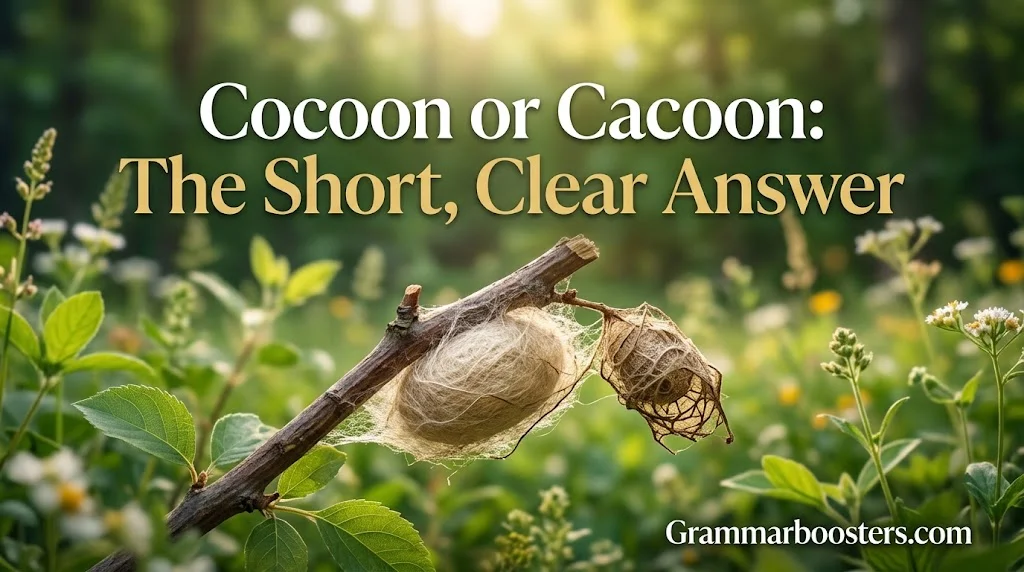
When referring to the protective structure that certain insect larvae build before becoming adults, the correct spelling is cocoon.
Correct: The moth larva spun a cocoon around itself.
Incorrect in this biological sense: The moth larva spun a cacoon around itself.
A cocoon is generally a protective covering made by an insect larva, often from silk. Moth caterpillars are among the best-known examples. Some other insects also construct protective coverings during their development.
The word cacoon can appear in English, but that doesn’t mean it is an acceptable spelling of cocoon. In particular, cacoon may occur in specialized plant names or botanical references. Context therefore matters.
Quick comparison
| Word | Main meaning | Correct for an insect’s silk covering? |
| Cocoon | Protective covering made by certain larvae | Yes |
| Cacoon | A separate term found in specialized usage, including botanical names | No |
| Pupa | Developmental stage between larva and adult in complete metamorphosis | Not the same thing |
| Chrysalis | The pupal form of a butterfly | Not the same thing |
So, if you’re writing about a moth spinning silk around its developing body, choose cocoon.
What Is a Cocoon?
A cocoon is a protective structure that some insect larvae construct around the pupal stage. Many cocoons consist largely of silk produced by the larva’s silk glands.
The familiar image is a caterpillar spinning fine threads around itself before entering a period of transformation. Inside the protective structure, the insect develops through its pupal stage and eventually emerges as an adult.
However, there’s an important detail that often gets lost in everyday explanations: not every insect that undergoes complete metamorphosis makes a cocoon.
Butterflies provide the easiest example. A butterfly has a larval stage, followed by a pupal stage called a chrysalis. The chrysalis itself generally serves as the exposed pupal case rather than a silk cocoon like the one associated with many moths.
What can a cocoon protect?
Depending on the insect and its environment, a cocoon can provide protection against:
- Physical disturbance
- Weather exposure
- Predators
- Parasites
- Environmental conditions
- Desiccation or excessive moisture
- Damage during the vulnerable pupal stage
The exact function varies between species. A cocoon isn’t simply a miniature sleeping bag. Its structure can reflect the insect’s ecology and the conditions it faces.
Some moth larvae incorporate leaves, plant fibers, hairs, soil particles, or other materials into their protective structures. Others produce relatively delicate silk coverings.
That variety is one reason it’s better to define a cocoon by its biological function and construction rather than by one rigid appearance.
Cocoon vs. Chrysalis vs. Pupa: The Differences That Matter
One of the biggest problems surrounding the word cocoon is that people often use it as if it means pupa. It doesn’t.
These terms overlap in everyday conversation, but they describe different biological concepts.
Cocoon
A cocoon is a protective covering constructed by certain larvae. It can surround the pupa.
Pupa
A pupa is a developmental stage in insects that undergo complete metamorphosis. The pupa occurs between the larval and adult stages.
Chrysalis
A chrysalis is the pupal form of a butterfly.
This distinction becomes clearer when you look at the life cycle.
| Term | What it describes | Example |
| Larva | Feeding and growing stage | Caterpillar |
| Pupa | Transformation stage | Moth pupa |
| Chrysalis | Butterfly’s pupal stage | Monarch chrysalis |
| Cocoon | Protective covering made by some larvae | Silk covering around some moth pupae |
| Adult | Mature reproductive stage | Butterfly or moth |
The key point is simple: a cocoon is a structure, while a pupa is a developmental stage.
A moth may develop as a pupa inside a cocoon. A butterfly has a chrysalis but typically doesn’t spin the kind of silk cocoon associated with many moths.
Why the confusion persists
In everyday speech, people often see a stationary insect surrounded by a protective structure and call the whole thing a “cocoon.” That’s understandable, but scientifically it can blur two different ideas.
Imagine a person inside a sleeping bag. The person and the sleeping bag aren’t the same thing. The same basic distinction helps explain a pupa and a cocoon.
How the Insect Life Cycle Works
To understand what a cocoon does, it’s useful to understand complete metamorphosis.
Insects such as butterflies, moths, beetles, bees, wasps, and flies can undergo a four-stage life cycle:
Egg → Larva → Pupa → Adult
Each stage has a different biological role.
Egg
The insect begins as an egg. Depending on the species, females place eggs on leaves, soil, wood, water, or other suitable surfaces.
The egg protects the developing embryo until it reaches the point where it can hatch.
Larva
The larval stage focuses heavily on feeding and growth.
A caterpillar is a moth or butterfly larva. During this stage, it can consume large amounts of food and grow rapidly.
Because the larva and adult often use different resources, complete metamorphosis can reduce competition between the two life stages.
Pupa
After sufficient growth, the insect enters the pupal stage.
This is where major anatomical transformation occurs. The insect reorganizes its body as it develops into an adult.
In many moths, the pupa remains inside a cocoon. In butterflies, the pupa usually appears as a chrysalis.
Adult
Finally, the adult insect emerges.
The adult may have wings, different mouthparts, reproductive organs, and a completely different lifestyle from the larva.
This dramatic transformation is why metamorphosis remains one of the most striking examples of biological development.
From Silk to Survival: Why Do Insects Make Cocoons?
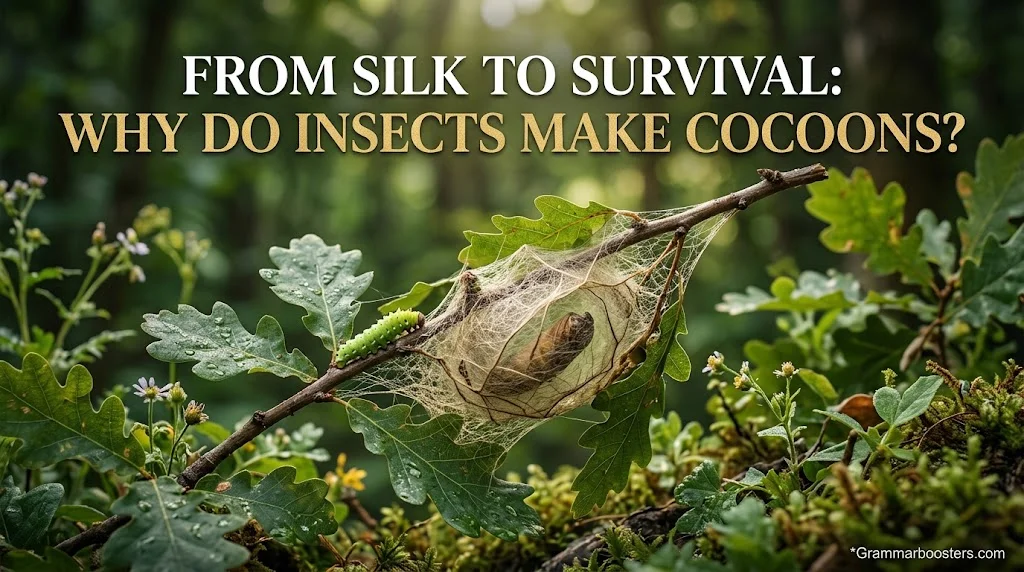
A cocoon is fundamentally about protection.
The pupal stage can leave an insect vulnerable because the developing animal doesn’t behave like an active adult. It usually can’t escape danger as easily, and it may lack the mobility or defenses it had during the larval stage.
Silk offers an effective building material.
Some larvae produce silk using specialized glands. They manipulate the silk with movements of the head and body, gradually creating a protective structure.
A cocoon can serve several purposes
- Physical protection: It can shield the developing insect from disturbances.
- Environmental buffering: The structure can help moderate exposure to outside conditions.
- Predator defense: A concealed or tough cocoon may make the pupa harder to detect or reach.
- Structural support: It can provide a stable place for the pupa to develop.
- Camouflage: Some cocoons blend into leaves, bark, soil, or other surroundings.
However, a cocoon isn’t an impenetrable fortress. Predators and parasitoids have evolved ways to locate and exploit pupae.
Nature rarely creates a perfect defense. Instead, insects use combinations of concealment, timing, physical barriers, chemical defenses, and other survival strategies.
What Happens Inside a Cocoon?
A common misconception is that the caterpillar simply “goes to sleep” inside the cocoon.
That’s an oversimplification.
During metamorphosis, the insect undergoes extensive developmental reorganization. Tissues change dramatically as the adult body develops.
In butterflies and moths, larval structures and adult structures differ substantially. The adult needs wings, adult legs, reproductive structures, sensory organs, and other features that weren’t fully developed in the feeding larva.
Hormonal signals help regulate these developmental transitions.
The pupal stage therefore represents an active period of biological transformation rather than ordinary sleep.
Do All Caterpillars Make Cocoons?
No.
This is one of the most useful facts to remember.
A caterpillar is the larval form of a butterfly or moth. But butterflies and moths don’t all use the same pupation strategy.
Many moths form cocoons, while butterflies generally form exposed chrysalises.
Even among moths, cocoon construction varies considerably. Some species make elaborate silk structures, while others use existing materials or sheltered locations.
Some larvae pupate in soil, plant material, bark, leaf litter, or other protected places.
Therefore, saying “every caterpillar makes a cocoon” would be inaccurate.
“Cocoon” as a Verb: Meaning and Usage
The word cocoon doesn’t only function as a noun.
English also uses cocoon as a verb.
To cocoon can mean to surround, wrap, or protect something. The verb can be literal or figurative.
Literal use
The larva cocooned itself in layers of silk.
Here, cocooned describes an action associated with creating a protective covering.
Figurative use
The word can also describe a person withdrawing into a protected or comfortable environment.
After a stressful week, she cocooned herself at home with a book and a cup of tea.
In this sentence, no insect is involved. The writer uses the biological image as a metaphor for retreating into a safe, private space.
Common forms
| Form | Example |
| Cocoon | The larva will cocoon itself. |
| Cocoons | The insect cocoons itself for protection. |
| Cocooned | She cocooned herself indoors. |
| Cocooning | Cocooning at home can feel relaxing. |
This figurative meaning has become a natural part of modern English.
What Does “Cocooning” Mean Today?
In modern language, cocooning often refers to creating a private, comfortable environment away from outside pressures.
Someone might say they are “cocooning” at home when they spend a quiet evening indoors, perhaps reading, watching a movie, cooking, or relaxing.
The metaphor works because a cocoon suggests privacy, shelter, and withdrawal from the outside world.
You’ll see this use in:
- Lifestyle writing
- Home and interior design
- Advertising
- Social media
- Wellness discussions
- Everyday conversation
- Popular psychology writing
For example:
“The rainy weekend was perfect for cocooning at home.”
The sentence doesn’t describe insect biology. It uses the word’s metaphorical meaning.
This modern sense grew from the visual idea of being enclosed in a protective space. The metaphor is especially intuitive because a cocoon separates its occupant from the outside environment during a major transition.
Is “Cacoon” Ever a Real Word?
This question needs a little nuance.
If you’re asking whether cacoon is the correct spelling for an insect’s protective silk covering, the answer is no. Use cocoon.
However, cacoon can appear as a separate lexical item in specialized contexts, particularly in botanical naming.
That distinction explains why someone might encounter the spelling in a dictionary, plant reference, historical text, or specialized database and assume it must be another spelling of cocoon.
It isn’t.
Think about context
| If you’re talking about… | Use |
| A moth’s silk covering | Cocoon |
| A butterfly’s pupal stage | Chrysalis |
| An insect’s pupal developmental stage | Pupa |
| A specialized plant or seed name | Cacoon, where that established name applies |
So the presence of cacoon somewhere in English doesn’t make it interchangeable with cocoon.
The Tropical “Cacoon” Bean: A Different Term
The word cacoon can occur in common names associated with tropical plants and seeds. This is a completely different linguistic and biological context from an insect cocoon.
This matters because common plant names aren’t always standardized in the same way scientific names are. A regional or historical common name can appear in older references, horticultural sources, ethnobotanical literature, or local usage.
The important lesson is simple:
Cacoon can have a separate botanical use, but that doesn’t make it an alternative spelling for an insect cocoon.
When identifying a plant, the scientific name is usually more precise than relying only on a common name. Common names can vary between regions and sometimes refer to more than one species.
This is also why context matters when searching for “cacoon.” A search about insects and metamorphosis points toward cocoon, while a search involving tropical plants or seeds may lead to the separate term cacoon.
Cocoon Synonyms and Related Terms
Finding a synonym for cocoon isn’t always as straightforward as replacing one word with another.
The best alternative depends on what you’re describing.
Protective covering
This is a broad descriptive phrase. It can work when the exact biological terminology isn’t necessary.
Case
In entomology, case can describe certain protective structures, but it isn’t a universal replacement for cocoon.
Enclosure
This emphasizes the idea of something being surrounded or enclosed. It’s broader than cocoon.
Pupal case
This phrase can be useful when discussing the relationship between the protective structure and the developing pupa.
Chrysalis
This should not be treated as a general synonym for cocoon. A chrysalis specifically refers to the pupal stage of a butterfly.
Pupa
Likewise, pupa isn’t a synonym for cocoon. One identifies a developmental stage, while the other describes a protective structure.
How to Use “Cocoon” Correctly in a Sentence
The easiest way to remember the spelling is to see the word in several real contexts.
Biological examples
- The moth larva spun a cocoon beneath a leaf.
- A silk cocoon protected the developing pupa.
- The caterpillar finished building its cocoon before pupating.
- The scientist examined the cocoon without disturbing the insect.
- The young moth emerged from its cocoon after completing development.
Figurative examples
- She spent the weekend cocooned in her apartment.
- The blanket helped him cocoon himself from the chilly evening.
- During the winter, the family enjoyed cocooning at home.
Incorrect biological usage
The butterfly built a cacoon.
The spelling is wrong for the insect structure.
A more precise sentence would depend on the species:
The butterfly formed a chrysalis.
Or, for an appropriate moth:
The moth larva spun a cocoon.
The distinction isn’t merely about spelling. It’s also about choosing the right biological term.
Why Do People Spell Cocoon as “Cacoon”?
The error is easy to understand.
English spelling doesn’t always provide a perfect guide to pronunciation. When people hear an unfamiliar word, they may spell it according to the sounds they perceive.
Cocoon can therefore become cacoon in informal writing.
Several factors can contribute to the mistake:
- The two spellings look almost identical.
- The vowel pattern isn’t obvious to inexperienced writers.
- People may encounter the word mainly through speech.
- Spell-checkers may not catch every contextual error.
- The existence of the separate word cacoon can reinforce confusion.
- People sometimes apply familiar spelling patterns to unfamiliar words.
The best memory trick is straightforward:
Insect covering = COCOON.
If you’re writing about a moth’s silk structure, start with co- and end with -coon.
The Origin and History of the Word “Cocoon”
The English word cocoon has a French connection.
English adopted cocoon from French cocon, which ultimately relates to a word for a shell or husk-like covering. The term became associated with the protective silk structure produced by certain insect larvae.
Its history reflects an interesting pattern in scientific and natural-history vocabulary. A physical object gets a name because of its appearance or function. Over time, that word becomes established within technical and everyday English.
Today, cocoon works on several levels:
- A biological noun
- A verb meaning to enclose or shelter
- A metaphor for privacy and withdrawal
- A figurative image of transformation
That last meaning has helped the word move far beyond entomology.
The metaphor of a cocoon is especially powerful because the structure hides a process that cannot easily be seen from outside. Something appears quiet and enclosed while significant transformation takes place within.
Cocoon and Transformation as a Metaphor
The biological meaning has influenced modern figurative language.
People often use cocoon to describe periods of privacy, personal growth, transition, or withdrawal.
For example:
“She spent the winter in a cocoon of books, music, and quiet.”
Here, the writer isn’t making a scientific claim. The cocoon functions as a metaphor for a protected environment.
However, it’s worth keeping the metaphor separate from biology.
An insect doesn’t “become a better version of itself” because it enters a cocoon. It undergoes a genetically programmed developmental process. Human uses of the word are metaphorical.
This distinction helps keep writing both engaging and scientifically accurate.
Common Cocoon Spelling and Usage Mistakes
Several mistakes appear repeatedly when people write about this subject.
Mistake: Writing “cacoon” for an insect
Wrong: The moth emerged from its cacoon.
Correct: The moth emerged from its cocoon.
Mistake: Calling every pupa a cocoon
A pupa is a developmental stage. A cocoon is a protective covering made by some larvae.
Mistake: Calling every butterfly covering a cocoon
A butterfly develops inside a chrysalis, not the typical silk cocoon associated with many moths.
Mistake: Treating chrysalis and pupa as unrelated
A chrysalis is actually a type of pupal stage, specifically the butterfly’s.
Mistake: Assuming every moth makes the same type of cocoon
Moth species differ dramatically in their behavior, materials, and pupation sites.
Mistake: Assuming “cacoon” is always nonsense
The spelling can occur in specialized contexts. The problem arises when it’s used as a supposed alternative spelling of cocoon.
A Closer Look at Moths and Butterflies
Moths and butterflies belong to the order Lepidoptera, and both undergo complete metamorphosis.
Their shared classification helps explain why people often confuse their developmental stages.
Yet their pupation strategies differ.
Many moth caterpillars produce silk cocoons. Some construct them in sheltered places or combine silk with materials from their surroundings.
Butterfly caterpillars generally form a chrysalis rather than a silk cocoon.
This isn’t an absolute visual rule that lets you identify every species instantly. Nature contains exceptions and enormous variation. But it’s a useful distinction for general English and basic biology.
A simple comparison
| Feature | Many moths | Butterflies |
| Larval form | Caterpillar | Caterpillar |
| Pupal stage | Pupa | Chrysalis |
| Silk cocoon | Common in many groups | Generally absent |
| Adult form | Winged moth | Winged butterfly |
| Life cycle | Complete metamorphosis | Complete metamorphosis |
The distinction becomes especially important when writing educational content. Using cocoon for every lepidopteran pupal stage may sound familiar, but it sacrifices accuracy.
Why the Cocoon Matters in Entomology
For entomologists, a cocoon isn’t merely an attractive natural object.
It can provide clues about the insect that produced it.
Researchers may examine:
- Shape
- Size
- Texture
- Construction material
- Location
- Attachment method
- Silk arrangement
- Color
- Surrounding plant material
These characteristics can help with identification, ecological studies, and behavioral research.
A cocoon can also reveal something about an insect’s relationship with its environment. A larva doesn’t build in a vacuum. It chooses a location and materials that may improve its chances of surviving the vulnerable pupal stage.
In that sense, the cocoon represents both insect behavior and developmental biology.
A Real-World Example: A Moth Cocoon vs. a Butterfly Chrysalis
Consider two familiar scenarios.
Example A: Moth
A moth caterpillar reaches the end of its larval growth. It finds a suitable location and produces silk. The silk forms a protective structure around the area where the pupa will develop.
In this case:
Larva → Cocoon → Pupa → Adult moth
The cocoon is the protective structure.
Example B: Butterfly
A butterfly caterpillar reaches maturity. It attaches itself to a suitable surface and forms a chrysalis.
In this case:
Larva → Chrysalis → Adult butterfly
There isn’t necessarily a separate silk cocoon surrounding the chrysalis.
This comparison explains why cocoon and chrysalis shouldn’t be treated as interchangeable terms.
How to Choose the Right Word Every Time
When you’re unsure whether to write cocoon, cacoon, pupa, or chrysalis, ask what you’re actually describing.
Use “cocoon” when:
- You’re discussing a protective insect covering.
- You’re describing a silk structure made by a larva.
- You’re talking about a moth’s protective enclosure.
- You’re using the word metaphorically to describe shelter or withdrawal.
Use “pupa” when:
- You’re referring to the developmental stage between larva and adult.
- You’re discussing insect metamorphosis scientifically.
- You don’t need to specify a particular type of pupal structure.
Use “chrysalis” when:
- You’re specifically referring to the pupal stage of a butterfly.
Use “cacoon” only when:
- You’re referring to an established specialized term that is actually spelled cacoon.
- The context supports a botanical or other distinct meaning.
This simple decision process prevents most errors.
Cocoon vs. Cacoon: Quick Decision Table
| Question | Correct term |
| What spelling describes an insect’s silk covering? | Cocoon |
| What is the developmental stage inside or associated with that covering? | Pupa |
| What is a butterfly’s pupal stage called? | Chrysalis |
| Is “cacoon” a standard alternative spelling of cocoon? | No |
| Can “cacoon” appear as a separate specialized word? | Yes |
| Can cocoon be used as a verb? | Yes |
| Can cocoon have a figurative meaning? | Yes |
Conclusion:
When the question is “Cacoon or cocoon?”, the answer is straightforward for ordinary biological writing: choose cocoon. That’s the standard English spelling for the protective structure made by certain insect larvae. If you’re discussing moth development, silk production, or a larva building a protective enclosure, cocoon is the word you want.
The bigger lesson is that cocoon, pupa, and chrysalis aren’t interchangeable. A cocoon is a structure. A pupa is a developmental stage. A chrysalis is the pupal form of a butterfly. Meanwhile, cacoon can appear as a separate specialized term, including in botanical names. Keeping those distinctions in mind makes your writing more accurate and helps you avoid one of those deceptively simple spelling mistakes that can slip past even careful writers.
FAQs
Is “cacoon” a misspelling of “cocoon”?
When someone uses cacoon to describe an insect’s protective covering, it is a spelling error. The standard English spelling is cocoon.
However, cacoon can occur independently in specialized terminology, including botanical common names. That separate use shouldn’t be confused with the insect term.
What is the correct spelling: cocoon or cacoon?
For an insect’s protective covering, cocoon is correct.
For example:
The moth larva built a cocoon from silk.
Cacoon isn’t an alternative spelling of this biological term.
Is a chrysalis the same thing as a cocoon?
No. A chrysalis is the pupal stage of a butterfly. A cocoon is a protective covering constructed by certain insect larvae, often around a pupa.
The two can look similar from a distance, but they represent different biological concepts.
Do butterflies make cocoons?
Butterflies generally form chrysalises rather than silk cocoons.
Moths are much more commonly associated with silk cocoons. Because both moths and butterflies are caterpillar-bearing insects in the order Lepidoptera, people often use the general word “cocoon” for both.
Can “cocoon” be used as a verb?
Yes.
Cocoon can function as a verb meaning to enclose or surround something protectively. It can also describe withdrawing into a comfortable or private environment.
For example:
She cocooned herself under a warm blanket.
What does “cacoon bean” mean?
Cacoon can occur in botanical common names associated with tropical plants or seeds. The term belongs to a different naming context from the insect word cocoon.
Because common plant names can vary regionally, a scientific name is preferable when precise plant identification matters.
Why is cocoon spelled with an “o”?
The English cocoon came through French cocon. The spelling became established in English as cocoon, which is now the standard form for the insect structure.
Is a cocoon alive?
A cocoon itself isn’t an animal. It’s a protective structure made by the insect larva. The developing pupa inside it is living tissue undergoing metamorphosis.

I’m Brian K, a language researcher and grammar writer who enjoys exploring English vocabulary, idioms, word differences, and everyday expressions. I believe learning English should be straightforward and enjoyable, so I create practical guides that simplify complex topics. Through accurate explanations and relatable examples, I aim to help readers communicate more naturally and confidently.