
Receiver is the correct spelling. Reciever is a common misspelling. If the two forms look almost identical, there’s a good reason people mix them up.
The vowels ei and ie are easy to reverse, especially when you remember the familiar “i before e” spelling rule. However, receiver follows a pattern that becomes much easier once you connect it with the verb receive.
Correct: receiver
Incorrect: reciever
The easiest memory trick is simple:
receive + r = receiver
That connection also helps with related forms such as received and receiving. But spelling isn’t the only thing worth knowing. Receiver has several meanings in everyday English, electronics, sports, telecommunications, and legal language. This guide explains the difference between receiver and reciever, shows how to use the correct word naturally, and gives you practical ways to avoid the mistake in future writing.
Receiver or Reciever: Quick Answer
Receiver is the only standard spelling. Reciever is incorrect.
| Spelling | Status | Example |
| receiver | Correct | The receiver picked up the signal. |
| reciever | Incorrect | The reciever picked up the signal. |
| receive | Correct | Did you receive my email? |
| received | Correct | We received your application. |
| receiving | Correct | She is receiving the package. |
The key spelling sequence is cei:
- receive
- receiver
- received
- receiving
If you remember receive, you can usually spell receiver correctly without having to memorize another isolated word.
Why Is “Receiver” Correct?
Receiver comes from the verb receive. The noun describes a person or thing that receives something.
The word can be understood as:
receive → receiver
For example:
The company received the package.
The company was the receiver of the package.
The spelling of the base word remains visible. That’s why the correct form contains ei, not ie.
The Important Letter Pattern
Look closely at the middle of the word:
receiver
The three-letter sequence cei is the part that often causes the mistake.
People sometimes write:
reciever
Instead, remember:
receiver
This isn’t a case where you need an elaborate spelling formula. Recognizing the -ceive pattern is more useful.
What Does “Receiver” Mean?
Receiver is a noun that generally refers to someone or something that receives something.
Its exact meaning depends on context.
A receiver might be:
- a person who receives an item or message
- an electronic device that receives a signal
- a telephone component
- a sports player who catches a pass
- a legal or financial professional appointed to manage certain assets
The central idea stays the same: something is being received.
Receiver as a Person
In ordinary English, a receiver can simply be the person who receives something.
For example:
The receiver signed for the package.
Here, the word doesn’t describe a special profession. It simply identifies the person who accepted the delivery.
You might also encounter it in formal descriptions of transactions, communications, or transfers.
The payment must reach the intended receiver.
In many everyday situations, however, recipient may sound more natural when you’re specifically talking about a person who receives something.
For example:
She was the recipient of the award.
So although receiver and recipient overlap in meaning, they aren’t always interchangeable.
Receiver as an Electronic Device
In technology, a receiver is a device or component designed to receive signals.
A radio receiver, for example, detects radio signals and processes them into usable information.
The same broad concept appears in many systems:
- radio receivers
- television receivers
- satellite receivers
- wireless receivers
- GPS receivers
- communication receivers
A basic communication model makes the relationship clear:
Transmitter
↓
Signal
↓
Receiver
The transmitter sends information. The receiver accepts and processes it.
For example:
The wireless receiver isn’t detecting the signal.
Here, receiver refers to equipment rather than a person.
Receiver in a Telephone
Receiver also has a long-established connection with traditional telephones.
Older telephones had a handset that people commonly called the receiver. A person would pick up the receiver to answer a call and put down the receiver after finishing.
For example:
She picked up the receiver and answered the phone.
Modern smartphones don’t have the same physical component in the traditional sense. Nevertheless, the expression remains familiar because it belongs to the vocabulary of conventional telephone systems.
Receiver in American Football
In American football, a receiver is a player whose role includes catching passes.
A wide receiver, often shortened to “receiver” in context, runs routes and attempts to catch passes thrown by the quarterback.
For example:
The receiver caught the pass near the sideline.
The sports meaning still connects naturally with the basic idea of receiving. The player receives the ball.
Receiver in Legal and Financial English
Receiver can also have a specialized legal or financial meaning.
In certain circumstances, a court or other authorized body may appoint a receiver to take control of, protect, or manage property or assets. The receiver’s exact responsibilities depend on the legal situation and applicable jurisdiction.
For example:
The court appointed a receiver to manage the company’s assets.
This meaning is more specialized than the everyday use. If you’re writing about a legal matter, use the term carefully and follow the terminology used in the relevant jurisdiction.
Receiver vs. Reciever: The Spelling Difference
The difference between the two forms comes down to the order of two vowels.
| Correct | Incorrect |
| receiver | reciever |
| ei | ie |
| receive | recieve |
| received | recieved |
| receiving | recieving |
The mistake is usually a simple vowel reversal.
Compare them visually:
receiver
reciever
The incorrect form moves the i in front of the e after the c.
That’s why learning the spelling through the word family can help.
receive → receiver → received → receiving
Once recei becomes visually familiar, the incorrect version starts to look unusual.
Why Do People Spell “Receiver” as “Reciever”?
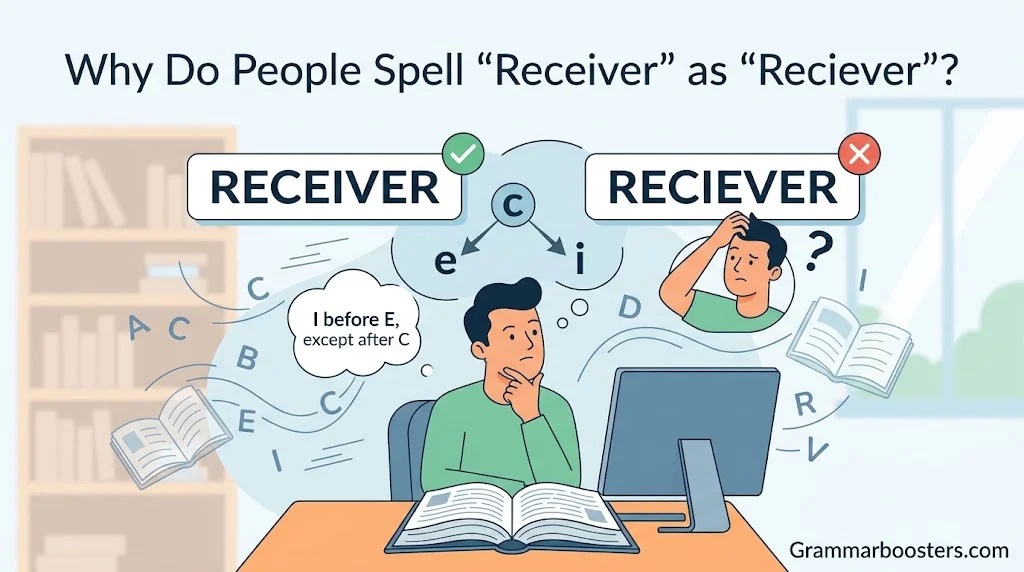
The mistake usually comes from a combination of spelling habits rather than a lack of understanding.
The “I Before E” Rule Can Cause Confusion
Many students learn:
“I before E except after C.”
The saying is intended as a memory aid. It isn’t a complete description of English spelling.
The important point here is that receive has ei after c:
receive
So someone who remembers only the shorter idea of “i before e” may accidentally write:
recieve
That error then carries into:
reciever
The better approach is to remember the actual word and its family.
Pronunciation Doesn’t Reveal the Spelling
When you hear receiver, the pronunciation doesn’t tell you whether to write ei or ie.
English has many words where spelling can’t be predicted perfectly from sound.
That’s why experienced writers often rely on a combination of:
- visual word recognition
- knowledge of word families
- spelling patterns
- reading experience
- dictionaries and spell-checking tools when needed
Fast Typing Can Reverse the Vowels
There’s also a practical reason for the error.
When people type quickly, adjacent letters can get transposed. Since e and i occur together in receiver, it’s easy to type them in the wrong order without noticing.
A quick proofreading pass usually catches the problem.
The “-Ceive” Pattern
One of the most useful ways to understand receiver is to look at related words containing -ceive.
| Word | Meaning |
| receive | to get, accept, or take something |
| deceive | to mislead someone |
| perceive | to notice, understand, or become aware of something |
| conceive | to form an idea or concept |
| receiver | someone or something that receives |
| deceiver | someone who deceives |
Notice the recurring sequence:
-ceive
For spelling purposes, this word-family connection is valuable.
You don’t have to memorize every word as an unrelated collection of letters. Once several familiar -ceive words become part of your vocabulary, the spelling pattern becomes easier to recognize.
Is “I Before E” a Reliable Rule for Receiver?
Not by itself. The traditional spelling rhyme is a useful memory aid, but it shouldn’t replace knowledge of individual words and word families.
For receiver, the reliable form is:
recei-
not:
recie-
The safest practical method is to connect the noun to its base verb:
receive → receiver
This approach is especially useful for ESL learners because it reduces the amount of information you need to remember.
Instead of learning:
receiver
as a completely separate spelling, think:
receive + r
That gives you a built-in spelling check.
Receive, Received, Receiving, and Receiver
The word family becomes particularly useful when you compare its common forms.
| Form | Function | Example |
| receive | Verb | I receive emails every morning. |
| receives | Present-tense verb | She receives several messages. |
| received | Past tense/past participle | We received your letter. |
| receiving | Present participle/gerund | He is receiving a delivery. |
| receiver | Noun | The receiver processed the signal. |
The central spelling remains recognizable across these forms.
Receive
Receive means to get, accept, or take something that is given, sent, or delivered.
Did you receive my message?
Received
Received is the past tense and past participle.
We received your application yesterday.
Receiving
Receiving is the present participle or gerund form.
The warehouse is receiving new inventory.
Receiver
Receiver is the noun.
The receiver detected the incoming signal.
Seeing the family together makes the spelling easier to retain.
Receiver vs. Recipient
Receiver and recipient can overlap in meaning, but they aren’t identical.
A recipient is generally a person who receives something.
She was the recipient of the scholarship.
A receiver can refer to a person or a thing that receives something.
The radio receiver picked up the broadcast.
This distinction becomes important in technical writing.
You wouldn’t normally call a radio a recipient because recipient is primarily used for people or entities receiving something.
Likewise, in a formal award announcement, recipient may sound more natural than receiver.
A Simple Decision Guide
| If you’re talking about… | Better choice |
| Someone getting an award | recipient |
| Someone accepting a package | recipient or receiver, depending on context |
| A radio component | receiver |
| A wireless device | receiver |
| A football player catching passes | receiver |
| A person managing assets under a legal appointment | receiver |
The right choice depends on meaning, not just spelling.
Receiver vs. Reception
Receiver and reception are related words, but they perform different grammatical jobs.
Receiver is a noun for a person or thing that receives.
The receiver picked up the signal.
Reception is a noun with several meanings connected to receiving or responding to something.
For example:
The new policy received a mixed reception.
In this sentence, reception describes how people responded to the policy.
It can also refer to a place or service area:
Please leave the package at reception.
Understanding these related forms helps prevent vocabulary mistakes while also reinforcing the spelling of receiver.
Receiver in Real-World Writing
A spelling rule becomes much more useful when you see how the word appears outside a vocabulary exercise.
Email Example
We received your application and will contact you shortly.
Here, the correct verb is received.
Technical Example
The wireless receiver lost its connection.
Here, receiver is a technical noun.
Delivery Example
The receiver must sign for the package.
Here, receiver refers to the person accepting the delivery.
Sports Example
The receiver broke free and caught the pass.
Here, receiver refers to an American football player.
Legal Example
The court appointed a receiver to oversee the company’s assets.
Here, receiver has a specialized legal meaning.
The context changes, but the spelling doesn’t.
Common Errors With Receiver
Most errors involving this word are straightforward.
Error: Receiver
The reciever answered the call.
Correct:
The receiver answered the call.
Error: Recieve
Did you recieve my email?
Correct:
Did you receive my email?
Error: Recieved
We recieved the documents.
Correct:
We received the documents.
Error: Recieving
The company is recieving new orders.
Correct:
The company is receiving new orders.
The four incorrect forms all come from the same underlying mistake: reversing the vowel order.
How to Remember the Spelling of Receiver
The best spelling trick is often the simplest one.
Think “Receive + R”
When you need receiver, start with receive.
receive + r = receiver
This is easier than trying to remember the entire noun independently.
Remember “CEI”
Another useful visual cue is:
CEI
You can spot it in:
- receive
- receiver
- deceive
- conceive
- perceive
If you’re about to type receiver, stop and look at the middle.
You want:
cei
Learn the Word Family
Write the forms together:
receive — received — receiving — receiver
This creates a visual pattern that becomes familiar through repetition.
Don’t Build the Word From Pronunciation
Sounding the word out won’t reliably tell you which vowel comes first.
Instead, use your knowledge of the written form.
Use a Spelling Check
When you’re writing something important, a dictionary or reliable spell-checker can confirm the spelling.
These references can also help you check definitions, pronunciation, grammatical information, and example sentences.
Receiver in Professional Communication

A spelling mistake can look minor, but repeated errors can distract readers in professional writing.
Consider an email that says:
“The reciever has confirmed the delivery.”
The meaning is understandable. Still, the spelling error makes the sentence look less polished.
The professional version is:
“The receiver has confirmed the delivery.”
This matters particularly when you’re writing:
- business emails
- technical reports
- customer-service messages
- academic assignments
- applications
- instructions
- website content
- product documentation
A good habit is to run a quick visual check over words you frequently misspell. You don’t need to reread every sentence several times. Focus on the words that tend to cause trouble.
Receiver in Academic Writing
Students may encounter receiver in several subjects, including English, communication studies, electronics, physics, sports, and business.
For example:
The receiver converts the incoming signal into usable information.
The sentence uses receiver as a technical noun.
In language studies, the concept of a receiver can also appear when discussing communication.
A simplified communication model looks like this:
Sender → Message → Receiver
The sender creates or transmits the message. The receiver gets and interprets it.
This meaning is especially useful when studying communication skills, media, or language.
Receiver in Communication
In communication theory, a receiver is generally the person or system that gets a message.
A basic model can be represented as:
| Element | Role |
| Sender | Creates or sends the message |
| Message | Information being communicated |
| Channel | Medium used to transmit it |
| Receiver | Gets and interprets the message |
| Feedback | Response to the message |
For example, imagine a manager sends an email to an employee.
The manager is the sender.
The email is the message.
The email system is part of the channel.
The employee is the receiver.
The employee’s reply provides feedback.
This broader use explains why receiver appears frequently in discussions about communication and information exchange.
Receiver vs. Reciever: A Practical Case Study
Imagine a student is writing a technology report and types:
“The reciever detects the incoming wireless signal.”
The sentence has the right technical meaning. The spelling is the problem.
The correction is:
“The receiver detects the incoming wireless signal.”
Now consider a second sentence:
“The reciever signed the delivery form.”
Again, the spelling is wrong.
The correction is:
“The receiver signed the delivery form.”
The meaning of receiver changes between the two sentences. In the first, it is an electronic device. In the second, it refers to a person.
Yet the spelling remains the same.
That’s an important lesson: context can change a word’s meaning without changing its spelling.
Is “Reciever” Ever an Acceptable Variant?
No. In standard English, reciever isn’t an alternative spelling of receiver.
You may see the incorrect form in:
- social media posts
- online comments
- informal messages
- user-generated content
- filenames
- old documents
- websites containing typos
Those appearances don’t establish receiver as a standard variant.
For school, work, publishing, and formal communication, use receiver.
American English and British English
The spelling receiver is standard in both American and British English.
There isn’t a US-versus-UK spelling difference here.
| Variety | Correct spelling |
| American English | receiver |
| British English | receiver |
| Canadian English | receiver |
| Australian English | receiver |
Pronunciation can vary across accents, but the standard written form remains receiver.
Receiver and Other “-Er” Nouns
English often uses -er to create nouns associated with an action.
Compare:
- teach → teacher
- drive → driver
- write → writer
- run → runner
- receive → receiver
This doesn’t mean every -er noun follows the same spelling process. English word formation has many historical patterns.
However, the comparison helps explain why receiver naturally functions as a noun connected to the action of receiving.
The important spelling remains the base:
receiv-
followed by:
-er
How to Proofread “Receiver” Quickly
If you often make this mistake, use a three-second check.
The Receiver Checklist
- Is the word spelled receiver?
- Does it contain cei?
- Did you accidentally type reciever?
- Can you connect it to receive?
- Does the word fit the intended meaning?
If you’re writing a formal document, don’t rely only on your memory. A dictionary or spell-checking tool can provide a quick confirmation.
Practice: Receiver or Reciever?
Choose the correct spelling in each sentence.
The radio ______ stopped working.
- receiver
- reciever
Answer: receiver
The radio receiver stopped working.
Did you ______ my email?
- recieve
- receive
Answer: receive
Did you receive my email?
We ______ the documents yesterday.
- recieved
- received
Answer: received
We received the documents yesterday.
The wireless ______ isn’t connecting.
- reciever
- receiver
Answer: receiver
The wireless receiver isn’t connecting.
The quarterback threw the ball to the open ______.
- reciever
- receiver
Answer: receiver
The quarterback threw the ball to the open receiver.
Correct These Common Mistakes
Try fixing each sentence before checking the answers.
The receiver picked up the signal.
I hope you receive the package soon.
We received your message.
The television receiver needs repair.
She is receiving a delivery today.
Correct Answers
The receiver picked up the signal.
I hope you receive the package soon.
We received your message.
The television receiver needs repair.
She is receiving a delivery today.
Notice that every correction reinforces the same spelling family.
Receiver vs. Reciever: Quick Comparison
| Feature | Receiver | Reciever |
| Standard English | Yes | No |
| Correct spelling | Yes | No |
| Contains cei | Yes | No |
| Related to receive | Yes | Intended to be, but misspelled |
| Used in technical English | Yes | No |
| Used in sports | Yes | No |
| Used in legal English | Yes | No |
| Standard in American English | Yes | No |
| Standard in British English | Yes | No |
If you’re choosing between the two, choose receiver.
Quick Reference: Common Receiver Forms
| Correct form | Example |
| receive | I receive several emails daily. |
| receives | She receives the reports each Friday. |
| received | We received your request. |
| receiving | The warehouse is receiving supplies. |
| receiver | The receiver detected the signal. |
| receivers | The receivers require maintenance. |
The shared receive sequence makes the relationship easier to remember.
Conclusion:
When it comes to Receiver vs. Reciever, the correct spelling is receiver. The word follows the spelling pattern found in receive, with -er added to form the noun. The misspelling reciever is common because English spelling rules can be confusing, especially the familiar “i before e” pattern. However, words containing -ceive, such as receive, deceive, and perceive, use ei.
Remembering this simple connection can help you avoid the mistake in emails, school assignments, reports, resumes, and everyday writing. Receiver can describe a person who receives something, an electronic device that receives signals, or a person who catches a pass in sports. Once you connect receiver with receive, the correct spelling becomes much easier to remember. If you ever hesitate, check the base word first: receive → receiver.
FAQs
Is “receiver” the correct spelling?
Yes, receiver is the correct spelling. It is formed from the verb receive by adding the suffix -er, which often creates a noun referring to someone or something that performs an action. Reciever is a common misspelling and should be avoided in formal, academic, professional, and published writing.
Is “reciever” ever correct?
No, reciever is not considered the standard English spelling. It is a common misspelling of receiver. The correct form contains ei after the letter c: receiver. If you are unsure, remember the related word receive, which uses the same spelling pattern and makes the correct form easier to recall.
Why do people spell “receiver” as “reciever”?
People often write reciever because of the familiar spelling idea that “i comes before e.” However, English has many exceptions and specific spelling patterns. Words ending in -ceive, including receive, deceive, and conceive, use ei. Pronunciation can also make the spelling harder to remember.
What does “receiver” mean?
Receiver generally means a person, device, or system that receives something. A receiver may accept a package, obtain information, capture a signal, or catch a ball. In technology, it can refer to equipment that receives radio, television, audio, or other signals. The exact meaning depends on the context.
What is the difference between “receiver” and “recipient”?
Both words describe someone who receives something, but their typical uses differ. A recipient is usually a person who receives something such as an award, letter, payment, or gift. A receiver can refer to a person, device, or system that receives something. In technical contexts, receiver is especially common.
How can I remember the spelling of “receiver”?
A simple memory trick is to start with receive and then add -r: receive → receiver. Focus on the ei spelling rather than trying to memorize the entire word separately. You can also remember related words such as deceive, perceive, and conceive, which follow the same -ceive pattern.
Is “receiver” used in American English?
Yes. Receiver is a standard word in American English and is widely used in everyday, professional, technical, legal, and sports contexts. The spelling remains receiver in American English. Whether you are writing an email, report, assignment, or technical document, receiver is the correct standard form.
Is “receiver” a noun or a verb?
Receiver is a noun. It refers to a person, device, organization, or other entity that receives something. The related verb is receive. For example, in the sentence “The receiver accepted the package,” receiver identifies the person who received it, while accepted describes the action.
What are some words related to “receiver”?
Several useful words belong to the same word family. The main forms include receive, received, receiving, and receiver. Related words such as reception, recipient, and receivable are also connected in meaning or formation. Learning these words together can strengthen your vocabulary and make the spelling of receiver easier to remember.
How can I avoid the “reciever” spelling mistake?
The easiest method is to connect receiver directly with receive. Before writing the noun, think of the base verb: receive + r = receiver. You can also proofread for the incorrect recie- pattern. This quick check is especially useful when writing emails, essays, reports, applications, and other important documents.

I’m Sarah M, an English content specialist dedicated to helping people improve their grammar, spelling, vocabulary, and writing skills. I love answering common language questions and turning difficult grammar concepts into simple, reader-friendly lessons. My goal is to make English learning enjoyable and accessible for anyone who wants to become a better communicator.